Advertisements
Advertisements
प्रश्न
If the sum of the surface areas of cube and a sphere is constant, what is the ratio of an edge of the cube to the diameter of the sphere, when the sum of their volumes is minimum?
Advertisements
उत्तर
Let x be the edge of the cube and r be the radius of the sphere.
Surface area of cube = 6x2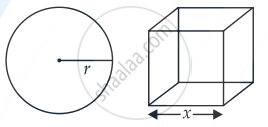
And surface area of the sphere = 4πr2
∴ 6x2 + 4πr2 = K ......(constant)
⇒ r = `sqrt(("K" - 6x^2)/(4pi)` .....(i)
Volume of the cube = x3 and the volume of sphere = `3/4 pi"r"^3`
∴ Sum of their volumes (V) = Volume of cube + Volume of sphere
⇒ V = `x^3 + 4/3 pi"r"^3`
⇒ V = `x^3 + 4/3 pi xx (("K" - 6x^2)/(4pi))^(3/2)`
Differentiating both sides w.r.t. x, we get
`"dV"/"dx" = 3x^2 + (4pi)/3 xx 3/2("K" - 6x^2)^(1/2) (- 12x) xx 1/((4pi)^(3/2)`
= `3x^2 + (2pi)/((4pi)^(3/2)) xx (-12x) ("K" - 6x^2)^(1/2)`
= `3x^2 + 1/(4pi^(1/2)) xx (-12x) ("K" - 6x^2)^(1/2)`
∴ `"dV"/"dx" = 3x^2 - (3x)/sqrt(pi) ("K" - 6x^2)^(1/2)` ....(ii)
For local maxima and local minima, `"dV"/"dx"` = 0
∴ `3x^2 - (3x)/sqrt(pi) ("K" - 6x^2)^(1/2)` = 0
⇒ `3x[x - ("k" - 6x^2)^(1/2)/sqrt(pi)]` = 0
x ≠ 0
∴ `x - ("K" - 6x^2)^(1/2)/sqrt(pi)` = 0
⇒ x = `("K" - 6x^2)^(1/2)/sqrt(pi)`
Squaring both sides, we get
x2 = `("K" - 6x^2)/pi`
⇒ `pix^2 = "K" - 6x^2`
⇒ `pix^2 + 6x^2` = K
⇒ `x^2(pi + 6)` = K
⇒ x2 = `"K"/(pi + 6)`
∴ x = `sqrt("K"/(pi + 6)`
Now putting the value of K in equation (i), we get
`6x^2 + 4pir^2 = x^2(pi + 6)`
⇒ `6x^2 + 4pi"r"^2 = pix^2 + 6x^2`
⇒ `4pi"r"^2 = pi"r"^2`
⇒ 4r2 = x2
∴ 2r = x
∴ x:2r = 1:1
Now differentiating equation (ii) w.r.t x, we have
`("d"^2"V")/("dx"^2) = 6x - 3/sqrt(pi) "d"/"dx" [x("K" - 6x^2)^(1/2)]`
= `6x - 3/sqrt(pi)[x * 1/(2sqrt("K" - 6x^2)) xx (-12x) + ("K" - 6x^2)^(1/2) * 1]`
= `6x - 3/sqrt(pi) [(-6x^2)/sqrt("K" - 6x^2) + sqrt("K" - 6x^2)]`
= `6x - 3/sqrt(pi) [(-6x^2 + "K" - 6x^2)/sqrt("K" - 6x^2)]`
= `6x + 3/sqrt(pi) [(12x^2 - "K")/sqrt("K" - 6x^2)]`
Put x = `sqrt("K"/(pi + 6)`
= `6sqrt("K"/(pi + 6)) + 3/sqrt(pi)[((12"K")/(pi + 6) - "K")/sqrt("K" - (6"K")/(pi + 6))]`
= `6sqrt("K"/(pi + 6)) + 3/sqrt(pi) [(12"K" - pi"K" - 6"K")/sqrt((pi"K" + 6"K" - 6"K")/(pi + 6))]`
= `6sqrt("K"/(pi + 6)) + 3/sqrt(pi) [(6"K" - pi"K")/sqrt((pi"K")/(pi + 6))]`
= `6sqrt("K"/(pi + 6)) + 3/(pisqrt("K"))[(6"K" - pi"K") sqrt(pi + 6)] > 0`
So it is minima.
Hence, the required ratio is 1 : 1 when the combined volume is minimum.
APPEARS IN
संबंधित प्रश्न
Show that the height of the cylinder of maximum volume, that can be inscribed in a sphere of radius R is `(2R)/sqrt3.` Also, find the maximum volume.
An open box is to be made out of a piece of a square card board of sides 18 cms by cutting off equal squares from the comers and turning up the sides. Find the maximum volume of the box.
If the sum of lengths of hypotenuse and a side of a right angled triangle is given, show that area of triangle is maximum, when the angle between them is π/3.
Prove that the following function do not have maxima or minima:
g(x) = logx
Prove that the following function do not have maxima or minima:
h(x) = x3 + x2 + x + 1
Find the absolute maximum value and the absolute minimum value of the following function in the given interval:
f (x) = sin x + cos x , x ∈ [0, π]
At what points in the interval [0, 2π], does the function sin 2x attain its maximum value?
What is the maximum value of the function sin x + cos x?
Find the maximum and minimum values of x + sin 2x on [0, 2π].
The point on the curve x2 = 2y which is nearest to the point (0, 5) is ______.
Find the points at which the function f given by f (x) = (x – 2)4 (x + 1)3 has
- local maxima
- local minima
- point of inflexion
A rod of 108 meters long is bent to form a rectangle. Find its dimensions if the area is maximum. Let x be the length and y be the breadth of the rectangle.
Find the point on the straight line 2x+3y = 6, which is closest to the origin.
A rectangle is inscribed in a semicircle of radius r with one of its sides on the diameter of the semicircle. Find the dimensions of the rectangle to get the maximum area. Also, find the maximum area.
Divide the number 30 into two parts such that their product is maximum.
Find the largest size of a rectangle that can be inscribed in a semicircle of radius 1 unit, so that two vertices lie on the diameter.
A box with a square base is to have an open top. The surface area of the box is 192 sq cm. What should be its dimensions in order that the volume is largest?
Solve the following : Show that of all rectangles inscribed in a given circle, the square has the maximum area.
Determine the maximum and minimum value of the following function.
f(x) = `x^2 + 16/x`
If f(x) = x.log.x then its maximum value is ______.
The function f(x) = x log x is minimum at x = ______.
A metal wire of 36 cm long is bent to form a rectangle. By completing the following activity, find it’s dimensions when it’s area is maximum.
Solution: Let the dimensions of the rectangle be x cm and y cm.
∴ 2x + 2y = 36
Let f(x) be the area of rectangle in terms of x, then
f(x) = `square`
∴ f'(x) = `square`
∴ f''(x) = `square`
For extreme value, f'(x) = 0, we get
x = `square`
∴ f''`(square)` = – 2 < 0
∴ Area is maximum when x = `square`, y = `square`
∴ Dimensions of rectangle are `square`
If f(x) = px5 + qx4 + 5x3 - 10 has local maximum and minimum at x = 1 and x = 3 respectively then (p, q) = ______.
The minimum value of the function f(x) = 13 - 14x + 9x2 is ______
The maximum value of `(1/x)^x` is ______.
Find the height of the cylinder of maximum volume that can be inscribed in a sphere of radius a.
Find the area of the largest isosceles triangle having a perimeter of 18 meters.
If y = alog|x| + bx2 + x has its extremum values at x = –1 and x = 2, then ______.
Let x and y be real numbers satisfying the equation x2 – 4x + y2 + 3 = 0. If the maximum and minimum values of x2 + y2 are a and b respectively. Then the numerical value of a – b is ______.
The set of values of p for which the points of extremum of the function f(x) = x3 – 3px2 + 3(p2 – 1)x + 1 lie in the interval (–2, 4), is ______.
A cone of maximum volume is inscribed in a given sphere. Then the ratio of the height of the cone to the diameter of the sphere is ______.
The minimum value of the function f(x) = xlogx is ______.
The rectangle has area of 50 cm2. Complete the following activity to find its dimensions for least perimeter.
Solution: Let x cm and y cm be the length and breadth of a rectangle.
Then its area is xy = 50
∴ `y =50/x`
Perimeter of rectangle `=2(x+y)=2(x+50/x)`
Let f(x) `=2(x+50/x)`
Then f'(x) = `square` and f''(x) = `square`
Now,f'(x) = 0, if x = `square`
But x is not negative.
∴ `x = root(5)(2) "and" f^('')(root(5)(2))=square>0`
∴ by the second derivative test f is minimum at x = `root(5)(2)`
When x = `root(5)(2),y=50/root(5)(2)=root(5)(2)`
∴ `x=root(5)(2) "cm" , y = root(5)(2) "cm"`
Hence, rectangle is a square of side `root(5)(2) "cm"`
A box with a square base is to have an open top. The surface area of box is 147 sq. cm. What should be its dimensions in order that the volume is largest?
20 is divided into two parts so that the product of the cube of one part and the square of the other part is maximum, then these two parts are
A maximum or minimum value of \[f\] is called a(n) _____.
For \[f(x)=3x^4+4x^3-12x^2+12\], what conclusion follows at \[x=1\]?
