Advertisements
Advertisements
प्रश्न
AB is a diameter of a circle and C is any point on the circle. Show that the area of ∆ABC is maximum, when it is isosceles.
Advertisements
उत्तर
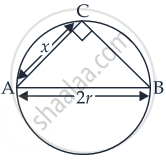
Let AB be the diameter and C be any point on the circle with radius r.
∠ACB = 90° ......[angle in the semi-circle is 90°]
Let AC = x
∴ BC = `sqrt("AB"^2 - "AC"^2)`
⇒ BC = `sqrt((2"r")^2 - x^2)`
⇒ BC = `sqrt(4"r"^2 - x^2)` ....(i)
Now area of ∆ABC
A = `1/2 xx "AC" xx "BC"`
⇒ A = `1/2 x * sqrt(4"r"^2 - x^2)`
Squaring both sides, we get
A2 = `1/4 x^2 (4"r"^2 - x^2)`
Let A2 = Z
∴ Z = `1/4 x^2(4"r"^2 - x^2)`
⇒ Z = `1/4(4x^2"r"^2 - x^4)`
Differentiating both sides w.r.t. x, we get
`"dZ"/"dx" = 1/4 [8x"r"^2 - 4x^3]` ....(ii)
For local maxima and local minima `"dZ"/"dx"` = 0
∴ `1/4 [8x"r"^2 - 4x^3]` = 0
⇒ `x[2"r"^2 - x^2]` = 0
x ≠ 0
∴ 2r2 – x2 = 0
⇒ x2 = 2r2
⇒ x = `sqrt(2)"r"`
= AC
Now from equation (i) we have
BC = `sqrt(4"r"^2 - 2"r"^2)`
⇒ BC = `sqrt(2"r"^2)`
⇒ BC = `sqrt(2)"r"`
So AC = BC
Hence, ∆ABC is an isosceles triangle.
Differentiating equation (ii) w.r.t. x, we get
`("d"^2"Z")/("dx"^2) = 1/4 [8"r"^2 - 12x^2]`
Put x = `sqrt(2)"r"`
∴ `("d"^2"Z")/("dx"^2) = 1/4 [8"r"^2 - 12 xx 2"r"^2]`
= `1/4[8"r"^2 - 24"r"^2]`
= `1/4 xx (-16"r"^2)`
= `-4"r"^2 < 0` maxima
Hence, the area of ∆ABC is maximum when it is an isosceles triangle.
APPEARS IN
संबंधित प्रश्न
Show that the height of the cylinder of maximum volume, that can be inscribed in a sphere of radius R is `(2R)/sqrt3.` Also, find the maximum volume.
Find the local maxima and local minima, if any, of the following function. Find also the local maximum and the local minimum values, as the case may be:
`h(x) = sinx + cosx, 0 < x < pi/2`
Prove that the following function do not have maxima or minima:
g(x) = logx
Find the absolute maximum value and the absolute minimum value of the following function in the given interval:
f (x) = (x −1)2 + 3, x ∈[−3, 1]
A square piece of tin of side 18 cm is to made into a box without a top by cutting a square from each corner and folding up the flaps to form the box. What should be the side of the square to be cut off so that the volume of the box is the maximum possible?
Of all the closed cylindrical cans (right circular), of a given volume of 100 cubic centimetres, find the dimensions of the can which has the minimum surface area?
A point on the hypotenuse of a triangle is at distance a and b from the sides of the triangle.
Show that the minimum length of the hypotenuse is `(a^(2/3) + b^(2/3))^(3/2).`
A rod of 108 meters long is bent to form a rectangle. Find its dimensions if the area is maximum. Let x be the length and y be the breadth of the rectangle.
The volume of a closed rectangular metal box with a square base is 4096 cm3. The cost of polishing the outer surface of the box is Rs. 4 per cm2. Find the dimensions of the box for the minimum cost of polishing it.
Find the maximum and minimum of the following functions : f(x) = 2x3 – 21x2 + 36x – 20
Find the largest size of a rectangle that can be inscribed in a semicircle of radius 1 unit, so that two vertices lie on the diameter.
An open cylindrical tank whose base is a circle is to be constructed of metal sheet so as to contain a volume of `pia^3`cu cm of water. Find the dimensions so that the quantity of the metal sheet required is minimum.
Solve the following : Show that the height of a right circular cylinder of greatest volume that can be inscribed in a right circular cone is one-third of that of the cone.
Solve the following:
Find the maximum and minimum values of the function f(x) = cos2x + sinx.
Determine the maximum and minimum value of the following function.
f(x) = x log x
If f(x) = x.log.x then its maximum value is ______.
Find the local maximum and local minimum value of f(x) = x3 − 3x2 − 24x + 5
A wire of length 120 cm is bent in the form of a rectangle. Find its dimensions if the area of the rectangle is maximum
If R is the circum radius of Δ ABC, then A(Δ ABC) = ______.
The maximum and minimum values for the function f(x) = 4x3 - 6x2 on [-1, 2] are ______
The minimum value of the function f(x) = 13 - 14x + 9x2 is ______
Find all the points of local maxima and local minima of the function f(x) = `- 3/4 x^4 - 8x^3 - 45/2 x^2 + 105`
If the sum of the lengths of the hypotenuse and a side of a right-angled triangle is given, show that the area of the triangle is maximum when the angle between them is `pi/3`
Find the dimensions of the rectangle of perimeter 36 cm which will sweep out a volume as large as possible, when revolved about one of its sides. Also, find the maximum volume.
The curves y = 4x2 + 2x – 8 and y = x3 – x + 13 touch each other at the point ______.
Find the height of the cylinder of maximum volume that can be inscribed in a sphere of radius a.
The area of a right-angled triangle of the given hypotenuse is maximum when the triangle is ____________.
The function `"f"("x") = "x" + 4/"x"` has ____________.
The combined resistance R of two resistors R1 and R2 (R1, R2 > 0) is given by `1/"R" = 1/"R"_1 + 1/"R"_2`. If R1 + R2 = C (a constant), then maximum resistance R is obtained if ____________.
A ball is thrown upward at a speed of 28 meter per second. What is the speed of ball one second before reaching maximum height? (Given that g= 10 meter per second2)
Range of projectile will be maximum when angle of projectile is
A wire of length 36 m is cut into two pieces, one of the pieces is bent to form a square and the other is bent to form a circle. If the sum of the areas of the two figures is minimum, and the circumference of the circle is k (meter), then `(4/π + 1)`k is equal to ______.
If the point (1, 3) serves as the point of inflection of the curve y = ax3 + bx2 then the value of 'a ' and 'b' are ______.
The set of values of p for which the points of extremum of the function f(x) = x3 – 3px2 + 3(p2 – 1)x + 1 lie in the interval (–2, 4), is ______.
A cone of maximum volume is inscribed in a given sphere. Then the ratio of the height of the cone to the diameter of the sphere is ______.
A right circular cylinder is to be made so that the sum of the radius and height is 6 metres. Find the maximum volume of the cylinder.
Assume \[f'(c)=0\] and the second derivative exists at \[c\]. Which condition gives a local maximum?
Assume \[f'(c)=0\] and the second derivative exists at \[c\]. Which condition gives a local minimum?
For \[f(x)=3x^4+4x^3-12x^2+12\], what conclusion follows at \[x=1\]?
