Advertisements
Advertisements
प्रश्न
A metal box with a square base and vertical sides is to contain 1024 cm3. The material for the top and bottom costs Rs 5/cm2 and the material for the sides costs Rs 2.50/cm2. Find the least cost of the box.
Advertisements
उत्तर
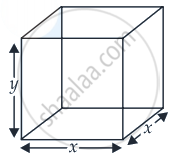
Let x be the side of the square base and y be the length of the vertical sides.
Area of the base and bottom = 2x2 cm2
∴ Cost of the material required = ₹ 5 × 2x2
= ₹ 10x2
Area of the 4 sides = 4xy cm2
∴ Cost of the material for the four sides
= ₹ 2.50 x 4xy
= ₹ 10xy
Total cost C = 10x2 + 10xy .....(i)
New volume of the box = x × x × y
⇒ 1024 = x2y
∴ y = `1024/x^2` ....(ii)
Putting the value of y in equation (i) we get
C = `10x^2 + 10x xx 1024/x^2`
⇒ C = `10x^2 + 10240/x`
Differentiating both sides w.r.t. x, we get
`"dC"/"dx" = 20x - 10240/x^2` ....(iii)
For local maxima and local minima `"dC"/"dx"` = 0
`20 - 102400/x^2` = 0
⇒ 20x3 – 10240 = 0
⇒ x3 = 512
⇒ x = 8 cm
Now from equation (ii)
y = `10240/(8)^2`
= `10240/64`
= 16 cm
∴ Cost of material used C = 10x2 + 10xy
= 10 × 8 × 8 + 10 × 8 × 16
= 640 + 1280
= 1920
Now differentiating equation (iii) we get
`("d"^2"C")/("dx"^2) = 20 + 20480/x^3`
Put x = 8
= `20 + 20480/(8)^3`
= `20 + 20480/512`
= 20 + 40 = 60 > 0 minima
Hence, the required cost is ₹ 1920 which is the minimum.
APPEARS IN
संबंधित प्रश्न
Examine the maxima and minima of the function f(x) = 2x3 - 21x2 + 36x - 20 . Also, find the maximum and minimum values of f(x).
Find the maximum and minimum value, if any, of the following function given by h(x) = x + 1, x ∈ (−1, 1)
Prove that the following function do not have maxima or minima:
g(x) = logx
Find the maximum value of 2x3 − 24x + 107 in the interval [1, 3]. Find the maximum value of the same function in [−3, −1].
Prove that the volume of the largest cone that can be inscribed in a sphere of radius R is `8/27` of the volume of the sphere.
Find the points at which the function f given by f (x) = (x – 2)4 (x + 1)3 has
- local maxima
- local minima
- point of inflexion
Find the maximum and minimum of the following functions : f(x) = `x^2 + (16)/x^2`
Divide the number 20 into two parts such that sum of their squares is minimum.
Solve the following : Show that the altitude of the right circular cone of maximum volume that can be inscribed in a sphere of radius r is `(4r)/(3)`.
Determine the maximum and minimum value of the following function.
f(x) = x log x
The total cost of producing x units is ₹ (x2 + 60x + 50) and the price is ₹ (180 − x) per unit. For what units is the profit maximum?
State whether the following statement is True or False:
An absolute maximum must occur at a critical point or at an end point.
Divide the number 20 into two parts such that their product is maximum
The minimum value of Z = 5x + 8y subject to x + y ≥ 5, 0 ≤ x ≤ 4, y ≥ 2, x ≥ 0, y ≥ 0 is ____________.
Max value of z equals 3x + 2y subject to x + y ≤ 3, x ≤ 2, -2x + y ≤ 1, x ≥ 0, y ≥ 0 is ______
If R is the circum radius of Δ ABC, then A(Δ ABC) = ______.
If f(x) = `x + 1/x, x ne 0`, then local maximum and x minimum values of function f are respectively.
The maximum value of function x3 - 15x2 + 72x + 19 in the interval [1, 10] is ______.
The maximum and minimum values for the function f(x) = 4x3 - 6x2 on [-1, 2] are ______
A telephone company in a town has 500 subscribers on its list and collects fixed charges of Rs 300/- per subscriber per year. The company proposes to increase the annual subscription and it is believed that for every increase of Re 1/- one subscriber will discontinue the service. Find what increase will bring maximum profit?
An open box with square base is to be made of a given quantity of cardboard of area c2. Show that the maximum volume of the box is `"c"^3/(6sqrt(3))` cubic units
Find the maximum profit that a company can make, if the profit function is given by P(x) = 41 + 24x – 18x2.
The combined resistance R of two resistors R1 and R2 (R1, R2 > 0) is given by `1/"R" = 1/"R"_1 + 1/"R"_2`. If R1 + R2 = C (a constant), then maximum resistance R is obtained if ____________.
The point on the curve `x^2 = 2y` which is nearest to the point (0, 5) is
A wire of length 22 m is to be cut into two pieces. One of the pieces is to be made into a square and the other into an equilateral triangle. Then, the length of the side of the equilateral triangle, so that the combined area of the square and the equilateral triangle is minimum, is ______.
A wire of length 36 m is cut into two pieces, one of the pieces is bent to form a square and the other is bent to form a circle. If the sum of the areas of the two figures is minimum, and the circumference of the circle is k (meter), then `(4/π + 1)`k is equal to ______.
If S1 and S2 are respectively the sets of local minimum and local maximum points of the function. f(x) = 9x4 + 12x3 – 36x2 + 25, x ∈ R, then ______.
A rectangle with one side lying along the x-axis is to be inscribed in the closed region of the xy plane bounded by the lines y = 0, y = 3x and y = 30 – 2x. The largest area of such a rectangle is ______.
The minimum value of the function f(x) = xlogx is ______.
If f(x) = `1/(4x^2 + 2x + 1); x ∈ R`, then find the maximum value of f(x).
A metal wire of 36 cm long is bent to form a rectangle. Find its dimensions when its area is maximum.
A running track of 440 m is to be laid out enclosing a football field. The football field is in the shape of a rectangle with a semi-circle at each end. If the area of the rectangular portion is to be maximum,then find the length of its sides. Also calculate the area of the football field.
Find the point on the curve y2 = 4x, which is nearest to the point (2, 1).
A box with a square base is to have an open top. The surface area of box is 147 sq. cm. What should be its dimensions in order that the volume is largest?
For a function defined on an interval \[I\], which condition means that \[f\] has a minimum value at \[c\in I\]?
Let \[c\] be a critical point of a continuous function \[f\]. If \[f'(x)\] changes sign from positive to negative as \[x\] passes through \[c\], what is \[c\]?
For \[f(x)=3x^4+4x^3-12x^2+12\], which is the correct factorization of \[f'(x)\]?
For \[f(x)=3x^4+4x^3-12x^2+12\], what is \[f''(x)\]?
