Topics
Mathematical Logic
- Statements and Truth Values in Mathematical Logic
- Logical Connectives
- Tautology, Contradiction, and Contingency
- Quantifier, Quantified and Duality Statements in Logic
- Negations of Compound Statements
- Converse, Inverse, and Contrapositive
- Algebra of Statements
- Application of Logic to Switching Circuits
- Overview of Mathematical Logic
Matrices
- Elementry Transformations
- Adjoint and Inverse of a Matrix
- Application of Matrices
- Overview of Matrices
Trigonometric Functions
- Trigonometric Equations and Their Solutions
- Solutions of Triangle>Polar Co-Ordinates
- Solving a Triangle>Solving a Triangle
- Basics of Inverse Trigonometric Functions
- Graphs of Inverse Trigonometric Functions
- Domain, Range & Principal Value
- Properties of Inverse Trigonometric Functions > Self-adjusting Property
- Overview of Trigonometric Functions
- Properties of Inverse Trigonometric Functions > Reciprocal Property
- Properties of Inverse Trigonometric Functions > Complementary Property
- Properties of Inverse Trigonometric Functions > Addition & Subtraction Formula for Inverse Tangent
- Properties of Inverse Trigonometric Functions > Double-angle Property
- Properties of Inverse Trigonometric Functions > Triple-angle Property
- Properties of Inverse Trigonometric Functions > Addition–Subtraction Formula for Inverse Sine & Cosine
- Properties of Inverse Trigonometric Functions > Negative Argument Property
Pair of Straight Lines
Vectors
- Overview of Vectors
- Basic Concepts of Vector Algebra
- Types of Vectors in Algebra
- Algebra of Vectors > Scalar Multiplication
- Algebra of Vectors > Addition & Subtraction of Two Vectors
- Collinearity and Coplanarity of Vectors
- Vectors in Coordinate Geometry
- Components of Vector in Algebra
- Vector Joining Two Points in Algebra
- Section Formula in Vector Algebra
- Product of Two Vectors > Scalar (Dot) Product
- Product of Two Vectors > Vector (Cross) Product
- Direction Ratios, Direction Cosine & Direction Angles in Vector
- Scalar Triple Product
- Vector Triple Product
Line and Plane
Linear Programming
Differentiation
- Introduction & Derivatives of Some Standard Functions
- Derivatives of Composite Functions
- Geometrical Meaning of Derivative
- Derivative of Inverse Trigonometric Function
- Logarithmic Differentiation
- Differentiation of Implicit Functions
- Derivatives of Functions in Parametric Forms
- Higher Order Derivatives
- Overview of Differentiation
Applications of Derivatives
Indefinite Integration
Definite Integration
- Definite Integral as Limit of Sum
- Integral Calculus
- Methods of Evaluation and Properties of Definite Integral
- Overview of Definite Integration
Application of Definite Integration
- Application of Definite Integration
- Area Bounded by Two Curves
- Overview of Application of Definite Integration
Differential Equations
- Basic Concepts of Differential Equations
- Order and Degree of a Differential Equation
- Formation of Differential Equations
- Forms of Solving Differential Equations> Homogeneous Differential Equations
- Forms of Solving Differential Equations>Linear Differential Equations
- Applications of Differential Equation
- Solution of a Differential Equation
- Overview of Differential Equations
Probability Distributions
- Random Variables
- Probability Distribution of Discrete Random Variables
- Probability Distribution of a Continuous Random Variable
- Variance of a Random Variable
- Expected Value and Variance of a Random Variable
- Overview of Probability Distributions
Binomial Distribution
Estimated time: 13 minutes
Maharashtra State Board: Class 11
Introduction
- Integral Calculus is a key branch of mathematics.
- It deals with the properties of integrals and their applications.
- Physically, the integral of a function f(x) (i.e., ∫f(x)dx) represents the area under the curve of the function f(x) versus x.
- It is essentially the reverse process of differentiation.
Maharashtra State Board: Class 11
Definition: Definite Integral
The representation \[\int_{x=a}^{x=b}\] f(x)dx is called the definite integral of f(x) from x = a to x = b.
Maharashtra State Board: Class 11
Definition: Indefinite Integral
is called the indefinite (without any limits on x) integral of f(x).
Maharashtra State Board: Class 11
Characteristics
- Reverse Process: Differentiation is the reverse process to that of integration.
- Area Under Curve: The physical interpretation of ∫f(x) dx is the area under the curve f(x) versus x.
- Definite Integral: It has specific limits on x (from to ).
- Indefinite Integral: It does not have any limits on x.
Maharashtra State Board: Class 11
Process: Finding the Area Under a General Curve
When a simple formula (like for a rectangle or triangle) is not available:
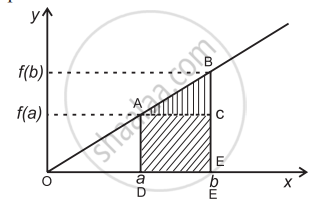
Area under a straight line.
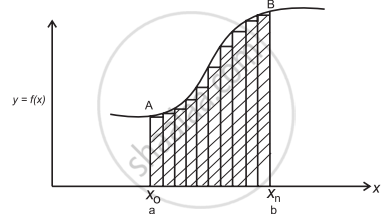
Area under a curve.
-
Divide the Area: The area under the curve is divided into a large number of vertical strips
- Assume Rectangles: The thickness (width) of each strip is assumed to be so small that the strip can be treated as a rectangle.
- Sum the Areas: The area under the curve is initially calculated as the sum of the areas of these rectangles:
Area = \[\sum_{i=1}^n\Delta A_i=\sum_{i=1}^n(x_i-x_{i-1})f(x_i)\]
where n is the number of strips and ΔAi is the area of the ith strip. - Take the Limit: Since the strips are only assumed to be rectangles, the sum is not exact. To get the exact area, the number of strips (n) is increased to infinity ():
Area = \[\lim_{n\to\infty}\sum_{i=1}^n(x_i-x_{i-1})f(x_i)\] - Use Integration: This limit process, which gives the exact area for a continuous change, is represented by the definite integral:
\[\int_{x=a}^{x=b}f(x)dx=\lim_{n\to\infty}\sum_{i=1}^n(x_i-x_{i-1})f(x_i)\]
Maharashtra State Board: Class 11
Significance
- Integration helps in getting the exact area under a curve, especially when the change is continuous (i.e., n is truly infinite).
- It is a crucial tool because it is the reverse operation of differentiation.
Maharashtra State Board: Class 11
Basics of Integration
Fundamental Relation (Relating Differentiation and Integration)
- If , then:
f(x) = \[\frac{d}{dx}(F(x))\]
Fundamental Theorem of Calculus (Definite Integral Evaluation)
-
To evaluate a definite integral:
\[F(x)|_a^b=F(b)-F(a)=\int_a^bf(x)dx\]
Properties of Integration
- Sum Rule: \[\int(f_1(x)+f_2(x))dx=\int f_1(x)dx+\int f_2(x)dx\]
- Constant Multiple Rule: \[\int Kf(x)dx=K\int f(x)dx\quad\mathrm{for~}K\] = Constant
Basic Indefinite Integral Formulas
| Function | Integral ( ∫ f(x) dx ) |
|---|---|
| xn | \[\frac{x^{n+1}}{n+1}\] |
| \[\vec {1}{x}\] | ln x |
| sin x | -cos x |
| cos x | sin x (Note: Source says ∫ cos x dx = in x, but the mathematically correct formula, likely intended, is ∫ cos x dx = sin x) |
| (ex) | (ex) |
Maharashtra State Board: Class 11
Example
Problem: Evaluate the following integrals:
- ∫ x8 dx
- \[\int_2^5x^2dx\]
- ∫ (x + sin x) dx
Solution:
- ∫ x8 dx
Using the formula \[\int x^ndx=\frac{x^{n+1}}{n+1}{:}\]
\[\int x^8dx=\frac{x^{8+1}}{8+1}=\frac{x^9}{9}\] - \[\int_2^5x^2dx\]
Step 1: Find the indefinite integral using \[\int x^ndx=\frac{x^{n+1}}{n+1}{:}\]
\[\int x^2dx=\frac{x^3}{3}\]
Step 2: Apply the definite integral evaluation formula :
\[\int_2^5x^2dx=\left.\frac{x^3}{3}\right|_2^5=\frac{5^3}{3}-\frac{2^3}{3}\]
Step 3: Calculate the values:
= \[\frac {125}{3}\] - \[\frac {8}{3}\] = \[\frac {117}{3}\]
Step 4: Simplify the final result:
= 39 - ∫ (x + sinx) dx
Step 1: Apply the Sum Rule (Eq. 2.45):
\[\int(x+\sin x)dx=\int xdx+\int\sin xdx\]
Step 2: Integrate each term using the basic formulas \[(\int x^{1}dx={\frac{x^{2}}{2}}\mathrm{and}\int\sin xdx=\] - cos x):
= \[\frac {x^2}{2}\] + (-cos x)
Step 3: Write the final expression:
= \[\frac {x^2}{2}\] - cos x
