Topics
Mathematical Logic
- Statements and Truth Values in Mathematical Logic
- Logical Connectives
- Tautology, Contradiction, and Contingency
- Quantifier, Quantified and Duality Statements in Logic
- Negations of Compound Statements
- Converse, Inverse, and Contrapositive
- Algebra of Statements
- Application of Logic to Switching Circuits
- Overview of Mathematical Logic
Matrices
- Elementry Transformations
- Adjoint and Inverse of a Matrix
- Application of Matrices
- Overview of Matrices
Trigonometric Functions
- Trigonometric Equations and Their Solutions
- Solutions of Triangle>Polar Co-Ordinates
- Solving a Triangle>Solving a Triangle
- Basics of Inverse Trigonometric Functions
- Graphs of Inverse Trigonometric Functions
- Domain, Range & Principal Value
- Properties of Inverse Trigonometric Functions > Self-adjusting Property
- Overview of Trigonometric Functions
- Properties of Inverse Trigonometric Functions > Reciprocal Property
- Properties of Inverse Trigonometric Functions > Complementary Property
- Properties of Inverse Trigonometric Functions > Addition & Subtraction Formula for Inverse Tangent
- Properties of Inverse Trigonometric Functions > Double-angle Property
- Properties of Inverse Trigonometric Functions > Triple-angle Property
- Properties of Inverse Trigonometric Functions > Addition–Subtraction Formula for Inverse Sine & Cosine
- Properties of Inverse Trigonometric Functions > Negative Argument Property
Pair of Straight Lines
Vectors
- Overview of Vectors
- Basic Concepts of Vector Algebra
- Types of Vectors in Algebra
- Algebra of Vectors > Scalar Multiplication
- Algebra of Vectors > Addition & Subtraction of Two Vectors
- Collinearity and Coplanarity of Vectors
- Vectors in Coordinate Geometry
- Components of Vector in Algebra
- Vector Joining Two Points in Algebra
- Section Formula in Vector Algebra
- Product of Two Vectors > Scalar (Dot) Product
- Product of Two Vectors > Vector (Cross) Product
- Direction Ratios, Direction Cosine & Direction Angles in Vector
- Scalar Triple Product
- Vector Triple Product
Line and Plane
Linear Programming
Differentiation
- Introduction & Derivatives of Some Standard Functions
- Derivatives of Composite Functions
- Geometrical Meaning of Derivative
- Derivative of Inverse Trigonometric Function
- Logarithmic Differentiation
- Differentiation of Implicit Functions
- Derivatives of Functions in Parametric Forms
- Higher Order Derivatives
- Overview of Differentiation
Applications of Derivatives
Indefinite Integration
Definite Integration
- Definite Integral as Limit of Sum
- Integral Calculus
- Methods of Evaluation and Properties of Definite Integral
- Overview of Definite Integration
Application of Definite Integration
- Application of Definite Integration
- Area Bounded by Two Curves
- Overview of Application of Definite Integration
Differential Equations
- Basic Concepts of Differential Equations
- Order and Degree of a Differential Equation
- Formation of Differential Equations
- Forms of Solving Differential Equations> Homogeneous Differential Equations
- Forms of Solving Differential Equations>Linear Differential Equations
- Applications of Differential Equation
- Solution of a Differential Equation
- Overview of Differential Equations
Probability Distributions
- Random Variables
- Probability Distribution of Discrete Random Variables
- Probability Distribution of a Continuous Random Variable
- Variance of a Random Variable
- Expected Value and Variance of a Random Variable
- Overview of Probability Distributions
Binomial Distribution
Formula: Angle between Two Planes
Vector Form:
\[\cos\theta=\left|\frac{\overline{\mathbf{n₁}}.\overline{\mathbf{n₂}}}{\left|\overline{\mathbf{n₁}}\right|.\left|\overline{\mathbf{n₂}}\right|}\right|\]
Cartesian Form:
\[\cos\theta=\left|\frac{\mathrm{a}_{1}\mathrm{a}_{2}+\mathrm{b}_{1}\mathrm{b}_{2}+\mathrm{c}_{1}\mathrm{c}_{2}}{\sqrt{\mathrm{a}_{1}^{2}+\mathrm{b}_{1}^{2}+\mathrm{c}_{1}^{2}}\sqrt{\mathrm{a}_{2}^{2}+\mathrm{b}_{2}^{2}+\mathrm{c}_{2}^{2}}}\right|\]
Notes
Observe that if θ is an angle between the two planes, then so is 180 – θ Fig.
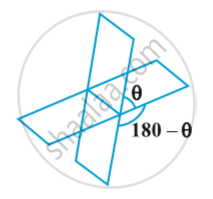
If `vec n _1` and `vec n_2` are normals to the planes and θ be the angle between the planes
`vec r . vec n _1 = d_1` and `vec r . vec n _2 = d_2` .
Then θ is the angle between the normals to the planes drawn from some common point We have
cos θ = `|(vec n_1 . vec n_2)/ (|vec n _1| |vec n_2|)|`
Cartesian form
Let θ be the angle between the planes,
`A_1x + B_1y +C_1z + D_1 = 0` and `A_2x +B_2y + C_2 z + D_2 = 0`
The direction ratios of the normal to the planes are `A_1, B_1, C_1` and `A_2, B_2, C_2` respectively.
Therefore , cos θ = `|(A_1 A_2 + B_1 B_2 + C_1 C_2)/ (sqrt(A_1^2 + B_1^2 + C_1^2 ) sqrt (A_2^2 + B_2^2 +C_2^2))|`
Formula: Angle between Line and Plane
Vector Form:
\[\sin\theta=\left|\frac{\overline{\mathbf{b}}.\overline{\mathbf{n}}}{\left|\overline{\mathbf{b}}\right|.\left|\overline{\mathbf{n}}\right|}\right|\]
Cartesian Form:
\[\mathrm{sin}\theta=\frac{\mathrm{aa}_{1}+\mathrm{bb}_{1}+\mathrm{cc}_{1}}{\sqrt{\mathrm{a}^{2}+\mathrm{b}^{2}+\mathrm{c}^{2}}\sqrt{\mathrm{a}_{1}^{2}+\mathrm{b}_{1}^{2}+\mathrm{c}_{1}^{2}}}\]
Key Points: Condition for Parallelism and Perpendicularity
Condition for Perpendicularity:
\[\overline{\mathbf{b}}=\lambda\overline{\mathbf{n}}\], λ is a parameter
\[\frac{\mathbf{a}_{1}}{\mathbf{a}}=\frac{\mathbf{b}_{1}}{\mathbf{b}}=\frac{\mathbf{c}_{1}}{\mathbf{c}}\]
Condition for Parallelism:
The line is parallel to the plane, if
\[\overline{\mathbf{b}}.\overline{\mathbf{n}}=0\]
aa₁ + bb₁ + cc₁ = 0
