Topics
Relations and Functions
Relations and Functions
Algebra
Inverse Trigonometric Functions
Calculus
Matrices
- Concept of Matrices
- Types of Matrices
- Equality of Matrices
- Operations on Matrices> Addition and Subtraction of Matrices
- Operations on Matrices>Scalar Multiplication
- Operations on Matrices> Matrix Multiplication
- Transpose of a Matrix
- Symmetric and Skew Symmetric Matrices
- Invertible Matrices
- Overview of Matrices
Determinants
Vectors and Three-dimensional Geometry
Continuity and Differentiability
- Continuous and Discontinuous Functions
- Algebra of Continuous Functions
- Concept of Differentiability
- Derivatives of Composite Functions
- Differentiation of Implicit Functions
- Derivative of Inverse Trigonometric Function
- Exponential and Logarithmic Functions
- Logarithmic Differentiation
- Derivatives of Functions in Parametric Forms
- Second Order Derivative
- Overview of Continuity and Differentiability
Linear Programming
Applications of Derivatives
Probability
Integrals
- Integration
- Integration as an Inverse Process of Differentiation
- Properties of Indefinite Integral
- Methods of Integration> Integration by Substitution
- Methods of Integration>Integration Using Trigonometric Identities
- Methods of Integration> Integration Using Partial Fraction
- Methods of Integration> Integration by Parts
- Integrals of Some Particular Functions
- Definite Integrals
- Fundamental Theorem of Integral Calculus
- Evaluation of Definite Integrals
- Properties of Definite Integrals
- Overview of Integrals
Sets
Applications of the Integrals
Differential Equations
- Basic Concepts of Differential Equations
- Order and Degree of a Differential Equation
- Solution of a Differential Equation
- Forms of Solving Differential Equations> Variable Separable
- Forms of Solving Differential Equations> Homogeneous Differential Equations
- Forms of Solving Differential Equations>Linear Differential Equations
- Overview of Differential Equations
Vectors
- Basic Concepts of Vector Algebra
- Direction Ratios, Direction Cosine & Direction Angles in Vector
- Types of Vectors in Algebra
- Algebra of Vectors > Addition & Subtraction of Two Vectors
- Algebra of Vectors > Scalar Multiplication
- Components of Vector in Algebra
- Vector Joining Two Points in Algebra
- Section Formula in Vector Algebra
- Product of Two Vectors > Scalar (Dot) Product
- Product of Two Vectors > Vector (Cross) Product
- Overview of Vectors
Three - Dimensional Geometry
Linear Programming
Probability
Introduction
When a continuous function is defined on a closed interval [a, b], it will always have a highest point and a lowest point within that specific range. Finding these points is crucial because a function might not have a maximum or minimum on an open interval, but closing the interval guarantees these absolute extreme values exist.
Definition: Absolute Maximum and Absolute Minimum
Absolute Maximum: The greatest value of a function on the entire given interval is called its absolute maximum value or global maximum value.
Absolute Minimum: The least value of a function on the entire given interval is called its absolute minimum value or global minimum value.
Graphical Understanding
For the graph of a continuous function on the closed interval [a,d]:
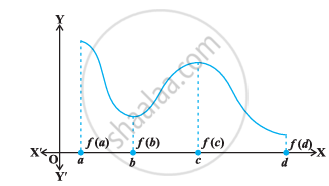
\[ f(a) = \text{absolute maximum value} \]
\[ f(b) = \text{local minimum value} \]
\[ f(c) = \text{local maximum value} \]
\[ f(d) = \text{absolute minimum value} \]
Thus, a local maximum or minimum need not be the absolute maximum or minimum.
Theorem 1: Extreme Value Theorem
A continuous function on a closed interval [a, b] will attain its absolute maximum and absolute minimum value at least once in that interval.
Theorem 2: Interior Absolute Extrema
If a differentiable function has an absolute max or min at an interior point c of the interval, then its derivative at that point is zero (f'(c) = 0).
Working Rule
-
Find critical points: Find all points x where f'(x) = 0 or where f is not differentiable.
-
Identify endpoints: Note the endpoints a and b of the closed interval.
-
Calculate values: Evaluate the original function f(x) at all the critical points and endpoints.
-
Compare: The highest value from Step 3 is the absolute maximum, and the lowest is the absolute minimum.
Example 1
Find the absolute maximum and minimum values of a function \[f\] given by
Solution:
Step 1: Differentiate the function
We have
or \[f'(x) = 16x^{\frac{1}{3}} - \frac{2}{x^{\frac{2}{3}}} = \frac{2(8x - 1)}{x^{\frac{2}{3}}}\]
Step 2: Find critical points
Also, f'(x) is not defined at x = 0, so x = 0 is also a critical point.
Critical points:
Step 3: Find function values
\[f(-1) = 12(-1)^{\frac{4}{3}} - 6(-1)^{\frac{1}{3}} = 18\]
\[f(0) = 12(0) - 6(0) = 0\]
Hence, we conclude that absolute maximum value of \[f\] is 18 that occurs at \[x = -1\] and absolute minimum value of \[f\] is \[\frac{-9}{4}\] that occurs at \[x = \frac{1}{8}\].
Key Points: Maximum and Minimum Values of a Function in a Closed Interval
-
Continuity on a closed interval guarantees existence of absolute extrema.
-
Differentiability at an interior extremum implies \(f'(c)=0\).
-
Endpoints must always be checked in closed interval problems.
-
Local extrema and absolute extrema are not always the same.
-
A critical point occurs when \(f'(x)=0\) or \(f'(x)\) is undefined.
-
Optimisation problems in calculus are applications of maxima and minima.
