Topics
Commercial Mathematics
Compound Interest
- Compound Interest as a Repeated Simple Interest Computation with a Growing Principal
- Use of Compound Interest in Computing Amount Over a Period of 2 Or 3-years
- Use of Formula
- Finding CI from the Relation CI = A – P
Goods and Services Tax (G.S.T.)
Algebra
Banking
Geometry
Shares and Dividends
Linear Inequations
Mensuration
Quadratic Equations
Trigonometry
Ratio and Proportion
Statistics
Probability
Factorisation of Polynomials
- Function and Polynomial
- Division Algorithm for Polynomials
- Remainder Theorem
- Factor Theorem
- Applications of Factor Theorem
Matrices
Arithmetic and Geometric Progression
Co-ordinate Geometry
- Foundation of Coordinate Geometry
- Advanced Concept of Reflection in Mathematics
- Invariant Points
- Combination of Reflections
- Using Graph Paper for Reflection
Similarity
Symmetry
Loci
- Locus
- Points Equidistant from Two Given Points
- Points Equidistant from Two Intersecting Lines
- Summary of Important Results on Locus
- Important Points on Concurrency in a Triangle
Circles
Tangent and Secant Properties
Constructions
Area and Volume of Solids (Cylinder, Cone and Sphere)
- Mensuration of Cylinder
- Hollow Cylinder
- Mensuration of Cones
- Mensuration of a Sphere
- Hemisphere
- Conversion of Solids
- Solid Figures
- Problems on Mensuration
Trigonometrical Identities
Heights and Distances
- Angles of Elevation and Depression
- Problems based on Elevation and Depression
Statistics : basic concepts, Mean, Median, Mode. Histograms and Ogive
Probability
- Introduction
- Definition: Circumcircle
- Definition: Circumcenter
- Definition: Circumradius
- Step-by-Step Construction
- Position of Circumcenter in Different Triangles
- Key Points Summary
Introduction
Imagine drawing a circle that passes through all three corners (vertices) of a triangle. This special circle is called the circumcircle of the triangle. Every triangle, no matter its shape or size, has exactly one unique circumcircle.
Definition: Circumcircle
A circumcircle is a circle that passes through all three vertices of a triangle. The three vertices lie on the boundary of the circle.
Definition: Circumcenter
The circumcenter is the center point of the circumcircle. It is the unique point where all three perpendicular bisectors of the triangle's sides meet.
- The circumcenter is equidistant from all three vertices of the triangle.
Definition: Circumradius
The circumradius is the radius of the circumcircle. It is the distance from the circumcenter to any vertex of the triangle.
Step-by-Step Construction
Step 1:
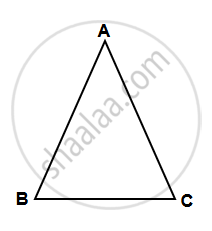
Draw a triangle ABC of any size using a ruler.
Step 2:
Bisect Two Sides: Draw the perpendicular bisectors for any two sides of the triangle(for example, side BC and side AC).
Step 3:
Locate the Circumcenter: Identify the point where these two perpendicular bisectors intersect. Let's call this point O.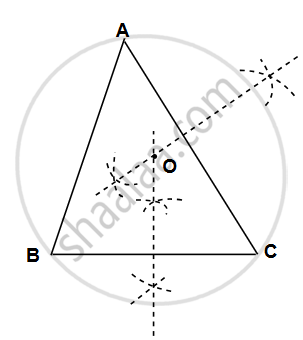
Step 4:
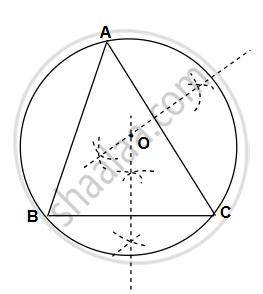
Set the Radius: Use a compass and measure the distance from the circumcenter (O) to any one of the vertices (e.g., OA). This distance is the circumradius.
OA = OB = OC = radius of the circle = circumradius.
Step 5:
Keeping the compass centred at O and set to the length of the circumradius, draw the circle.
Position of Circumcenter in Different Triangles
The location of the circumcenter depends on the type of triangle:
| Triangle Type | Circumcenter Location |
|---|---|
| Acute Triangle (all angles < 90°) | Inside the triangle |
| Right-Angled Triangle (one angle = 90°) | On the hypotenuse (at its midpoint) |
| Obtuse Triangle (one angle > 90°) | Outside the triangle |
| Equilateral Triangle (all angles = 60°) | At the geometric center |
Key Points Summary
-
The Circumcircle touches all three vertices of the triangle.
-
The Circumcenter is the unique intersection point of the perpendicular bisectors.
-
The Circumcenter is the only point inside (or outside) the triangle that is equidistant from the three vertices.
-
The distance from the circumcenter to any vertex is the Circumradius.
