Topics
Commercial Mathematics
Compound Interest
- Compound Interest as a Repeated Simple Interest Computation with a Growing Principal
- Use of Compound Interest in Computing Amount Over a Period of 2 Or 3-years
- Use of Formula
- Finding CI from the Relation CI = A – P
Goods and Services Tax (G.S.T.)
Algebra
Banking
Geometry
Shares and Dividends
Linear Inequations
Mensuration
Quadratic Equations
Trigonometry
Ratio and Proportion
Statistics
Probability
Factorisation of Polynomials
- Function and Polynomial
- Division Algorithm for Polynomials
- Remainder Theorem
- Factor Theorem
- Applications of Factor Theorem
Matrices
Arithmetic and Geometric Progression
Co-ordinate Geometry
- Foundation of Coordinate Geometry
- Advanced Concept of Reflection in Mathematics
- Invariant Points
- Combination of Reflections
- Using Graph Paper for Reflection
Similarity
Symmetry
Loci
- Locus
- Points Equidistant from Two Given Points
- Points Equidistant from Two Intersecting Lines
- Summary of Important Results on Locus
- Important Points on Concurrency in a Triangle
Circles
Tangent and Secant Properties
Constructions
Area and Volume of Solids (Cylinder, Cone and Sphere)
- Mensuration of Cylinder
- Hollow Cylinder
- Mensuration of Cones
- Mensuration of a Sphere
- Hemisphere
- Conversion of Solids
- Solid Figures
- Problems on Mensuration
Trigonometrical Identities
Heights and Distances
- Angles of Elevation and Depression
- Problems based on Elevation and Depression
Statistics : basic concepts, Mean, Median, Mode. Histograms and Ogive
Probability
Introduction
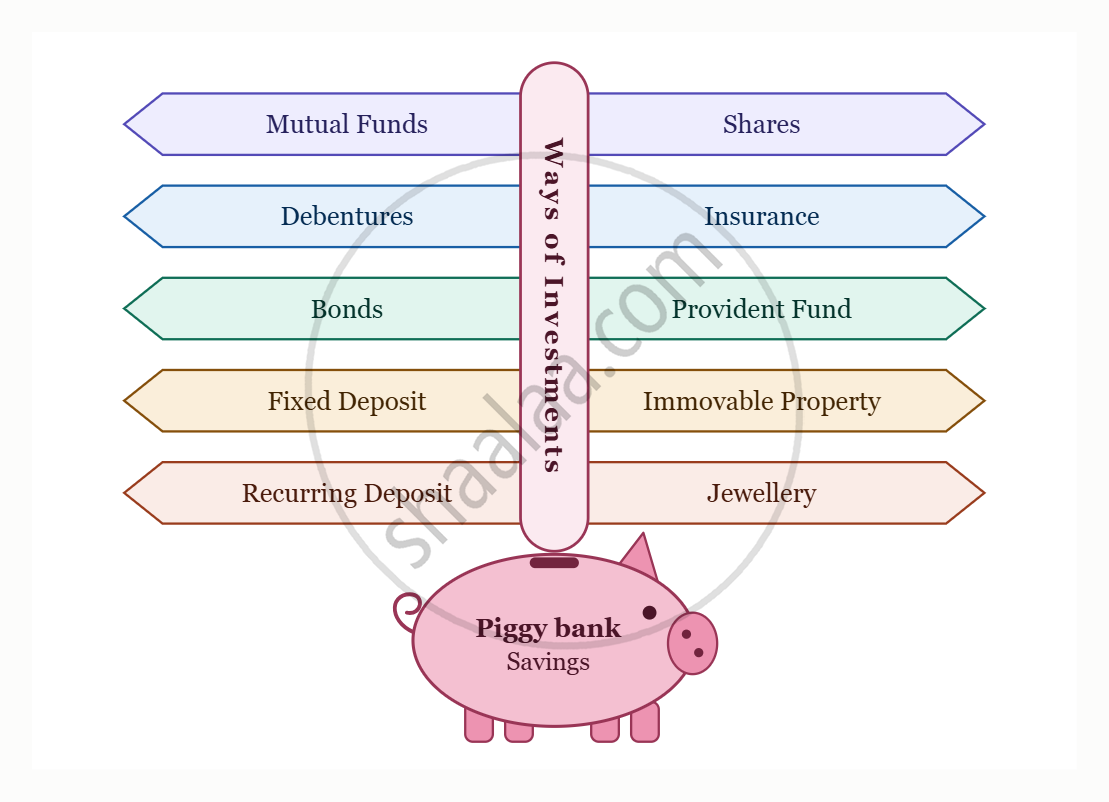
When people earn money, they do not always spend all of it. Some part is saved for future needs such as education, medical expenses, buying a house, or retirement. However, merely saving money is not enough because the value of money can fall over time due to rising prices, known as inflation. Therefore, people invest their savings in different options to earn additional income and increase their wealth.
Investment means using money today to buy an asset or financial product with the expectation of earning a return in the future. This return may come as interest, rent, dividend, profit, or an increase in the value of the asset.
CISCE: Class 10
Definition: Capital
The total amount of money needed to run the company is called the capital.
CISCE: Class 10
Definition: Shares
A share is the smallest unit of the capital of a company. The capital of a company is divided into small equal parts, each of which is called a share.
Definition: Shareholder
A shareholder is a person who owns one or more shares of a company. A shareholder is a part owner of the company in proportion to the number of shares held.
Definition: Stock Exchange
A stock exchange is a place where the buying and selling of shares takes place. It is also known as the share market or capital market.
CISCE: Class 10
Definition: Dividend
The annual profit distributed among shareholders is called a dividend.
CISCE: Class 10
Definition: Face Value / Nominal Value / Par Value (F.V. / N.V.)
The value of a share printed on the share certificate is called its Nominal Value, or Face Value, or Par Value.
CISCE: Class 10
Definition: Market Value of a Share (M.V.)
The shares of different companies can be bought or sold in the market through the stock exchange.
Formula: Shares, Dividends and Rate of Return
Investment and Number of Shares
\[ \text{Investment} = \text{Number of Shares} \times \text{Market Value} \]
\[ \text{Number of Shares} = \frac{\text{Total Investment}}{\text{Market Value per Share}} \]
Dividend
\[ \text{Dividend per Share} = \frac{\text{Dividend } \%}{100} \times \text{Face Value} \]
\[ \text{Total Annual Dividend} = \text{Number of Shares} \times \text{Dividend per Share} \]
Rate of Return
\[ \text{Rate of Return} = \frac{\text{Total Annual Dividend}}{\text{Total Investment}} \times 100 \]
Premium, Par, and Discount
A share may be sold at a price different from its face value.
| Condition | Relationship | Term |
|---|---|---|
| Market Value is more than Face Value | MV > FV | Share is at a premium |
| Market Value is equal to Face Value | MV = FV | Share is at par |
| Market Value is less than Face Value | MV < FV | Share is at a discount |
Example 1
Question: Complete the following table using given information.
\[ \begin{array}{|c|c|c|c|} \hline \text{Sr.No.} & FV & \text{Share is at} & MV \\ \hline \text{(i)} & ₹10 & \text{Premium of ₹7} & \\ \hline \text{(ii)} & ₹25 & & ₹16 \\ \hline \text{(iii)} & & \text{at par} & ₹5 \\ \hline \end{array} \]
Solution:
(i) Face Value (FV) = \[ \text{₹ } 10 \]
Share is at a premium of \[ \text{₹ } 7 \]
Formula: \[ \text{Market Value (MV)} = \text{FV} + \text{Premium} \]
\[ \text{MV} = 10 + 7 = \text{₹ } 17 \]
(ii) Face Value (FV) = \[ \text{₹ } 25 \]
Market Value (MV) = \[ \text{₹ } 16 \]
Since \[ \text{MV} < \text{FV}, \] the share is at a discount.
Formula: \[ \text{Discount} = \text{FV} - \text{MV} \]
\[ \text{Discount} = 25 - 16 = \text{₹ } 9 \] (Share is at a discount of \[ \text{₹ } 9 \] )
(iii) Share is at par
Market Value (MV) = \[ \text{₹ } 5 \]
When a share is at par, Face Value equals Market Value ( \[ \text{FV} = \text{MV} \] ).
\[ \text{FV} = \text{₹ } 5 \]
Example 2
Question: Smita has invested ₹12,000 and purchased shares of FV ₹10 at a premium of ₹2. Find the number of shares she purchased.
Solution:
Given:
Total Investment = \[ \text{₹ } 12{,}000 \]
Face Value (FV) = \[ \text{₹ } 10 \]
Premium = \[ \text{₹ } 2 \]
1. Calculate Market Value (MV):
\[ \text{MV} = \text{FV} + \text{Premium} \]
\[ \text{MV} = 10 + 2 = 12 \]
2. Calculate Number of Shares:
\[ \text{Number of shares} = \frac{\text{Total investment}}{\text{MV}} \]
\[ \text{Number of shares} = \frac{12000}{12} = 1000 \text{ shares} \]
CISCE: Class 10
Key Points: Important Facts of Share
| Term | Short Explanation |
|---|---|
| Share | The smallest unit of a company’s capital. |
| Dividend | Part of the company’s profit is distributed per share, calculated on Face Value. |
| Stock Exchange | Market where shares are bought and sold (e.g. BSE, NSE). |
| Market Index | Indicator of stock market performance (SENSEX – BSE, NIFTY – NSE). |
| Face Value (FV) | Value printed on the share certificate (also called par value). |
| Market Value (MV) | The price at which a share is bought/sold in the market. |
| MV > FV | Shares issued at a premium. |
| MV = FV | Share issued at Par. |
| MV < FV | Shares issued at a discount. |
| Sum Invested | Total amount spent to buy shares. Formula: Number of shares × MV |
| Rate of Return (RoR) | Percentage return on investment. Formula: (Dividend ÷ MV) × 100 |
