हिंदी

Ratio

Advertisements

Topics

  • Definition: Ratio
  • Key Concepts in Ratios
  • Examples
  • Real-Life Application
CISCE: Class 6

Definition: Ratio

A ratio is the relationship between two quantities of the same kind with the same unit, obtained by dividing the first by the second.

Example:
The ratio between 15 kg and 20 kg 
15 kg : 20 kg = `15/20` = `3/4` = 3:4.

Maharashtra State Board: Class 6

Key Concepts in Ratios

  1. Same-kind quantities:
    Only two quantities of the same kind can form a ratio.
    Example: The ratio between ₹50 and ₹80 is valid.
    However, the ratio is not valid between 50 m and 80 kg.
  2. Symbol of ratio:
    We place the symbol ":" between the two quantities we are comparing.
  3. How to write a ratio:
    We write the ratio between 3 and 4 as 3:4 (read as "3 is to 4").
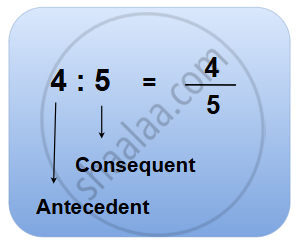
  4. Parts of a ratio:
    The first number is referred to as the antecedent.
    The second number is referred to as the consequent.
  5. A ratio is a pure number.
    It has no unit (like cm, kg, ₹, etc.).
CISCE: Class 6

Examples

Find the ratio of

  1. 60 to 48
  2. 3.75 kg to 750 gm

Solution:

(i) Required ratio = `60 / 48` = `5 / 4` = 5 : 4

(ii) Since 3.75 kg = 3.75 × 1000 gm = 3750 gm

Required ratio = `"3.75 kg" / "750 gm"`

                         = `"3750 gm" / "750 gm"`

                          = `5 / 1`

                          = 5 : 1

CISCE: Class 6

Real-Life Application

Athletics (Race Results)

In sports, ratios help compare times in a race.

Example:

  • Runner A completes a 100-metre race in 12 seconds, and Runner B takes 15 seconds.

  • The ratio of their times is 12:15, which simplifies to 4:5.

Real-life meaning:

  • The ratio 4:5 shows that Runner A is faster than Runner B.


Example Question 1

Ratio of distance of the school from Mary’s home to the distance of the school from John’s home is 2: 1.
(a) Who lives nearer to the school?
(b) Complete the following table which shows some possible distances that
Mary and John could live from the school.
Distance from Mary’s home to school (in km.)
10   4    
Distance from John’s home to school (in km.)
5 4   3 1
 
(a) John lives nearer to the school (As the ratio is 2: 1).
(b)
Distance from Mary’s home to school (in km.)
10 8 4 6 2
Distance from John’s home to school (in km.)
5 4 2 3 1

Example Question 2

Find the ratio of 90 cm to 1.5 m.

The two quantities are not in the same units. Therefore, we have to convert them into the same units.
1.5 m = 1.5 × 100 cm = 150 cm.
Therefore, the required ratio is 90: 150.
= `90/150 = (90 xx 30)/(150 xx 30) = 3/5`.
Required ratio is 3: 5.

Example Question 3

There are 45 persons working in an office. If the number of females is 25 and the remaining are males, find the ratio of:
(a) The number of females to the number of males.
(b) The number of males to the number of females.
Number of females = 25
Total number of workers = 45
Number of males = 45 – 25 = 20
Therefore, the ratio of number of females to the number of males = 25: 20 = 5: 4
And the ratio of number of males to the number of females = 20: 25 = 4: 5.

Test Yourself

Shaalaa.com | Word Problems On Ratio Part - 1

Shaalaa.com


Next video


Shaalaa.com


Word Problems On Ratio Part - 1 [00:10:12]
S
Advertisements
Share
Notifications

Englishहिंदीमराठी


      Forgot password?
Use app×