Topics
Commercial Mathematics
Compound Interest
- Compound Interest as a Repeated Simple Interest Computation with a Growing Principal
- Use of Compound Interest in Computing Amount Over a Period of 2 Or 3-years
- Use of Formula
- Finding CI from the Relation CI = A – P
Goods and Services Tax (G.S.T.)
Algebra
Banking
Geometry
Shares and Dividends
Linear Inequations
Mensuration
Quadratic Equations
Trigonometry
Ratio and Proportion
Statistics
Probability
Factorisation of Polynomials
- Function and Polynomial
- Division Algorithm for Polynomials
- Remainder Theorem
- Factor Theorem
- Applications of Factor Theorem
Matrices
Arithmetic and Geometric Progression
Co-ordinate Geometry
- Foundation of Coordinate Geometry
- Advanced Concept of Reflection in Mathematics
- Invariant Points
- Combination of Reflections
- Using Graph Paper for Reflection
Similarity
Symmetry
Loci
- Locus
- Points Equidistant from Two Given Points
- Points Equidistant from Two Intersecting Lines
- Summary of Important Results on Locus
- Important Points on Concurrency in a Triangle
Circles
Tangent and Secant Properties
Constructions
Area and Volume of Solids (Cylinder, Cone and Sphere)
- Mensuration of Cylinder
- Hollow Cylinder
- Mensuration of Cones
- Mensuration of a Sphere
- Hemisphere
- Conversion of Solids
- Solid Figures
- Problems on Mensuration
Trigonometrical Identities
Heights and Distances
- Angles of Elevation and Depression
- Problems based on Elevation and Depression
Statistics : basic concepts, Mean, Median, Mode. Histograms and Ogive
Probability
Introduction
In many real-life situations, we need to find the total of several terms of such a sequence—for example, total monthly savings, total seats in successive rows of an auditorium, or total distance covered when equal amounts are added each hour. The sum of the first n terms of an Arithmetic Progression helps us find such totals quickly and systematically, without adding every term one by one.
Maharashtra State Board: Class 10
CISCE: Class 10
Formula: Sum of First ‘n’ Terms
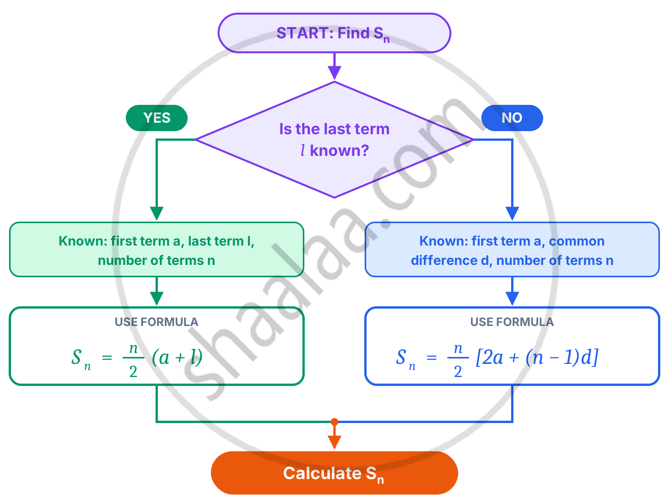
If a, n, l are known → \[S_n=\frac{n}{2}(a+l)\]
If a, n, d are known → \[S_n=\frac{n}{2}\left[2a+(n-1)d\right]\]
Maharashtra State Board: Class 10
Formula: Sum of First n Natural Numbers
\[1+2+\cdots+n=\frac{n(n+1)}{2}\]
Formula: Sum of First n Even Natural Numbers
\[2+4+\cdots+2n=n(n+1)\]
Formula: Sum of First n Odd Natural Numbers
\[1+3+\cdots+(2n-1)=n^2\]
Choosing Right Formula
Example 1
Question: Let's find the sum of first 100 terms of A.P. 14, 16, 18, ….
Solution:
Step 1: Identify the given values from the A.P. ( \[ 14, 16, 18, \ldots \] )
- First term \[ a = 14 \]
- Common difference \[ d = 16 - 14 = 2 \]
- Number of terms \[ n = 100 \]
Step 2: Use the sum of \[ n \] terms formula ( \[ S_{n} \] )
\[ S_{n} = \frac{n}{2}[2a + (n - 1)d] \]
Step 3: Substitute and evaluate
\[ S_{100} = \frac{100}{2}[2(14) + (100 - 1) \times 2] \]
\[ = 50[28 + 198] \]
\[ = 50 \times 226 = 11{,}300 \]
Final Answer:
\[ \therefore \] The sum of the first 100 terms of the given A.P. is \[ 11{,}300. \]
Example 2
Question: Find the sum of first n odd natural numbers.
Solution : First \[ n \] natural numbers
\[ 1,\ 3,\ 5,\ 7,\ \ldots,\ (2n-1). \]
\[ a = t_1 = 1 \] and \[ t_n = (2n-1),\quad d = 2 \]
\[ \begin{array}{l|l|l} \textbf{Method I} & \textbf{Method II} & \textbf{Method III} \\[4pt] S_n = \dfrac{n}{2}[t_1+t_n] & S_n = \dfrac{n}{2}[2a+(n-1)d] & 1+3+\ldots\ 2n-1 \\[8pt] = \dfrac{n}{2}[1+(2n-1)] & = \dfrac{n}{2}[2\times 1+(n-1)\times 2] & = (1+2+3+\ldots+2n) \\[4pt] & & \quad - (2+4+6+\ldots+2n) \\[8pt] = \dfrac{n}{2}[1+2n-1] & = \dfrac{n}{2}[2+2n-2] & = \dfrac{2n(2n+1)}{2} - \dfrac{2n(n+1)}{2} \\[8pt] = \dfrac{n}{2}\times 2n & = \dfrac{n}{2}\times 2n & = (2n^2+n) - (n^2+n) \\[8pt] = n^2 & = n^2 & = n^2 \end{array} \]
Key Points: Sum of First ‘n’ Terms of an Arithmetic Progressions
- An A.P. has the form \[ a,\; a + d,\; a + 2d, \ldots. \]
- The \[ n\text{th} \] term is \[ a_{n} = a + (n - 1)d. \]
- The sum of the first \[ n \] terms is: \[ S_{n} = \frac{n}{2}[2a + (n - 1)d] \]
- If the last term is known: \[ S_{n} = \frac{n}{2}(a + l) \]
- Sum of first \[ n \] natural numbers: \[ \frac{n(n + 1)}{2} \]
- Sum of first \[ n \] even numbers: \[ n(n + 1) \]
- Sum of first \[ n \] odd numbers: \[ n^{2} \]
