Topics
Linear Equations in Two Variables
- Foundation of Linear Equations in Two Variables
- Simultaneous Linear Equations
- Graph of a Linear Equation in Two Variables
- Methods of Solving Linear Equations in Two Variables > Graphical Method
- Methods of Solving Linear Equations in Two Variables > Determinant method (Cramer’s Rule)
- Equations Reducible to Linear Equations
- Application of Simultaneous Equations
Quadratic Equations
- Concept of Quadratic Equations
- Factorisation Method
- Completing the Square Method
- Quadratic Formula (Shreedharacharya's Rule)
- Nature of Roots of a Quadratic Equation
- Relation Between Zeroes (Roots) and Coefficients of a Quadratic Equation
- Formation of a Quadratic Equation with Given Roots
- Application of Quadratic Equation
Arithmetic Progression
Financial Planning
Probability
Statistics
Method Selection Guide
| Situation | Recommended Method | Reason |
|---|---|---|
| One variable has coefficient 1 | Substitution | Easy to isolate a variable |
| Coefficients are simple multiples | Elimination | Quick cancellation |
| Equations contain fractions | Substitution after simplification | Reduces fractional complexity |
| Equations are in standard form | Cross-multiplication or determinants | Direct formula-based solution |
| Graphical interpretation is required | Graphical method | Shows intersection visually |
Word-Problem Translation Guide
| English Phrase | Mathematical Meaning |
|---|---|
| “More than” | Addition, + |
| “Less than” | Subtraction, − |
| “Times” | Multiplication, × |
| “Is”, “equals”, “gives” | Equals sign, = |
| “Sum” | Add the quantities |
| “Difference” | Subtract the smaller from the larger |
| “Perimeter of rectangle” | 2(l + b) |
| “Speed downstream” | Speed of boat in still water + speed of stream |
| “Speed upstream” | Speed of boat in still water - speed of stream |
| “Time” | \[ \frac{\text{Distance}}{\text{Speed}} \] |
| “Two-digit number” | 10x + y, where x is tens digit and y is units digit |
Problem-Solving Flowchart
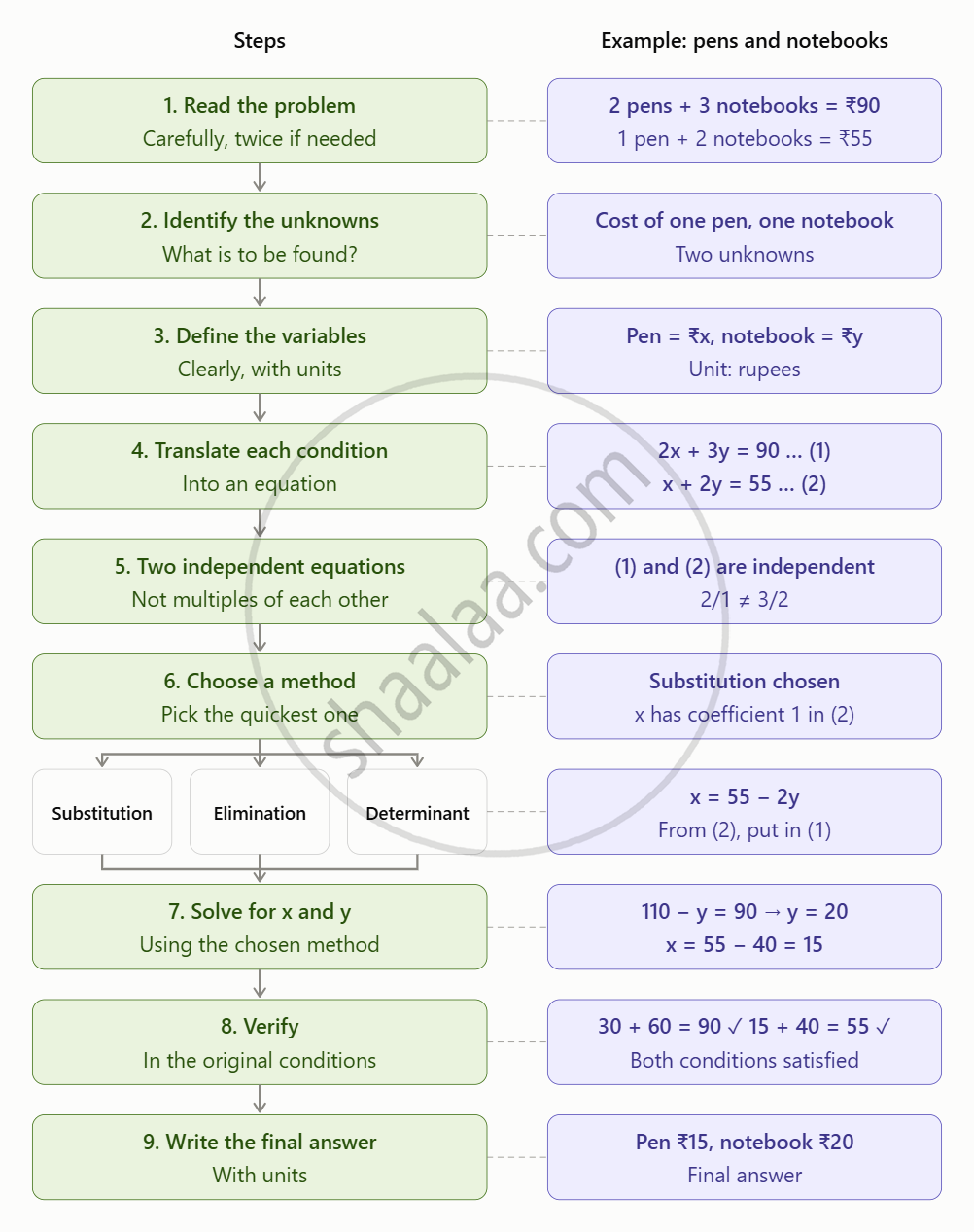
Example 1
Sarthak's present age is x years and Sakshi's present age is y years. Frame simultaneous linear equations based on the following conditions:
-
Sarthak's age is less by 8 than double the age of Sakshi.
-
The sum of the present ages of Sarthak and Sakshi is 25.
-
4 years ago, Sakshi's age was 3 years less than Sarthak's age at that time.
(Find their present ages using any two suitable conditions).
Solution:
1. Condition 1:
"Sarthak's age is less by 8 than double the age of Sakshi"
Equation: \[ x = 2y - 8 \implies x - 2y = -8 \]
2. Condition 2:
"The sum of the present ages of Sarthak and Sakshi is 25"
Equation: \[ x + y = 25 \]
3. Condition 3:
"4 years ago, Sakshi's age was 3 years less than Sarthak's age at that time"
Calculation: \[ (y - 4) = (x - 4) - 3 \implies y - 4 = x - 7 \]
Equation: \[ x - y = 3 \]
Example 2
A certain amount is equally distributed among certain number of students. Each would get ₹2 less if 10 students were more and each would get ₹6 more if 15 students were less. Find the number of students and the amount distributed.
Solution:
Let the number of students be \[ x \] and amount given to each student be \[ \text{₹}y. \]
\[ \therefore \] Total amount distributed is \[ xy. \]
From the first condition:
\[ (x + 10)(y - 2) = xy \]
\[ \therefore xy - 2x + 10y - 20 = xy \]
\[ \therefore -2x + 10y = 20 \]
\[ \therefore -x + 5y = 10 \ldots (I) \]
From the second condition:
\[ (x - 15)(y + 6) = xy \]
\[ \therefore xy + 6x - 15y - 90 = xy \]
\[ \therefore 6x - 15y = 90 \]
\[ \therefore 2x - 5y = 30 \ldots (II) \]
Adding equations (I) and (II):
\[ \begin{array}{r} -x + 5y = 10 \\ +\;\; 2x - 5y = 30 \\ \hline x = 40 \end{array} \]
Substitute this value of \[ x \] in equation (I):
\[ -x + 5y = 10 \]
\[ \therefore -40 + 5y = 10 \]
\[ \therefore 5y = 50 \]
\[ \therefore y = 10 \]
Final Answer:
Total amount distributed is \[ = xy = 40 \times 10 = \text{₹}400. \]
\[ \therefore \text{₹}400 \] distributed equally among 40 students.
