Topics
Real Numbers
- Concept of Divisibility
- Euclid's Division Lemma
- Euclid’s Division Algorithm
- Application of Euclid Lemma > Finding the HCF of Two Positive Integers
- Application of Euclid Lemma > Finding the HCF of Three Numbers
- Application of Euclid Lemma > On Expressing the HCF of Two Numbers a and b in the Form xa + yb
- Fundamental Theorem of Arithmetic
- Applications of the Fundamental Theorem of Arithmetic
- Rational Numbers
- Irrational Numbers
- Nature of the Decimal Expansions of Rational Numbers
Number Systems
Algebra
Polynomials
- Concept of Polyomial
- Graph of Polynomials
- Geometrical Meaning of the Zeroes of a Polynomial
- Relation Between Zeroes (Roots) and Coefficients of a Polynomial
- Relationship Between the Zeros and Coefficients of a Quadratic Polynomial
- Relationship between Zeros And Coefficients of a Cubic Polynomial
- Division Algorithm for Polynomials
Coordinate Geometry
Pair of Linear Equations in Two Variables
Quadratic Equations
Geometry
Arithmetic Progressions
Trignometry
Coordinate Geometry
Mensuration
Statistics and Probability
Triangles
Circles
- Tangent to a Circle
- Number of Tangents from a Point on a Circle
Introduction to Trigonometry
Some Applications of Trigonometry
- Angles of Elevation and Depression
- Problems based on Elevation and Depression
Areas Related to Circles
Surface Areas and Volumes
Statistics
Probability
Notes
We know that a line divides the Cartesian plane into two parts. Each part is known as a half plane. A vertical line will divide the plane in left and right half planes and a non-vertical line will divide the plane into lower and upper half planes Fig.
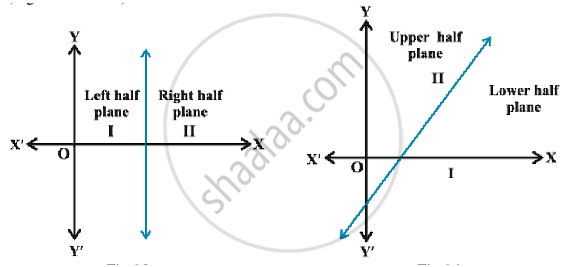
A point in the Cartesian plane will either lie on a line or will lie in either of the half planes I or II. We shall now examine the relationship, if any, of the points in the plane and the inequalities ax + by < c or ax + by > c.
Let us consider the line
ax + by = c, a ≠ 0, b ≠ 0 ... (1)
There are three possibilities namely:
(i) ax + by = c (ii) ax + by > c (iii) ax + by < c.
In case (i), clearly, all points (x, y) satisfying (i) lie on the line it represents and conversely. Consider case (ii), let us first assume that b > 0. Consider a point P (α,β) on the line ax + by = c, b > 0, so that aα + bβ = c.Take an arbitrary point Q (α , γ) in the half plane II . fig
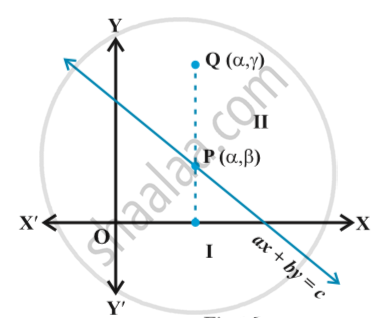
Now , we interpret, γ > β (Why?)
or bγ > bβ or aα + b γ > aα + bβ (Why?)
or aα + b γ > c i.e., Q(α,γ ) satisfies the inequality ax + by > c.
Thus, all the points lying in the half plane II above the line ax + by = c satisfies the inequality ax + by > c. Conversely, let (α, β) be a point on line ax + by = c and an arbitrary point Q(α, γ) satisfying
ax + by > c
so that aα + bγ > c
⇒ aα + b γ > aα + bβ (Why?)
⇒ γ > β (as b > 0)
This means that the point (α, γ) lies in the half plane II.
Thus, any point in the half plane II satisfies ax + by > c, and conversely any point satisfying the inequality ax + by > c lies in half plane II.
In case b < 0, we can similarly prove that any point satisfying ax + by > c lies in the half plane I, and conversely.
Hence, we deduce that all points satisfying ax + by > c lies in one of the half planes II or I according as b > 0 or b < 0, and conversely.
Thus, graph of the inequality ax + by > c will be one of the half plane (called solution region) and represented by shading in the corresponding half plane.
