Topics
Commercial Mathematics
Compound Interest
- Compound Interest as a Repeated Simple Interest Computation with a Growing Principal
- Use of Compound Interest in Computing Amount Over a Period of 2 Or 3-years
- Use of Formula
- Finding CI from the Relation CI = A – P
Goods and Services Tax (G.S.T.)
Algebra
Banking
Geometry
Shares and Dividends
Linear Inequations
Mensuration
Quadratic Equations
Trigonometry
Ratio and Proportion
Statistics
Probability
Factorisation of Polynomials
- Function and Polynomial
- Division Algorithm for Polynomials
- Remainder Theorem
- Factor Theorem
- Applications of Factor Theorem
Matrices
Arithmetic and Geometric Progression
Co-ordinate Geometry
- Foundation of Coordinate Geometry
- Advanced Concept of Reflection in Mathematics
- Invariant Points
- Combination of Reflections
- Using Graph Paper for Reflection
Similarity
Symmetry
Loci
- Locus
- Points Equidistant from Two Given Points
- Points Equidistant from Two Intersecting Lines
- Summary of Important Results on Locus
- Important Points on Concurrency in a Triangle
Circles
Tangent and Secant Properties
Constructions
Area and Volume of Solids (Cylinder, Cone and Sphere)
- Mensuration of Cylinder
- Hollow Cylinder
- Mensuration of Cones
- Mensuration of a Sphere
- Hemisphere
- Conversion of Solids
- Solid Figures
- Problems on Mensuration
Trigonometrical Identities
Heights and Distances
- Angles of Elevation and Depression
- Problems based on Elevation and Depression
Statistics : basic concepts, Mean, Median, Mode. Histograms and Ogive
Probability
Introduction
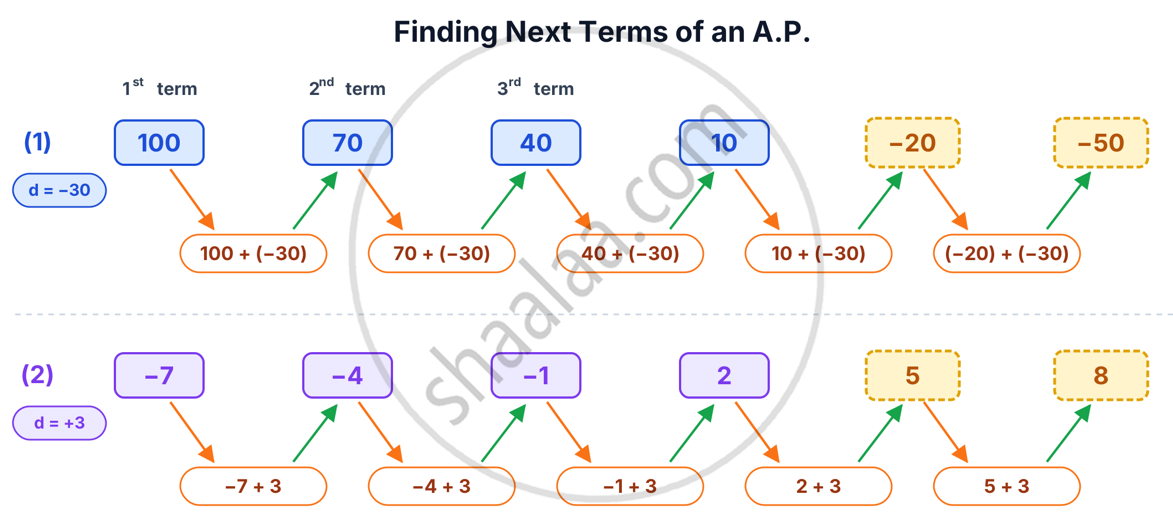
An Arithmetic Progression (A.P.) is a list of numbers in which each term is obtained by adding the same fixed number to the previous term.
Real-life analogy:
If you save ₹500 in the first month, ₹700 in the second month, ₹900 in the third month, and so on, your monthly savings increase by ₹200 every time. This forms an A.P.
Here, the fixed increase is ₹200.
Important: The fixed number added is called the common difference.
CISCE: Class 10
Definition: Arithmetic Progression (A.P.)
An Arithmetic Progression (A.P.) is a sequence in which the difference between consecutive terms is constant.
- Common difference = d = second term − first term
-
The general form of an AP is a, a + d, a + 2d, a + 3d, …
a = first term
d = common difference
Common Difference: Positive, Negative, and Zero
| Type of A.P. | Common difference | Nature of sequence | Example |
|
Increasing A.P.
|
d > 0
|
Terms increase
|
2, 5, 8, 11,...
|
|
Decreasing A.P.
|
d < 0
|
Terms decrease
|
20, 17, 14, 11,...
|
|
Constant A.P.
|
d = 0
|
All terms are equal
|
6, 6, 6, 6,...
|
Example
Check whether the given sequence is an A.P. If it is an A.P., find the next two terms.
Solution:
Step 1: Identify the terms of the sequence
Given sequence: \[ \frac{3}{2}, \frac{1}{2}, -\frac{1}{2}, -\frac{3}{2}, \ldots \]
\[ t_{1} = \frac{3}{2}, t_{2} = \frac{1}{2}, t_{3} = -\frac{1}{2}, t_{4} = -\frac{3}{2} \]
Step 2: Find the common differences ( \[ t_{n + 1} - t_{n} \] )
\[ t_{2} - t_{1} = \frac{1}{2} - \frac{3}{2} = -\frac{2}{2} = -1 \]
\[ t_{3} - t_{2} = -\frac{1}{2} - \frac{1}{2} = -\frac{2}{2} = -1 \]
\[ t_{4} - t_{3} = -\frac{3}{2} - \left(-\frac{1}{2}\right) = -\frac{3}{2} + \frac{1}{2} = -\frac{2}{2} = -1 \]
Step 3: Confirm the A.P.
Since the common difference \[ d = -1 \] is constant, the given sequence is an A.P.
Step 4: Find the next two terms
\[ -\frac{3}{2} - 1 = -\frac{5}{2} \]
\[ -\frac{5}{2} - 1 = -\frac{7}{2} \]
\[ \therefore \] The next two terms are \[ -\frac{5}{2} \] and \[ -\frac{7}{2}. \]
Key Points: Arithmetic Progression (A.P.)
- Definition: An A.P. is a sequence in which the difference between consecutive terms is constant.
- Condition for A.P.: \[ a_{n + 1} - a_{n} = d \]
- General form: \[ a,\; a + d,\; a + 2d,\; a + 3d, \ldots \]
Test Yourself
Video Tutorials
Shaalaa.com | Arithmetic Progression part 1 (Introduction)
Series: 1
00:09:30 undefined
00:23:46 undefined
00:07:29 undefined
00:14:10 undefined
00:19:40 undefined
00:13:12 undefined
