Topics
Commercial Mathematics
Compound Interest
- Compound Interest as a Repeated Simple Interest Computation with a Growing Principal
- Use of Compound Interest in Computing Amount Over a Period of 2 Or 3-years
- Use of Formula
- Finding CI from the Relation CI = A – P
Goods and Services Tax (G.S.T.)
Algebra
Banking
Geometry
Shares and Dividends
Linear Inequations
Mensuration
Quadratic Equations
- Concept of Quadratic Equations
- Method of Solving a Quadratic Equation>Factorisation Method
- Method of Solving a Quadratic Equation>Factorisation Method
- Method of Solving a Quadratic Equation>Quadratic Formula (Shreedharacharya's Rule)
- Nature of Roots of a Quadratic Equation
- Equations Reducible to Quadratic Equations
Trigonometry
Ratio and Proportion
Statistics
Factorisation of Polynomials
- Function and Polynomial
- Division Algorithm for Polynomials
- Remainder Theorem
- Factor Theorem
- Applications of Factor Theorem
Probability
Matrices
Arithmetic and Geometric Progression
Co-ordinate Geometry
- Foundation of Coordinate Geometry
- Advanced Concept of Reflection in Mathematics
- Invariant Points
- Combination of Reflections
- Using Graph Paper for Reflection
Similarity
Symmetry
Loci
- Locus
- Points Equidistant from Two Given Points
- Points Equidistant from Two Intersecting Lines
- Summary of Important Results on Locus
- Important Points on Concurrency in a Triangle
Circles
Tangent and Secant Properties
Constructions
Area and Volume of Solids (Cylinder, Cone and Sphere)
- Mensuration of Cylinder
- Hollow Cylinder
- Mensuration of Cones
- Mensuration of a Sphere
- Hemisphere
- Conversion of Solids
- Solid Figures
- Problems on Mensuration
Trigonometrical Identities
Heights and Distances
- Angles of Elevation and Depression
- Problems based on Elevation and Depression
Statistics : basic concepts, Mean, Median, Mode. Histograms and Ogive
Probability
- Definition: Proportion
- Rules of Proportion
- Example 1
- Example 2
- Example 3
- Example 4
- Real-Life Applications
- Key Points Summary
Definition: Proportion
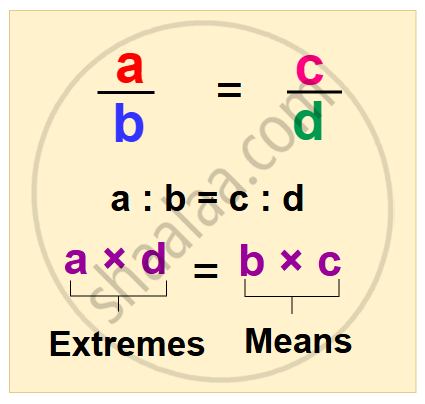
Four non-zero quantities, a, b, c, and d, are said to be in proportion (or are proportional) if:
a : b = c : d.
The above equation is expressed as a : b :: c : d
This is read as “a is to b as c is to d.”
Rules of Proportion
1. Proportion format:
- If a:b = c:d, it means two ratios are equal.
where a = first term, b = second term, c = third term, d = fourth term
2. Extremes and means:
- a and d are called the extremes (outside terms).
- b and c are called the means (middle terms).
3. Cross-multiplication rule:
- a × d = b × c
(Product of extremes = Product of means)
4. Fourth proportional:
- In a:b = c:d, the fourth term, d, is called the fourth proportional.
5. Same kind and units:
- For any ratio or proportion, the compared quantities must be of the same kind and unit.
- Units of and must match; units of aa and bb must match.
Example 1
Check whether or not the given ratios form a proportion:
1) 15:24 and 35:56
Solution:
Product of extremes = 15 × 56 = 840
and product of means = 24 × 35 = 840
Since product of extremes = product of means
⇒ The given two ratios form a proportion
2) 2`1/4` : 5`2/5` and 3`1/3` : 4`1/6`
Solution:
Product of extremes = 2`1/4` × 4`1/6` = `9/4` × `25/6` = `75/8`
product of means = 5`2/5` × 3`1/3` = `27/5` × `10/3` = `18/1`
⇒ product of extremes `\cancel(=)` product of means
⇒ The given two ratios do not form a proportion.
Example 2
- The numbers 8, x, 9 and 36 are in proportion. Find x.
- If x : 15 = 8 : 12, find x.
Solution:
i) The numbers 8, x, 9 and 36 are in proportion.
⇒ 8: x = 9 : 36
⇒ x × 9 = 8 × 36
⇒ x =`"8 × 36 " / 9` = 32
ii) x:15 = 8:12
⇒ x × 12 = 15 × 8
⇒ x = `"15 × 8 " / 9` = 10
Example 3
The first, third and fourth terms of a proportion are 12, 8 and 14, respectively.
Find the second term.
Solution:
Let the second term be x.
∴ 12, x, 8 and 14 are in proportion, i.e., 12:x = 8:14.
=> x × 8 = 12 × 14
=> x = `"12 × 14 " / 8` = 21
∴ The second term of the proportion is 21.
Example 4
The ratio of the length and the width of a sheet of paper is 3 : 2. If the length is 12 cm, find the width.
Solution:
Let width = x cm
The ratio of length to width = 12 : x
According to the given statement, 12 : x = 3 : 2
=> x × 3 = 12 × 2
=> x = `"12 × 2 " / 3` = 8
∴ Width = 8 cm
Real-Life Applications
Situation: If you need 6 erasers for every 3 pencils, how many erasers do you need for 12 pencils?
Let the number of erasers be x.
Set up proportion:
-
-
-
Answer: You need 24 erasers.
Key Points Summary
-
Ratios compare values of the same kind.
-
A proportion means two ratios are the same.
-
Use cross-multiplication to check proportion.
-
Always write ratios in their simplest form.
Example Question 1
Are the ratios 25g: 30g and 40 kg: 48 kg in proportion?
25 g: 30 g = `25/30 `= 5: 6
40 kg: 48 kg = `40/48` = 5: 6
So, 25: 30 = 40: 48.
Therefore, the ratios 25 g: 30 g and 40 kg: 48 kg are in proportion, i.e. 25: 30:: 40: 48
The middle terms in this are 30, 40 and the extreme terms are 25, 48.
Example Question 2
Are 30, 40, 45, and 60 in proportion?
Ratio of 30 to 40 = `30/40` = 3: 4.
Ratio of 45 to 60 = `45/60` = 3: 4.
Since, 30: 40 = 45: 60
Therefore, 30, 40, 45, and 60 are in proportion.
Example Question 3
Do the ratios 15 cm to 2 m and 10 sec to 3 minutes form a proportion?
15 cm : 2 m :: 10 sec : 3 min
15 cm : 2 × 100 cm :: 10 sec : 30 × 60 sec
15 : 200 :: 10 : 1800
3 : 40 :: 1 : 180
No, they donot form a proportion
Ratio of 15 cm to 2 m = 15: 2 × 100 (1 m = 100 cm)
= 3: 40
Ratio of 10 sec to 3 min = 10: 3 × 60 (1 min = 60 sec)
=1: 18
Since, 3: 40 ≠ 1: 18, therefore, the given ratios do not form a proportion.
Example Question 4
A hostel is to be built for schoolgoing girls. Two toilets are to be built for every 15 girls. If 75 girls will be living in the hostel, how many toilets will be required in this proportion?
Let us suppose x toilets will be needed for 75 girls.
The ratio of the number of toilets to the number of girls is `2/15`.
∴ `x/75 = 2/15`
∴ `x/75 xx 75 = 2/15 xx 75`................(Multiplying both sides by 75)
∴ x = 2 × 5
∴ x = 10
∴ 10 toilets will be required for 75 girls.
