Topics
Commercial Mathematics
Compound Interest
- Compound Interest as a Repeated Simple Interest Computation with a Growing Principal
- Use of Compound Interest in Computing Amount Over a Period of 2 Or 3-years
- Use of Formula
- Finding CI from the Relation CI = A – P
Goods and Services Tax (G.S.T.)
Algebra
Banking
Geometry
Shares and Dividends
Linear Inequations
Mensuration
Quadratic Equations
Trigonometry
Ratio and Proportion
Statistics
Probability
Factorisation of Polynomials
- Function and Polynomial
- Division Algorithm for Polynomials
- Remainder Theorem
- Factor Theorem
- Applications of Factor Theorem
Matrices
Arithmetic and Geometric Progression
Co-ordinate Geometry
- Foundation of Coordinate Geometry
- Advanced Concept of Reflection in Mathematics
- Invariant Points
- Combination of Reflections
- Using Graph Paper for Reflection
Similarity
Symmetry
Loci
- Locus
- Points Equidistant from Two Given Points
- Points Equidistant from Two Intersecting Lines
- Summary of Important Results on Locus
- Important Points on Concurrency in a Triangle
Circles
Tangent and Secant Properties
Constructions
Area and Volume of Solids (Cylinder, Cone and Sphere)
- Mensuration of Cylinder
- Hollow Cylinder
- Mensuration of Cones
- Mensuration of a Sphere
- Hemisphere
- Conversion of Solids
- Solid Figures
- Problems on Mensuration
Trigonometrical Identities
Heights and Distances
- Angles of Elevation and Depression
- Problems based on Elevation and Depression
Statistics : basic concepts, Mean, Median, Mode. Histograms and Ogive
Probability
- Introduction
- Definition: In-Circle
- Definition: Incenter
- Definition: Inradius
- Step-by-Step Construction
- Key Points Summary
Introduction
Imagine you have a triangular piece of land, and you want to build the largest possible circular fountain exactly at the center without crossing the triangle’s boundaries.
The geometry concept that solves this problem is the In-Circle.
This topic is crucial because it connects fundamental geometric principles—specifically angle bisectors—to practical constructions, showing us that every triangle has a unique central point defined by its angles.
Definition: In-Circle
The In-Circle of a triangle is the largest possible circle that can be drawn inside the triangle such that it just touches (is tangent to) all three sides.
Definition: Incenter
The point where all three angle bisectors of a triangle meet. This point is the center of the In-Circle.
Definition: Inradius
The perpendicular distance from the Incenter (I) to any of the three sides. This distance is the radius of the In-Circle.
Step-by-Step Construction
Step 1:
Draw a triangle ABC of any size.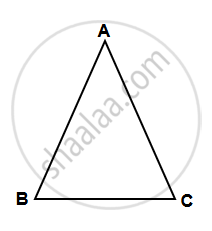
Step 2:
Draw angle bisectors from all three vertices.
Step 3:
Find where they meet → This is the incenter (I).
Step 4:
Determine the Radius (Inradius) → Draw a perpendicular from I to any side → Measure this, it is called the inradius (r).
Step 5:
Draw the In-Circle: Using point I as the centre and length IP as the radius, draw the circle.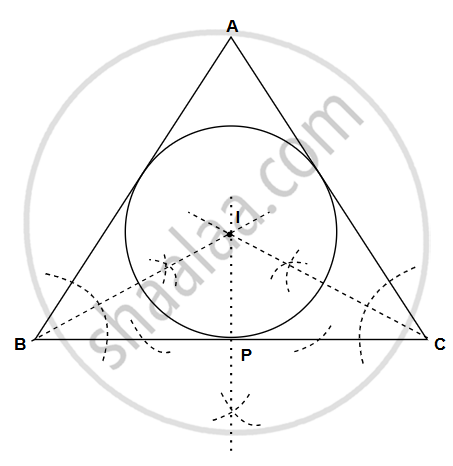
Key Points Summary
-
In-circle - Circle inside touching all sides.
-
Incenter (I) - Center point of In-circle.
-
Inradius (r) - Radius of In-circle.
-
Angle bisector - Line cutting angle in half.
-
Tangent - Line touching circle at one point.
-
Tangent point - Where In-circle touches a side.
