Advertisements
Advertisements
प्रश्न
The ratio of the sums of m and n terms of an A.P. is m2: n2. Show that the ratio of mth and nthterm is (2m – 1): (2n – 1)
Advertisements
उत्तर
Let a and b be the first term and the common difference of the A.P. respectively.
According to the given condition,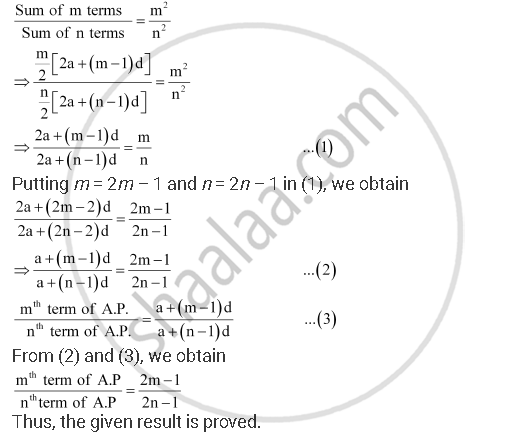
संबंधित प्रश्न
Insert five numbers between 8 and 26 such that the resulting sequence is an A.P.
if `(a^n + b^n)/(a^(n-1) + b^(n-1))` is the A.M. between a and b, then find the value of n.
A sequence is defined by an = n3 − 6n2 + 11n − 6, n ϵ N. Show that the first three terms of the sequence are zero and all other terms are positive.
Let < an > be a sequence. Write the first five term in the following:
a1 = 1, an = an − 1 + 2, n ≥ 2
Let < an > be a sequence. Write the first five term in the following:
a1 = a2 = 2, an = an − 1 − 1, n > 2
Show that the following sequence is an A.P. Also find the common difference and write 3 more terms in case.
−1, 1/4, 3/2, 11/4, ...
Find:
nth term of the A.P. 13, 8, 3, −2, ...
Is 68 a term of the A.P. 7, 10, 13, ...?
How many terms are there in the A.P.\[- 1, - \frac{5}{6}, -\frac{2}{3}, - \frac{1}{2}, . . . , \frac{10}{3}?\]
The 10th and 18th terms of an A.P. are 41 and 73 respectively. Find 26th term.
The sum of 4th and 8th terms of an A.P. is 24 and the sum of the 6th and 10th terms is 34. Find the first term and the common difference of the A.P.
Three numbers are in A.P. If the sum of these numbers be 27 and the product 648, find the numbers.
Find the four numbers in A.P., whose sum is 50 and in which the greatest number is 4 times the least.
If the sum of three numbers in A.P. is 24 and their product is 440, find the numbers.
Find the sum of the following arithmetic progression :
a + b, a − b, a − 3b, ... to 22 terms
Find the sum of the following serie:
101 + 99 + 97 + ... + 47
Find the sum of all odd numbers between 100 and 200.
Show that the sum of all odd integers between 1 and 1000 which are divisible by 3 is 83667.
Find the sum of all integers between 50 and 500 which are divisible by 7.
Find the r th term of an A.P., the sum of whose first n terms is 3n2 + 2n.
If 12th term of an A.P. is −13 and the sum of the first four terms is 24, what is the sum of first 10 terms?
Find the sum of all two digit numbers which when divided by 4, yields 1 as remainder.
Find an A.P. in which the sum of any number of terms is always three times the squared number of these terms.
The sums of n terms of two arithmetic progressions are in the ratio 5n + 4 : 9n + 6. Find the ratio of their 18th terms.
The sums of first n terms of two A.P.'s are in the ratio (7n + 2) : (n + 4). Find the ratio of their 5th terms.
If a, b, c is in A.P., prove that:
(a − c)2 = 4 (a − b) (b − c)
A man arranges to pay off a debt of Rs 3600 by 40 annual instalments which form an arithmetic series. When 30 of the instalments are paid, he dies leaving one-third of the debt unpaid, find the value of the first instalment.
A piece of equipment cost a certain factory Rs 600,000. If it depreciates in value, 15% the first, 13.5% the next year, 12% the third year, and so on. What will be its value at the end of 10 years, all percentages applying to the original cost?
Shamshad Ali buys a scooter for Rs 22000. He pays Rs 4000 cash and agrees to pay the balance in annual instalments of Rs 1000 plus 10% interest on the unpaid amount. How much the scooter will cost him.
In a cricket team tournament 16 teams participated. A sum of ₹8000 is to be awarded among themselves as prize money. If the last place team is awarded ₹275 in prize money and the award increases by the same amount for successive finishing places, then how much amount will the first place team receive?
If the sum of n terms of an A.P. is 2 n2 + 5 n, then its nth term is
If a1, a2, a3, .... an are in A.P. with common difference d, then the sum of the series sin d [sec a1 sec a2 + sec a2 sec a3 + .... + sec an − 1 sec an], is
If four numbers in A.P. are such that their sum is 50 and the greatest number is 4 times the least, then the numbers are
If, S1 is the sum of an arithmetic progression of 'n' odd number of terms and S2 the sum of the terms of the series in odd places, then \[\frac{S_1}{S_2}\] =
If in an A.P., Sn = n2p and Sm = m2p, where Sr denotes the sum of r terms of the A.P., then Sp is equal to
Mark the correct alternative in the following question:
The 10th common term between the A.P.s 3, 7, 11, 15, ... and 1, 6, 11, 16, ... is
Find the sum of first 24 terms of the A.P. a1, a2, a3, ... if it is known that a1 + a5 + a10 + a15 + a20 + a24 = 225.
The sum of n terms of an AP is 3n2 + 5n. The number of term which equals 164 is ______.
If a1, a2, a3, .......... are an A.P. such that a1 + a5 + a10 + a15 + a20 + a24 = 225, then a1 + a2 + a3 + ...... + a23 + a24 is equal to ______.
