Advertisements
Advertisements
प्रश्न
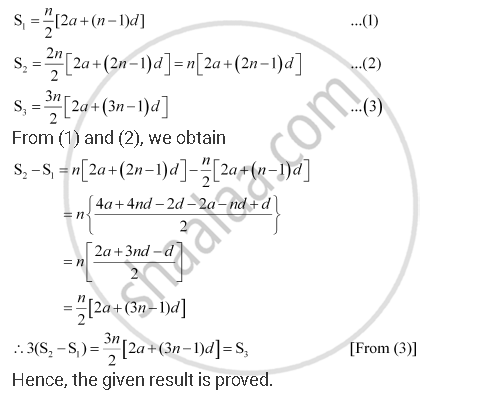
Let the sum of n, 2n, 3n terms of an A.P. be S1, S2 and S3, respectively, show that S3 = 3 (S2– S1)
Advertisements
उत्तर
Let a and b be the first term and the common difference of the A.P. respectively.
Therefore,
संबंधित प्रश्न
Find the sum of all natural numbers lying between 100 and 1000, which are multiples of 5.
The sums of n terms of two arithmetic progressions are in the ratio 5n + 4: 9n + 6. Find the ratio of their 18th terms
Find the sum of all two digit numbers which when divided by 4, yields 1 as remainder.
Find:
10th term of the A.P. 1, 4, 7, 10, ...
Which term of the sequence 24, \[23\frac{1}{4,} 22\frac{1}{2,} 21\frac{3}{4}\]....... is the first negative term?
The first term of an A.P. is 5, the common difference is 3 and the last term is 80; find the number of terms.
If the nth term of the A.P. 9, 7, 5, ... is same as the nth term of the A.P. 15, 12, 9, ... find n.
Find the 12th term from the following arithmetic progression:
3, 8, 13, ..., 253
The 4th term of an A.P. is three times the first and the 7th term exceeds twice the third term by 1. Find the first term and the common difference.
The sum of 4th and 8th terms of an A.P. is 24 and the sum of the 6th and 10th terms is 34. Find the first term and the common difference of the A.P.
The angles of a quadrilateral are in A.P. whose common difference is 10°. Find the angles.
Find the sum of the following arithmetic progression :
50, 46, 42, ... to 10 terms
Find the sum of the following arithmetic progression :
a + b, a − b, a − 3b, ... to 22 terms
Find the sum of the following arithmetic progression :
\[\frac{x - y}{x + y}, \frac{3x - 2y}{x + y}, \frac{5x - 3y}{x + y}\], ... to n terms.
Find the sum of the following serie:
101 + 99 + 97 + ... + 47
The number of terms of an A.P. is even; the sum of odd terms is 24, of the even terms is 30, and the last term exceeds the first by \[10 \frac{1}{2}\] , find the number of terms and the series.
Find the sum of all two digit numbers which when divided by 4, yields 1 as remainder.
How many terms of the A.P. −6, \[- \frac{11}{2}\], −5, ... are needed to give the sum −25?
If S1 be the sum of (2n + 1) terms of an A.P. and S2 be the sum of its odd terms, then prove that: S1 : S2 = (2n + 1) : (n + 1).
If a, b, c is in A.P., prove that:
a2 + c2 + 4ac = 2 (ab + bc + ca)
If \[a\left( \frac{1}{b} + \frac{1}{c} \right), b\left( \frac{1}{c} + \frac{1}{a} \right), c\left( \frac{1}{a} + \frac{1}{b} \right)\] are in A.P., prove that a, b, c are in A.P.
If the sums of n terms of two arithmetic progressions are in the ratio 2n + 5 : 3n + 4, then write the ratio of their m th terms.
Write the sum of first n even natural numbers.
If m th term of an A.P. is n and nth term is m, then write its pth term.
If 7th and 13th terms of an A.P. be 34 and 64 respectively, then its 18th term is
In n A.M.'s are introduced between 3 and 17 such that the ratio of the last mean to the first mean is 3 : 1, then the value of n is
If Sn denotes the sum of first n terms of an A.P. < an > such that
Mark the correct alternative in the following question:
If in an A.P., the pth term is q and (p + q)th term is zero, then the qth term is
The first term of an A.P. is a, the second term is b and the last term is c. Show that the sum of the A.P. is `((b + c - 2a)(c + a))/(2(b - a))`.
If the sum of m terms of an A.P. is equal to the sum of either the next n terms or the next p terms, then prove that `(m + n) (1/m - 1/p) = (m + p) (1/m - 1/n)`
The first term of an A.P.is a, and the sum of the first p terms is zero, show that the sum of its next q terms is `(-a(p + q)q)/(p - 1)`
The sum of terms equidistant from the beginning and end in an A.P. is equal to ______.
The sum of n terms of an AP is 3n2 + 5n. The number of term which equals 164 is ______.
If b2, a2, c2 are in A.P., then `1/(a + b), 1/(b + c), 1/(c + a)` will be in ______
The internal angles of a convex polygon are in A.P. The smallest angle is 120° and the common difference is 5°. The number to sides of the polygon is ______.
What is the general form of an A.P. with first term \(a\) and common difference \(d\)?
