Advertisements
Advertisements
प्रश्न
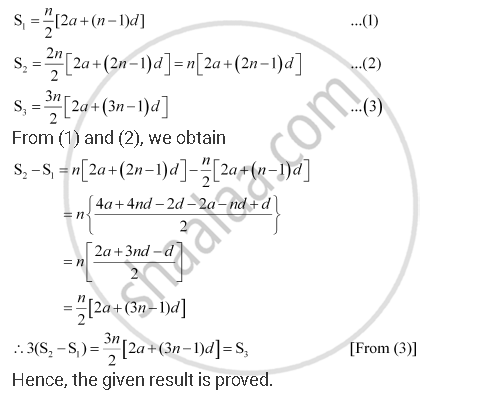
Let the sum of n, 2n, 3n terms of an A.P. be S1, S2 and S3, respectively, show that S3 = 3 (S2– S1)
Advertisements
उत्तर
Let a and b be the first term and the common difference of the A.P. respectively.
Therefore,
संबंधित प्रश्न
Find the sum of all natural numbers lying between 100 and 1000, which are multiples of 5.
Find the sum to n terms of the A.P., whose kth term is 5k + 1.
If the sum of first p terms of an A.P. is equal to the sum of the first q terms, then find the sum of the first (p + q) terms.
If the sum of n terms of an A.P. is 3n2 + 5n and its mth term is 164, find the value of m.
Show that the sum of (m + n)th and (m – n)th terms of an A.P. is equal to twice the mth term.
The sum of the first four terms of an A.P. is 56. The sum of the last four terms is 112. If its first term is 11, then find the number of terms.
A man deposited Rs 10000 in a bank at the rate of 5% simple interest annually. Find the amount in 15th year since he deposited the amount and also calculate the total amount after 20 years.
Let < an > be a sequence. Write the first five term in the following:
a1 = a2 = 2, an = an − 1 − 1, n > 2
The Fibonacci sequence is defined by a1 = 1 = a2, an = an − 1 + an − 2 for n > 2
Find `(""^an +1)/(""^an")` for n = 1, 2, 3, 4, 5.
The nth term of a sequence is given by an = 2n2 + n + 1. Show that it is not an A.P.
If the sequence < an > is an A.P., show that am +n +am − n = 2am.
Which term of the A.P. 4, 9, 14, ... is 254?
If 10 times the 10th term of an A.P. is equal to 15 times the 15th term, show that 25th term of the A.P. is zero.
The 10th and 18th terms of an A.P. are 41 and 73 respectively. Find 26th term.
Find the second term and nth term of an A.P. whose 6th term is 12 and the 8th term is 22.
How many numbers are there between 1 and 1000 which when divided by 7 leave remainder 4?
\[\text { If } \theta_1 , \theta_2 , \theta_3 , . . . , \theta_n \text { are in AP, whose common difference is d, then show that }\]
\[\sec \theta_1 \sec \theta_2 + \sec \theta_2 \sec \theta_3 + . . . + \sec \theta_{n - 1} \sec \theta_n = \frac{\tan \theta_n - \tan \theta_1}{\sin d} \left[ NCERT \hspace{0.167em} EXEMPLAR \right]\]
Find the sum of the following serie:
(a − b)2 + (a2 + b2) + (a + b)2 + ... + [(a + b)2 + 6ab]
If the 5th and 12th terms of an A.P. are 30 and 65 respectively, what is the sum of first 20 terms?
Find the sum of n terms of the A.P. whose kth terms is 5k + 1.
Find the sum of all two digit numbers which when divided by 4, yields 1 as remainder.
Find an A.P. in which the sum of any number of terms is always three times the squared number of these terms.
If a, b, c is in A.P., prove that:
(a − c)2 = 4 (a − b) (b − c)
A man saved Rs 16500 in ten years. In each year after the first he saved Rs 100 more than he did in the receding year. How much did he save in the first year?
A man saves Rs 32 during the first year. Rs 36 in the second year and in this way he increases his savings by Rs 4 every year. Find in what time his saving will be Rs 200.
A man arranges to pay off a debt of Rs 3600 by 40 annual instalments which form an arithmetic series. When 30 of the instalments are paid, he dies leaving one-third of the debt unpaid, find the value of the first instalment.
A manufacturer of radio sets produced 600 units in the third year and 700 units in the seventh year. Assuming that the product increases uniformly by a fixed number every year, find (i) the production in the first year (ii) the total product in 7 years and (iii) the product in the 10th year.
A man saved ₹66000 in 20 years. In each succeeding year after the first year he saved ₹200 more than what he saved in the previous year. How much did he save in the first year?
If the sum of n terms of an AP is 2n2 + 3n, then write its nth term.
Write the sum of first n even natural numbers.
If a1, a2, a3, .... an are in A.P. with common difference d, then the sum of the series sin d [sec a1 sec a2 + sec a2 sec a3 + .... + sec an − 1 sec an], is
Mark the correct alternative in the following question:
\[\text { If in an A . P } . S_n = n^2 q \text { and } S_m = m^2 q, \text { where } S_r \text{ denotes the sum of r terms of the A . P . , then }S_q \text { equals }\]
If second, third and sixth terms of an A.P. are consecutive terms of a G.P., write the common ratio of the G.P.
If a, b, c are in A.P. and x, y, z are in G.P., then the value of xb − c yc − a za − b is
The first three of four given numbers are in G.P. and their last three are in A.P. with common difference 6. If first and fourth numbers are equal, then the first number is
If a, b, c are in G.P. and a1/x = b1/y = c1/z, then xyz are in
If there are (2n + 1) terms in an A.P., then prove that the ratio of the sum of odd terms and the sum of even terms is (n + 1) : n
If the sum of m terms of an A.P. is equal to the sum of either the next n terms or the next p terms, then prove that `(m + n) (1/m - 1/p) = (m + p) (1/m - 1/n)`
If a1, a2, ..., an are in A.P. with common difference d (where d ≠ 0); then the sum of the series sin d (cosec a1 cosec a2 + cosec a2 cosec a3 + ...+ cosec an–1 cosec an) is equal to cot a1 – cot an
