Advertisements
Advertisements
प्रश्न
If the sum of a certain number of terms of the A.P. 25, 22, 19, … is 116. Find the last term
Advertisements
उत्तर १
Let the sum of n terms of the given A.P. be 116.
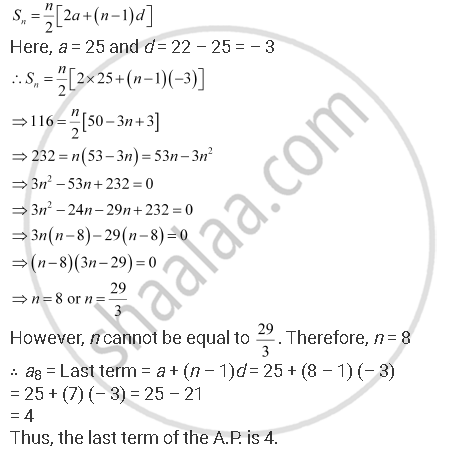
उत्तर २
In the given problem, we have the sum of the certain number of terms of an A.P. and we need to find the last term for that A.P.
So here, let us first find the number of terms whose sum is 116. For that, we will use the formula,
`S_n = n/2[2a+ (n-1)d]`
Where; a = first term for the given A.P.
d = common difference of the given A.P.
n = number of terms
So for the given A.P (25, 22, 19, .....)
The first term (a) = 25
The sum of n terms `S_n = 116`
Common difference of the A.P (d) = `a_2 - a_1`
= 22 - 25
= -3
So, on substituting the values in the formula for the sum of n terms of A.P. we get
`116 = n/2 [2(25) + (n - 1)(-3)]`
`116 = (n/2)[50 + (-3n + 3)]`
`116 = (n/2) [53 - 3n]`
`(116)(2) = 53n - 3n^2`
So, we get the following quadratic equation,
`3n^2 - 53n + 232 = 0`
On solving by splitting the middle term,we get
`3n^2 - 24n - 29n + 232 = 0`
3n(n - 8) - 29(n - 8) = 0
(3n - 29)(n - 8) = 0
Further
3n - 29 = 0
`n = 29/3`
Also
n - 8 = 0
Now since n cannot be a fraction, so the number of terms is a8
`a_8 = a_1 + 7d`
= 25 + 7(-3)
= 25 - 21
= 4
Therefore the last term of the given A.P such that the sum of terms is 116 is 4
संबंधित प्रश्न
If the sum of n terms of an A.P. is 3n2 + 5n and its mth term is 164, find the value of m.
Between 1 and 31, m numbers have been inserted in such a way that the resulting sequence is an A.P. and the ratio of 7th and (m – 1)th numbers is 5:9. Find the value of m.
A sequence is defined by an = n3 − 6n2 + 11n − 6, n ϵ N. Show that the first three terms of the sequence are zero and all other terms are positive.
The nth term of a sequence is given by an = 2n2 + n + 1. Show that it is not an A.P.
Find:
nth term of the A.P. 13, 8, 3, −2, ...
Which term of the A.P. 84, 80, 76,... is 0?
The first term of an A.P. is 5, the common difference is 3 and the last term is 80; find the number of terms.
In a certain A.P. the 24th term is twice the 10th term. Prove that the 72nd term is twice the 34th term.
Three numbers are in A.P. If the sum of these numbers be 27 and the product 648, find the numbers.
The sum of three numbers in A.P. is 12 and the sum of their cubes is 288. Find the numbers.
Find the sum of the following arithmetic progression :
41, 36, 31, ... to 12 terms
Find the sum of the following arithmetic progression :
\[\frac{x - y}{x + y}, \frac{3x - 2y}{x + y}, \frac{5x - 3y}{x + y}\], ... to n terms.
Find the sum of the following serie:
(a − b)2 + (a2 + b2) + (a + b)2 + ... + [(a + b)2 + 6ab]
Find the sum of all natural numbers between 1 and 100, which are divisible by 2 or 5.
Find the sum of all integers between 100 and 550, which are divisible by 9.
If Sn = n2 p and Sm = m2 p, m ≠ n, in an A.P., prove that Sp = p3.
If the sum of a certain number of terms of the AP 25, 22, 19, ... is 116. Find the last term.
Find an A.P. in which the sum of any number of terms is always three times the squared number of these terms.
If a, b, c is in A.P., prove that:
a2 + c2 + 4ac = 2 (ab + bc + ca)
Insert five numbers between 8 and 26 such that the resulting sequence is an A.P.
Shamshad Ali buys a scooter for Rs 22000. He pays Rs 4000 cash and agrees to pay the balance in annual instalments of Rs 1000 plus 10% interest on the unpaid amount. How much the scooter will cost him.
A man starts repaying a loan as first instalment of Rs 100 = 00. If he increases the instalments by Rs 5 every month, what amount he will pay in the 30th instalment?
A carpenter was hired to build 192 window frames. The first day he made five frames and each day thereafter he made two more frames than he made the day before. How many days did it take him to finish the job?
If log 2, log (2x − 1) and log (2x + 3) are in A.P., write the value of x.
Write the value of n for which n th terms of the A.P.s 3, 10, 17, ... and 63, 65, 67, .... are equal.
If the sums of n terms of two AP.'s are in the ratio (3n + 2) : (2n + 3), then find the ratio of their 12th terms.
If 7th and 13th terms of an A.P. be 34 and 64 respectively, then its 18th term is
If the sum of n terms of an A.P. be 3 n2 − n and its common difference is 6, then its first term is
Sum of all two digit numbers which when divided by 4 yield unity as remainder is
The first and last terms of an A.P. are 1 and 11. If the sum of its terms is 36, then the number of terms will be
If a1, a2, a3, .... an are in A.P. with common difference d, then the sum of the series sin d [sec a1 sec a2 + sec a2 sec a3 + .... + sec an − 1 sec an], is
If n arithmetic means are inserted between 1 and 31 such that the ratio of the first mean and nth mean is 3 : 29, then the value of n is
If there are (2n + 1) terms in an A.P., then prove that the ratio of the sum of odd terms and the sum of even terms is (n + 1) : n
If a1, a2, ..., an are in A.P. with common difference d (where d ≠ 0); then the sum of the series sin d (cosec a1 cosec a2 + cosec a2 cosec a3 + ...+ cosec an–1 cosec an) is equal to cot a1 – cot an
Let Sn denote the sum of the first n terms of an A.P. If S2n = 3Sn then S3n: Sn is equal to ______.
If a1, a2, a3, .......... are an A.P. such that a1 + a5 + a10 + a15 + a20 + a24 = 225, then a1 + a2 + a3 + ...... + a23 + a24 is equal to ______.
If 100 times the 100th term of an A.P. with non zero common difference equals the 50 times its 50th term, then the 150th term of this A.P. is ______.
The number of terms in an A.P. is even; the sum of the odd terms in lt is 24 and that the even terms is 30. If the last term exceeds the first term by `10 1/2`, then the number of terms in the A.P. is ______.
Which of the following best defines an Arithmetic Progression (A.P.)?
