Advertisements
Advertisements
प्रश्न
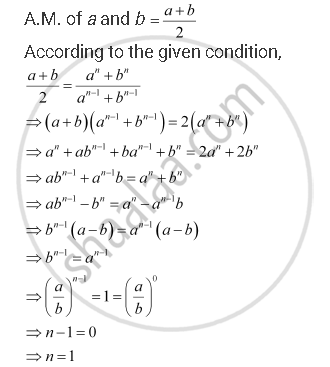
if `(a^n + b^n)/(a^(n-1) + b^(n-1))` is the A.M. between a and b, then find the value of n.
Advertisements
उत्तर
संबंधित प्रश्न
If the sum of n terms of an A.P. is (pn + qn2), where p and q are constants, find the common difference.
If the sum of first p terms of an A.P. is equal to the sum of the first q terms, then find the sum of the first (p + q) terms.
Sum of the first p, q and r terms of an A.P. are a, b and c, respectively.
Prove that `a/p (q - r) + b/q (r- p) + c/r (p - q) = 0`
How many terms are there in the A.P. 7, 10, 13, ... 43 ?
The 6th and 17th terms of an A.P. are 19 and 41 respectively, find the 40th term.
If 9th term of an A.P. is zero, prove that its 29th term is double the 19th term.
If the nth term of the A.P. 9, 7, 5, ... is same as the nth term of the A.P. 15, 12, 9, ... find n.
The sum of 4th and 8th terms of an A.P. is 24 and the sum of the 6th and 10th terms is 34. Find the first term and the common difference of the A.P.
The sum of three numbers in A.P. is 12 and the sum of their cubes is 288. Find the numbers.
Find the sum of the following arithmetic progression :
50, 46, 42, ... to 10 terms
Find the sum of the following arithmetic progression :
3, 9/2, 6, 15/2, ... to 25 terms
Find the sum of the following arithmetic progression :
a + b, a − b, a − 3b, ... to 22 terms
Find the sum of first n natural numbers.
Find the sum of all odd numbers between 100 and 200.
Find the sum of all integers between 84 and 719, which are multiples of 5.
Find the sum of all even integers between 101 and 999.
Find the sum of all those integers between 100 and 800 each of which on division by 16 leaves the remainder 7.
Solve:
1 + 4 + 7 + 10 + ... + x = 590.
The first term of an A.P. is 2 and the last term is 50. The sum of all these terms is 442. Find the common difference.
If 12th term of an A.P. is −13 and the sum of the first four terms is 24, what is the sum of first 10 terms?
If S1 be the sum of (2n + 1) terms of an A.P. and S2 be the sum of its odd terms, then prove that: S1 : S2 = (2n + 1) : (n + 1).
The sums of n terms of two arithmetic progressions are in the ratio 5n + 4 : 9n + 6. Find the ratio of their 18th terms.
If \[\frac{1}{a}, \frac{1}{b}, \frac{1}{c}\] are in A.P., prove that:
\[\frac{b + c}{a}, \frac{c + a}{b}, \frac{a + b}{c}\] are in A.P.
If a, b, c is in A.P., then show that:
a2 (b + c), b2 (c + a), c2 (a + b) are also in A.P.
A carpenter was hired to build 192 window frames. The first day he made five frames and each day thereafter he made two more frames than he made the day before. How many days did it take him to finish the job?
We know that the sum of the interior angles of a triangle is 180°. Show that the sums of the interior angles of polygons with 3, 4, 5, 6, ... sides form an arithmetic progression. Find the sum of the interior angles for a 21 sided polygon.
Write the common difference of an A.P. the sum of whose first n terms is
If the sums of n terms of two AP.'s are in the ratio (3n + 2) : (2n + 3), then find the ratio of their 12th terms.
In n A.M.'s are introduced between 3 and 17 such that the ratio of the last mean to the first mean is 3 : 1, then the value of n is
If n arithmetic means are inserted between 1 and 31 such that the ratio of the first mean and nth mean is 3 : 29, then the value of n is
The first and last term of an A.P. are a and l respectively. If S is the sum of all the terms of the A.P. and the common difference is given by \[\frac{l^2 - a^2}{k - (l + a)}\] , then k =
If second, third and sixth terms of an A.P. are consecutive terms of a G.P., write the common ratio of the G.P.
If the sum of m terms of an A.P. is equal to the sum of either the next n terms or the next p terms, then prove that `(m + n) (1/m - 1/p) = (m + p) (1/m - 1/n)`
The first term of an A.P.is a, and the sum of the first p terms is zero, show that the sum of its next q terms is `(-a(p + q)q)/(p - 1)`
Find the rth term of an A.P. sum of whose first n terms is 2n + 3n2
If you save ₹500 in the first month, ₹700 in the second month, ₹900 in the third month, and so on, what is the common difference of the A.P. \(500, 700, 900, 1100, \ldots\)?
