Advertisements
Advertisements
प्रश्न
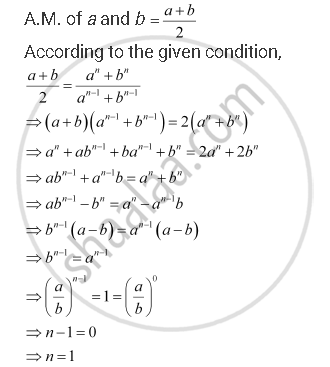
if `(a^n + b^n)/(a^(n-1) + b^(n-1))` is the A.M. between a and b, then find the value of n.
Advertisements
उत्तर
संबंधित प्रश्न
How many terms of the A.P. -6 , `-11/2` , -5... are needed to give the sum –25?
Find the sum to n terms of the A.P., whose kth term is 5k + 1.
If the sum of first p terms of an A.P. is equal to the sum of the first q terms, then find the sum of the first (p + q) terms.
If the sum of n terms of an A.P. is 3n2 + 5n and its mth term is 164, find the value of m.
Between 1 and 31, m numbers have been inserted in such a way that the resulting sequence is an A.P. and the ratio of 7th and (m – 1)th numbers is 5:9. Find the value of m.
Find the sum of integers from 1 to 100 that are divisible by 2 or 5.
Let < an > be a sequence. Write the first five term in the following:
a1 = 1 = a2, an = an − 1 + an − 2, n > 2
Let < an > be a sequence. Write the first five term in the following:
a1 = a2 = 2, an = an − 1 − 1, n > 2
Show that the following sequence is an A.P. Also find the common difference and write 3 more terms in case.
\[\sqrt{2}, 3\sqrt{2}, 5\sqrt{2}, 7\sqrt{2}, . . .\]
Find:
10th term of the A.P. 1, 4, 7, 10, ...
If the sequence < an > is an A.P., show that am +n +am − n = 2am.
Which term of the A.P. 4, 9, 14, ... is 254?
How many terms are there in the A.P.\[- 1, - \frac{5}{6}, -\frac{2}{3}, - \frac{1}{2}, . . . , \frac{10}{3}?\]
How many numbers of two digit are divisible by 3?
An A.P. consists of 60 terms. If the first and the last terms be 7 and 125 respectively, find 32nd term.
The first and the last terms of an A.P. are a and l respectively. Show that the sum of nthterm from the beginning and nth term from the end is a + l.
The angles of a quadrilateral are in A.P. whose common difference is 10°. Find the angles.
Find the sum of the series:
3 + 5 + 7 + 6 + 9 + 12 + 9 + 13 + 17 + ... to 3n terms.
If S1 be the sum of (2n + 1) terms of an A.P. and S2 be the sum of its odd terms, then prove that: S1 : S2 = (2n + 1) : (n + 1).
If the sum of n terms of an A.P. is nP + \[\frac{1}{2}\] n (n − 1) Q, where P and Q are constants, find the common difference.
If a, b, c is in A.P., then show that:
a2 (b + c), b2 (c + a), c2 (a + b) are also in A.P.
If \[\frac{b + c}{a}, \frac{c + a}{b}, \frac{a + b}{c}\] are in A.P., prove that:
bc, ca, ab are in A.P.
If a, b, c is in A.P., prove that:
(a − c)2 = 4 (a − b) (b − c)
If a, b, c is in A.P., prove that:
a2 + c2 + 4ac = 2 (ab + bc + ca)
Shamshad Ali buys a scooter for Rs 22000. He pays Rs 4000 cash and agrees to pay the balance in annual instalments of Rs 1000 plus 10% interest on the unpaid amount. How much the scooter will cost him.
In a cricket team tournament 16 teams participated. A sum of ₹8000 is to be awarded among themselves as prize money. If the last place team is awarded ₹275 in prize money and the award increases by the same amount for successive finishing places, then how much amount will the first place team receive?
Write the common difference of an A.P. the sum of whose first n terms is
If the sum of n terms of an AP is 2n2 + 3n, then write its nth term.
Write the value of n for which n th terms of the A.P.s 3, 10, 17, ... and 63, 65, 67, .... are equal.
If the sums of n terms of two AP.'s are in the ratio (3n + 2) : (2n + 3), then find the ratio of their 12th terms.
If the sum of first n even natural numbers is equal to k times the sum of first n odd natural numbers, then k =
If the first, second and last term of an A.P are a, b and 2a respectively, then its sum is
Mark the correct alternative in the following question:
Let Sn denote the sum of first n terms of an A.P. If S2n = 3Sn, then S3n : Sn is equal to
If a, b, c are in A.P. and x, y, z are in G.P., then the value of xb − c yc − a za − b is
If a, b, c are in G.P. and a1/x = b1/y = c1/z, then xyz are in
Let Sn denote the sum of the first n terms of an A.P. If S2n = 3Sn then S3n: Sn is equal to ______.
Let 3, 6, 9, 12 ....... upto 78 terms and 5, 9, 13, 17 ...... upto 59 be two series. Then, the sum of the terms common to both the series is equal to ______.
For an A.P. with first term \(a\) and common difference \(d\), the common difference is computed as:
Which type of A.P. is represented by the sequence \(2, 5, 8, 11, \ldots\)?
A sequence \(20, 17, 14, 11, \ldots\) is classified as:
