Advertisements
Advertisements
प्रश्न
Find the sum of integers from 1 to 100 that are divisible by 2 or 5.
Advertisements
उत्तर
The integers from 1 to 100, which are divisible by 2, are 2, 4, 6… 100.
This forms an A.P. with both the first term and common difference equal to 2.
⇒100 = 2 + (n –1) 2
⇒ n = 50
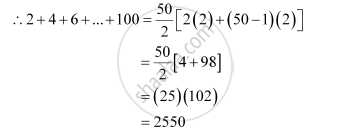
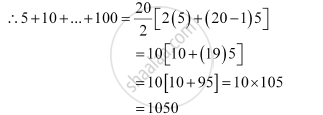
The integers from 1 to 100, which are divisible by 5, are 5, 10… 100.
This forms an A.P. with both the first term and common difference equal to 5.
∴100 = 5 + (n –1) 5
⇒ 5n = 100
⇒ n = 20
The integers, which are divisible by both 2 and 5, are 10, 20, … 100.
This also forms an A.P. with both the first term and common difference equal to 10.
∴100 = 10 + (n –1) (10)
⇒ 100 = 10n
⇒ n = 10

∴Required sum = 2550 + 1050 – 550 = 3050
Thus, the sum of the integers from 1 to 100, which are divisible by 2 or 5, is 3050.
संबंधित प्रश्न
If the sum of n terms of an A.P. is 3n2 + 5n and its mth term is 164, find the value of m.
Insert five numbers between 8 and 26 such that the resulting sequence is an A.P.
Between 1 and 31, m numbers have been inserted in such a way that the resulting sequence is an A.P. and the ratio of 7th and (m – 1)th numbers is 5:9. Find the value of m.
Show that the sum of (m + n)th and (m – n)th terms of an A.P. is equal to twice the mth term.
A man deposited Rs 10000 in a bank at the rate of 5% simple interest annually. Find the amount in 15th year since he deposited the amount and also calculate the total amount after 20 years.
Let < an > be a sequence. Write the first five term in the following:
a1 = 1, an = an − 1 + 2, n ≥ 2
If 10 times the 10th term of an A.P. is equal to 15 times the 15th term, show that 25th term of the A.P. is zero.
The sum of 4th and 8th terms of an A.P. is 24 and the sum of the 6th and 10th terms is 34. Find the first term and the common difference of the A.P.
Find the sum of the following arithmetic progression :
3, 9/2, 6, 15/2, ... to 25 terms
Find the sum of the following arithmetic progression :
(x − y)2, (x2 + y2), (x + y)2, ... to n terms
Find the sum of the following serie:
2 + 5 + 8 + ... + 182
Find the sum of all odd numbers between 100 and 200.
Find the sum of all integers between 84 and 719, which are multiples of 5.
Find the r th term of an A.P., the sum of whose first n terms is 3n2 + 2n.
If the sum of n terms of an A.P. is nP + \[\frac{1}{2}\] n (n − 1) Q, where P and Q are constants, find the common difference.
The sums of n terms of two arithmetic progressions are in the ratio 5n + 4 : 9n + 6. Find the ratio of their 18th terms.
If a, b, c is in A.P., then show that:
a2 (b + c), b2 (c + a), c2 (a + b) are also in A.P.
If a, b, c is in A.P., prove that:
(a − c)2 = 4 (a − b) (b − c)
A man saved Rs 16500 in ten years. In each year after the first he saved Rs 100 more than he did in the receding year. How much did he save in the first year?
A man arranges to pay off a debt of Rs 3600 by 40 annual instalments which form an arithmetic series. When 30 of the instalments are paid, he dies leaving one-third of the debt unpaid, find the value of the first instalment.
A man starts repaying a loan as first instalment of Rs 100 = 00. If he increases the instalments by Rs 5 every month, what amount he will pay in the 30th instalment?
A carpenter was hired to build 192 window frames. The first day he made five frames and each day thereafter he made two more frames than he made the day before. How many days did it take him to finish the job?
A man is employed to count Rs 10710. He counts at the rate of Rs 180 per minute for half an hour. After this he counts at the rate of Rs 3 less every minute than the preceding minute. Find the time taken by him to count the entire amount.
Write the common difference of an A.P. whose nth term is xn + y.
If m th term of an A.P. is n and nth term is m, then write its pth term.
In n A.M.'s are introduced between 3 and 17 such that the ratio of the last mean to the first mean is 3 : 1, then the value of n is
The first and last terms of an A.P. are 1 and 11. If the sum of its terms is 36, then the number of terms will be
Mark the correct alternative in the following question:
If in an A.P., the pth term is q and (p + q)th term is zero, then the qth term is
Mark the correct alternative in the following question:
\[\text { If in an A . P } . S_n = n^2 q \text { and } S_m = m^2 q, \text { where } S_r \text{ denotes the sum of r terms of the A . P . , then }S_q \text { equals }\]
Mark the correct alternative in the following question:
Let Sn denote the sum of first n terms of an A.P. If S2n = 3Sn, then S3n : Sn is equal to
Show that (x2 + xy + y2), (z2 + xz + x2) and (y2 + yz + z2) are consecutive terms of an A.P., if x, y and z are in A.P.
If a1, a2, ..., an are in A.P. with common difference d (where d ≠ 0); then the sum of the series sin d (cosec a1 cosec a2 + cosec a2 cosec a3 + ...+ cosec an–1 cosec an) is equal to cot a1 – cot an
A man saved Rs 66000 in 20 years. In each succeeding year after the first year he saved Rs 200 more than what he saved in the previous year. How much did he save in the first year?
If in an A.P., Sn = qn2 and Sm = qm2, where Sr denotes the sum of r terms of the A.P., then Sq equals ______.
Let Sn denote the sum of the first n terms of an A.P. If S2n = 3Sn then S3n: Sn is equal to ______.
The number of terms in an A.P. is even; the sum of the odd terms in lt is 24 and that the even terms is 30. If the last term exceeds the first term by `10 1/2`, then the number of terms in the A.P. is ______.
A sequence \(20, 17, 14, 11, \ldots\) is classified as:
