Advertisements
Advertisements
Question
Find the sum of integers from 1 to 100 that are divisible by 2 or 5.
Advertisements
Solution
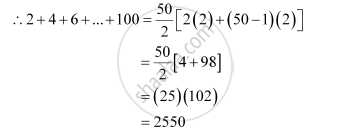
The integers from 1 to 100, which are divisible by 2, are 2, 4, 6… 100.
This forms an A.P. with both the first term and common difference equal to 2.
⇒100 = 2 + (n –1) 2
⇒ n = 50
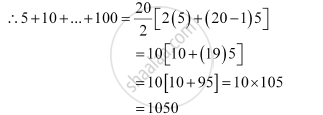
The integers from 1 to 100, which are divisible by 5, are 5, 10… 100.
This forms an A.P. with both the first term and common difference equal to 5.
∴100 = 5 + (n –1) 5
⇒ 5n = 100
⇒ n = 20
The integers, which are divisible by both 2 and 5, are 10, 20, … 100.
This also forms an A.P. with both the first term and common difference equal to 10.
∴100 = 10 + (n –1) (10)
⇒ 100 = 10n
⇒ n = 10

∴Required sum = 2550 + 1050 – 550 = 3050
Thus, the sum of the integers from 1 to 100, which are divisible by 2 or 5, is 3050.
RELATED QUESTIONS
Find the sum to n terms of the A.P., whose kth term is 5k + 1.
If the sum of n terms of an A.P. is (pn + qn2), where p and q are constants, find the common difference.
Sum of the first p, q and r terms of an A.P. are a, b and c, respectively.
Prove that `a/p (q - r) + b/q (r- p) + c/r (p - q) = 0`
If the sum of three numbers in A.P., is 24 and their product is 440, find the numbers.
Find the sum of all two digit numbers which when divided by 4, yields 1 as remainder.
Let < an > be a sequence defined by a1 = 3 and, an = 3an − 1 + 2, for all n > 1
Find the first four terms of the sequence.
Show that the following sequence is an A.P. Also find the common difference and write 3 more terms in case.
\[\sqrt{2}, 3\sqrt{2}, 5\sqrt{2}, 7\sqrt{2}, . . .\]
Is 302 a term of the A.P. 3, 8, 13, ...?
The 6th and 17th terms of an A.P. are 19 and 41 respectively, find the 40th term.
If 10 times the 10th term of an A.P. is equal to 15 times the 15th term, show that 25th term of the A.P. is zero.
Find the second term and nth term of an A.P. whose 6th term is 12 and the 8th term is 22.
The sum of 4th and 8th terms of an A.P. is 24 and the sum of the 6th and 10th terms is 34. Find the first term and the common difference of the A.P.
\[\text { If } \theta_1 , \theta_2 , \theta_3 , . . . , \theta_n \text { are in AP, whose common difference is d, then show that }\]
\[\sec \theta_1 \sec \theta_2 + \sec \theta_2 \sec \theta_3 + . . . + \sec \theta_{n - 1} \sec \theta_n = \frac{\tan \theta_n - \tan \theta_1}{\sin d} \left[ NCERT \hspace{0.167em} EXEMPLAR \right]\]
Find the sum of the following arithmetic progression :
3, 9/2, 6, 15/2, ... to 25 terms
Find the sum of the following arithmetic progression :
a + b, a − b, a − 3b, ... to 22 terms
Find the sum of the following arithmetic progression :
(x − y)2, (x2 + y2), (x + y)2, ... to n terms
Find the sum of all those integers between 100 and 800 each of which on division by 16 leaves the remainder 7.
Solve:
25 + 22 + 19 + 16 + ... + x = 115
The third term of an A.P. is 7 and the seventh term exceeds three times the third term by 2. Find the first term, the common difference and the sum of first 20 terms.
The first term of an A.P. is 2 and the last term is 50. The sum of all these terms is 442. Find the common difference.
How many terms of the A.P. −6, \[- \frac{11}{2}\], −5, ... are needed to give the sum −25?
If \[\frac{1}{a}, \frac{1}{b}, \frac{1}{c}\] are in A.P., prove that:
\[\frac{b + c}{a}, \frac{c + a}{b}, \frac{a + b}{c}\] are in A.P.
If a, b, c is in A.P., then show that:
a2 (b + c), b2 (c + a), c2 (a + b) are also in A.P.
If \[\frac{b + c}{a}, \frac{c + a}{b}, \frac{a + b}{c}\] are in A.P., prove that:
\[\frac{1}{a}, \frac{1}{b}, \frac{1}{c}\] are in A.P.
If a, b, c is in A.P., prove that:
a3 + c3 + 6abc = 8b3.
In a cricket team tournament 16 teams participated. A sum of ₹8000 is to be awarded among themselves as prize money. If the last place team is awarded ₹275 in prize money and the award increases by the same amount for successive finishing places, then how much amount will the first place team receive?
If log 2, log (2x − 1) and log (2x + 3) are in A.P., write the value of x.
If the sums of n terms of two AP.'s are in the ratio (3n + 2) : (2n + 3), then find the ratio of their 12th terms.
Sum of all two digit numbers which when divided by 4 yield unity as remainder is
If four numbers in A.P. are such that their sum is 50 and the greatest number is 4 times the least, then the numbers are
If the sum of m terms of an A.P. is equal to the sum of either the next n terms or the next p terms, then prove that `(m + n) (1/m - 1/p) = (m + p) (1/m - 1/n)`
If the sum of n terms of a sequence is quadratic expression then it always represents an A.P
If the ratio of the sum of n terms of two APs is 2n:(n + 1), then the ratio of their 8th terms is ______.
If n AM's are inserted between 1 and 31 and ratio of 7th and (n – 1)th A.M. is 5:9, then n equals ______.
The sum of n terms of an AP is 3n2 + 5n. The number of term which equals 164 is ______.
If a1, a2, a3, .......... are an A.P. such that a1 + a5 + a10 + a15 + a20 + a24 = 225, then a1 + a2 + a3 + ...... + a23 + a24 is equal to ______.
If the first term of an A.P. is 3 and the sum of its first 25 terms is equal to the sum of its next 15 terms, then the common difference of this A.P. is ______.
