Advertisements
Advertisements
Question
Find the sum of all natural numbers lying between 100 and 1000, which are multiples of 5.
Advertisements
Solution
The natural numbers lying between 100 and 1000, which are multiples of 5, are 105, 110, … 995.
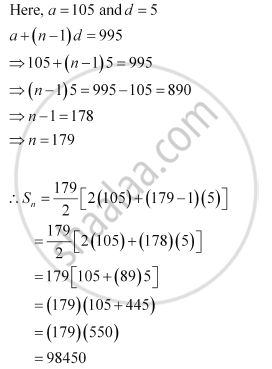
Thus, the sum of all natural numbers lying between 100 and 1000, which are multiples of 5, is 98450.
RELATED QUESTIONS
How many terms of the A.P. -6 , `-11/2` , -5... are needed to give the sum –25?
The ratio of the sums of m and n terms of an A.P. is m2: n2. Show that the ratio of mth and nthterm is (2m – 1): (2n – 1)
If the sum of n terms of an A.P. is 3n2 + 5n and its mth term is 164, find the value of m.
The pth, qth and rth terms of an A.P. are a, b, c respectively. Show that (q – r )a + (r – p )b + (p – q )c = 0
A person writes a letter to four of his friends. He asks each one of them to copy the letter and mail to four different persons with instruction that they move the chain similarly. Assuming that the chain is not broken and that it costs 50 paise to mail one letter. Find the amount spent on the postage when 8th set of letter is mailed.
Show that the following sequence is an A.P. Also find the common difference and write 3 more terms in case.
−1, 1/4, 3/2, 11/4, ...
Show that the following sequence is an A.P. Also find the common difference and write 3 more terms in case.
\[\sqrt{2}, 3\sqrt{2}, 5\sqrt{2}, 7\sqrt{2}, . . .\]
Show that the following sequence is an A.P. Also find the common difference and write 3 more terms in case.
9, 7, 5, 3, ...
The nth term of a sequence is given by an = 2n + 7. Show that it is an A.P. Also, find its 7th term.
Which term of the A.P. 4, 9, 14, ... is 254?
The sum of 4th and 8th terms of an A.P. is 24 and the sum of the 6th and 10th terms is 34. Find the first term and the common difference of the A.P.
The sum of three numbers in A.P. is 12 and the sum of their cubes is 288. Find the numbers.
Find the sum of the following arithmetic progression :
(x − y)2, (x2 + y2), (x + y)2, ... to n terms
Solve:
25 + 22 + 19 + 16 + ... + x = 115
The third term of an A.P. is 7 and the seventh term exceeds three times the third term by 2. Find the first term, the common difference and the sum of first 20 terms.
If Sn = n2 p and Sm = m2 p, m ≠ n, in an A.P., prove that Sp = p3.
Find the sum of n terms of the A.P. whose kth terms is 5k + 1.
The sums of n terms of two arithmetic progressions are in the ratio 5n + 4 : 9n + 6. Find the ratio of their 18th terms.
The income of a person is Rs 300,000 in the first year and he receives an increase of Rs 10000 to his income per year for the next 19 years. Find the total amount, he received in 20 years.
A man starts repaying a loan as first instalment of Rs 100 = 00. If he increases the instalments by Rs 5 every month, what amount he will pay in the 30th instalment?
If the sums of n terms of two arithmetic progressions are in the ratio 2n + 5 : 3n + 4, then write the ratio of their m th terms.
If the sum of n terms of an A.P. be 3 n2 − n and its common difference is 6, then its first term is
Sum of all two digit numbers which when divided by 4 yield unity as remainder is
If Sn denotes the sum of first n terms of an A.P. < an > such that
The first and last terms of an A.P. are 1 and 11. If the sum of its terms is 36, then the number of terms will be
The first and last term of an A.P. are a and l respectively. If S is the sum of all the terms of the A.P. and the common difference is given by \[\frac{l^2 - a^2}{k - (l + a)}\] , then k =
If the first, second and last term of an A.P are a, b and 2a respectively, then its sum is
If a, b, c are in A.P. and x, y, z are in G.P., then the value of xb − c yc − a za − b is
If there are (2n + 1) terms in an A.P., then prove that the ratio of the sum of odd terms and the sum of even terms is (n + 1) : n
Find the sum of first 24 terms of the A.P. a1, a2, a3, ... if it is known that a1 + a5 + a10 + a15 + a20 + a24 = 225.
Show that (x2 + xy + y2), (z2 + xz + x2) and (y2 + yz + z2) are consecutive terms of an A.P., if x, y and z are in A.P.
In an A.P. the pth term is q and the (p + q)th term is 0. Then the qth term is ______.
The first term of an A.P.is a, and the sum of the first p terms is zero, show that the sum of its next q terms is `(-a(p + q)q)/(p - 1)`
If the sum of n terms of an A.P. is given by Sn = 3n + 2n2, then the common difference of the A.P. is ______.
Let 3, 6, 9, 12 ....... upto 78 terms and 5, 9, 13, 17 ...... upto 59 be two series. Then, the sum of the terms common to both the series is equal to ______.
The number of terms in an A.P. is even; the sum of the odd terms in lt is 24 and that the even terms is 30. If the last term exceeds the first term by `10 1/2`, then the number of terms in the A.P. is ______.
