Advertisements
Advertisements
Question
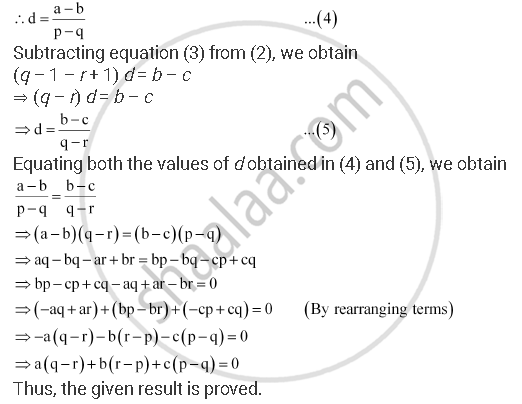
The pth, qth and rth terms of an A.P. are a, b, c respectively. Show that (q – r )a + (r – p )b + (p – q )c = 0
Advertisements
Solution
Let t and d be the first term and the common difference of the A.P. respectively.
The nth term of an A.P. is given by, an = t + (n – 1) d
Therefore,
ap = t + (p – 1) d = a … (1)
aq = t + (q – 1)d = b … (2)
ar = t + (r – 1) d = c … (3)
Subtracting equation (2) from (1), we obtain
(p – 1 – q + 1) d = a – b
⇒ (p – q) d = a – b
RELATED QUESTIONS
Find the sum to n terms of the A.P., whose kth term is 5k + 1.
If the sum of n terms of an A.P. is 3n2 + 5n and its mth term is 164, find the value of m.
Between 1 and 31, m numbers have been inserted in such a way that the resulting sequence is an A.P. and the ratio of 7th and (m – 1)th numbers is 5:9. Find the value of m.
A man deposited Rs 10000 in a bank at the rate of 5% simple interest annually. Find the amount in 15th year since he deposited the amount and also calculate the total amount after 20 years.
Let < an > be a sequence. Write the first five term in the following:
a1 = 1, an = an − 1 + 2, n ≥ 2
Let < an > be a sequence. Write the first five term in the following:
a1 = 1 = a2, an = an − 1 + an − 2, n > 2
Show that the following sequence is an A.P. Also find the common difference and write 3 more terms in case.
\[\sqrt{2}, 3\sqrt{2}, 5\sqrt{2}, 7\sqrt{2}, . . .\]
Which term of the A.P. 84, 80, 76,... is 0?
Which term of the A.P. 4, 9, 14, ... is 254?
Is 302 a term of the A.P. 3, 8, 13, ...?
How many terms are there in the A.P.\[- 1, - \frac{5}{6}, -\frac{2}{3}, - \frac{1}{2}, . . . , \frac{10}{3}?\]
Find the 12th term from the following arithmetic progression:
3, 5, 7, 9, ... 201
The 4th term of an A.P. is three times the first and the 7th term exceeds twice the third term by 1. Find the first term and the common difference.
Find the second term and nth term of an A.P. whose 6th term is 12 and the 8th term is 22.
Three numbers are in A.P. If the sum of these numbers be 27 and the product 648, find the numbers.
Find the four numbers in A.P., whose sum is 50 and in which the greatest number is 4 times the least.
Find the sum of all odd numbers between 100 and 200.
If the sum of a certain number of terms of the AP 25, 22, 19, ... is 116. Find the last term.
Find the sum of odd integers from 1 to 2001.
If \[\frac{b + c}{a}, \frac{c + a}{b}, \frac{a + b}{c}\] are in A.P., prove that:
bc, ca, ab are in A.P.
If a, b, c is in A.P., prove that:
a3 + c3 + 6abc = 8b3.
If \[a\left( \frac{1}{b} + \frac{1}{c} \right), b\left( \frac{1}{c} + \frac{1}{a} \right), c\left( \frac{1}{a} + \frac{1}{b} \right)\] are in A.P., prove that a, b, c are in A.P.
If \[\frac{3 + 5 + 7 + . . . + \text { upto n terms }}{5 + 8 + 11 + . . . . \text { upto 10 terms }}\] 7, then find the value of n.
If the sums of n terms of two AP.'s are in the ratio (3n + 2) : (2n + 3), then find the ratio of their 12th terms.
If n arithmetic means are inserted between 1 and 31 such that the ratio of the first mean and nth mean is 3 : 29, then the value of n is
The first and last term of an A.P. are a and l respectively. If S is the sum of all the terms of the A.P. and the common difference is given by \[\frac{l^2 - a^2}{k - (l + a)}\] , then k =
If in an A.P., Sn = n2p and Sm = m2p, where Sr denotes the sum of r terms of the A.P., then Sp is equal to
Mark the correct alternative in the following question:
If in an A.P., the pth term is q and (p + q)th term is zero, then the qth term is
Mark the correct alternative in the following question:
The 10th common term between the A.P.s 3, 7, 11, 15, ... and 1, 6, 11, 16, ... is
If second, third and sixth terms of an A.P. are consecutive terms of a G.P., write the common ratio of the G.P.
If a, b, c are in A.P. and x, y, z are in G.P., then the value of xb − c yc − a za − b is
The product of three numbers in A.P. is 224, and the largest number is 7 times the smallest. Find the numbers
A man saved Rs 66000 in 20 years. In each succeeding year after the first year he saved Rs 200 more than what he saved in the previous year. How much did he save in the first year?
A man accepts a position with an initial salary of Rs 5200 per month. It is understood that he will receive an automatic increase of Rs 320 in the very next month and each month thereafter. What is his total earnings during the first year?
Any term of an A.P. (except first) is equal to half the sum of terms which are equidistant from it.
