Advertisements
Advertisements
Question
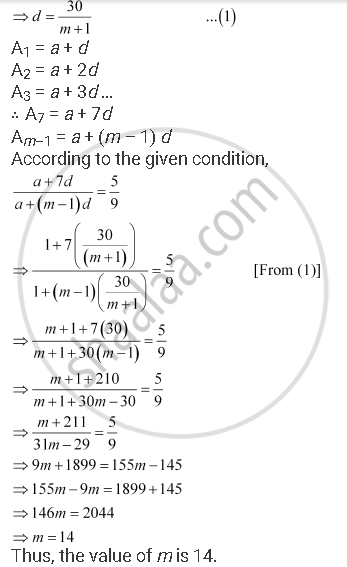
Between 1 and 31, m numbers have been inserted in such a way that the resulting sequence is an A.P. and the ratio of 7th and (m – 1)th numbers is 5:9. Find the value of m.
Advertisements
Solution
Let A1, A2, … Am be m numbers such that 1, A1, A2, … Am, 31 is an A.P.
Here, a = 1, b = 31, n = m + 2
∴ 31 = 1 + (m + 2 – 1) (d)
⇒ 30 = (m + 1) d
RELATED QUESTIONS
Find the sum of odd integers from 1 to 2001.
How many terms of the A.P. -6 , `-11/2` , -5... are needed to give the sum –25?
If the sum of first p terms of an A.P. is equal to the sum of the first q terms, then find the sum of the first (p + q) terms.
Find the sum of all numbers between 200 and 400 which are divisible by 7.
A man deposited Rs 10000 in a bank at the rate of 5% simple interest annually. Find the amount in 15th year since he deposited the amount and also calculate the total amount after 20 years.
A manufacturer reckons that the value of a machine, which costs him Rs 15625, will depreciate each year by 20%. Find the estimated value at the end of 5 years.
Find:
nth term of the A.P. 13, 8, 3, −2, ...
How many terms are there in the A.P. 7, 10, 13, ... 43 ?
How many terms are there in the A.P.\[- 1, - \frac{5}{6}, -\frac{2}{3}, - \frac{1}{2}, . . . , \frac{10}{3}?\]
The 10th and 18th terms of an A.P. are 41 and 73 respectively. Find 26th term.
If the nth term of the A.P. 9, 7, 5, ... is same as the nth term of the A.P. 15, 12, 9, ... find n.
Find the sum of all integers between 84 and 719, which are multiples of 5.
Find the sum of all integers between 100 and 550, which are divisible by 9.
Find the sum of all those integers between 100 and 800 each of which on division by 16 leaves the remainder 7.
Solve:
1 + 4 + 7 + 10 + ... + x = 590.
Find the sum of n terms of the A.P. whose kth terms is 5k + 1.
Find the sum of odd integers from 1 to 2001.
If a2, b2, c2 are in A.P., prove that \[\frac{a}{b + c}, \frac{b}{c + a}, \frac{c}{a + b}\] are in A.P.
If a, b, c is in A.P., prove that:
a2 + c2 + 4ac = 2 (ab + bc + ca)
If x, y, z are in A.P. and A1 is the A.M. of x and y and A2 is the A.M. of y and z, then prove that the A.M. of A1 and A2 is y.
A man starts repaying a loan as first instalment of Rs 100 = 00. If he increases the instalments by Rs 5 every month, what amount he will pay in the 30th instalment?
A man accepts a position with an initial salary of ₹5200 per month. It is understood that he will receive an automatic increase of ₹320 in the very next month and each month thereafter.
(i) Find his salary for the tenth month.
(ii) What is his total earnings during the first year?
A man saved ₹66000 in 20 years. In each succeeding year after the first year he saved ₹200 more than what he saved in the previous year. How much did he save in the first year?
If log 2, log (2x − 1) and log (2x + 3) are in A.P., write the value of x.
Write the value of n for which n th terms of the A.P.s 3, 10, 17, ... and 63, 65, 67, .... are equal.
If the sum of n terms of an A.P. be 3 n2 − n and its common difference is 6, then its first term is
Sum of all two digit numbers which when divided by 4 yield unity as remainder is
In the arithmetic progression whose common difference is non-zero, the sum of first 3 n terms is equal to the sum of next n terms. Then the ratio of the sum of the first 2 n terms to the next 2 nterms is
If the sum of first n even natural numbers is equal to k times the sum of first n odd natural numbers, then k =
If a, b, c are in A.P. and x, y, z are in G.P., then the value of xb − c yc − a za − b is
A man accepts a position with an initial salary of Rs 5200 per month. It is understood that he will receive an automatic increase of Rs 320 in the very next month and each month thereafter. Find his salary for the tenth month
Find the rth term of an A.P. sum of whose first n terms is 2n + 3n2
If 9 times the 9th term of an A.P. is equal to 13 times the 13th term, then the 22nd term of the A.P. is ______.
What is the general form of an A.P. with first term \(a\) and common difference \(d\)?
Which type of A.P. is represented by the sequence \(2, 5, 8, 11, \ldots\)?
If you save ₹500 in the first month, ₹700 in the second month, ₹900 in the third month, and so on, what is the common difference of the A.P. \(500, 700, 900, 1100, \ldots\)?
