Advertisements
Advertisements
Question
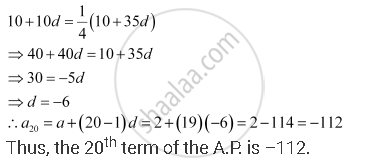
In an A.P, the first term is 2 and the sum of the first five terms is one-fourth of the next five terms. Show that 20th term is –112.
Advertisements
Solution
First term = 2
Let d be the common difference of the A.P.
Therefore, the A.P. is 2, 2 + d, 2 + 2d, 2 + 3d, …
Sum of first five terms = 10 + 10d
Sum of next five terms = 10 + 35d
According to the given condition,
RELATED QUESTIONS
A man starts repaying a loan as first installment of Rs. 100. If he increases the installment by Rs 5 every month, what amount he will pay in the 30th installment?
Show that the sum of (m + n)th and (m – n)th terms of an A.P. is equal to twice the mth term.
The pth, qth and rth terms of an A.P. are a, b, c respectively. Show that (q – r )a + (r – p )b + (p – q )c = 0
A person writes a letter to four of his friends. He asks each one of them to copy the letter and mail to four different persons with instruction that they move the chain similarly. Assuming that the chain is not broken and that it costs 50 paise to mail one letter. Find the amount spent on the postage when 8th set of letter is mailed.
Let < an > be a sequence. Write the first five term in the following:
a1 = a2 = 2, an = an − 1 − 1, n > 2
Find:
10th term of the A.P. 1, 4, 7, 10, ...
Is 68 a term of the A.P. 7, 10, 13, ...?
Which term of the sequence 24, \[23\frac{1}{4,} 22\frac{1}{2,} 21\frac{3}{4}\]....... is the first negative term?
How many terms are there in the A.P. 7, 10, 13, ... 43 ?
The first term of an A.P. is 5, the common difference is 3 and the last term is 80; find the number of terms.
If 9th term of an A.P. is zero, prove that its 29th term is double the 19th term.
The 10th and 18th terms of an A.P. are 41 and 73 respectively. Find 26th term.
An A.P. consists of 60 terms. If the first and the last terms be 7 and 125 respectively, find 32nd term.
The first and the last terms of an A.P. are a and l respectively. Show that the sum of nthterm from the beginning and nth term from the end is a + l.
The angles of a quadrilateral are in A.P. whose common difference is 10°. Find the angles.
Find the sum of the following arithmetic progression :
\[\frac{x - y}{x + y}, \frac{3x - 2y}{x + y}, \frac{5x - 3y}{x + y}\], ... to n terms.
Find the sum of first n odd natural numbers.
Solve:
1 + 4 + 7 + 10 + ... + x = 590.
Find the sum of odd integers from 1 to 2001.
The sums of first n terms of two A.P.'s are in the ratio (7n + 2) : (n + 4). Find the ratio of their 5th terms.
If a2, b2, c2 are in A.P., prove that \[\frac{a}{b + c}, \frac{b}{c + a}, \frac{c}{a + b}\] are in A.P.
If \[a\left( \frac{1}{b} + \frac{1}{c} \right), b\left( \frac{1}{c} + \frac{1}{a} \right), c\left( \frac{1}{a} + \frac{1}{b} \right)\] are in A.P., prove that a, b, c are in A.P.
A manufacturer of radio sets produced 600 units in the third year and 700 units in the seventh year. Assuming that the product increases uniformly by a fixed number every year, find (i) the production in the first year (ii) the total product in 7 years and (iii) the product in the 10th year.
If the sum of n terms of an A.P. be 3 n2 − n and its common difference is 6, then its first term is
The first and last terms of an A.P. are 1 and 11. If the sum of its terms is 36, then the number of terms will be
If four numbers in A.P. are such that their sum is 50 and the greatest number is 4 times the least, then the numbers are
If in an A.P., Sn = n2p and Sm = m2p, where Sr denotes the sum of r terms of the A.P., then Sp is equal to
Mark the correct alternative in the following question:
If in an A.P., the pth term is q and (p + q)th term is zero, then the qth term is
Mark the correct alternative in the following question:
\[\text { If in an A . P } . S_n = n^2 q \text { and } S_m = m^2 q, \text { where } S_r \text{ denotes the sum of r terms of the A . P . , then }S_q \text { equals }\]
If a, b, c are in G.P. and a1/x = b1/y = c1/z, then xyz are in
Any term of an A.P. (except first) is equal to half the sum of terms which are equidistant from it.
If the sum of n terms of a sequence is quadratic expression then it always represents an A.P
The sum of n terms of an AP is 3n2 + 5n. The number of term which equals 164 is ______.
If b2, a2, c2 are in A.P., then `1/(a + b), 1/(b + c), 1/(c + a)` will be in ______
The internal angles of a convex polygon are in A.P. The smallest angle is 120° and the common difference is 5°. The number to sides of the polygon is ______.
For an A.P. with first term \(a\) and common difference \(d\), the common difference is computed as:
What is the general form of an A.P. with first term \(a\) and common difference \(d\)?
If you save ₹500 in the first month, ₹700 in the second month, ₹900 in the third month, and so on, what is the common difference of the A.P. \(500, 700, 900, 1100, \ldots\)?
