Advertisements
Advertisements
प्रश्न
The pth, qth and rth terms of an A.P. are a, b, c respectively. Show that (q – r )a + (r – p )b + (p – q )c = 0
Advertisements
उत्तर
Let t and d be the first term and the common difference of the A.P. respectively.
The nth term of an A.P. is given by, an = t + (n – 1) d
Therefore,
ap = t + (p – 1) d = a … (1)
aq = t + (q – 1)d = b … (2)
ar = t + (r – 1) d = c … (3)
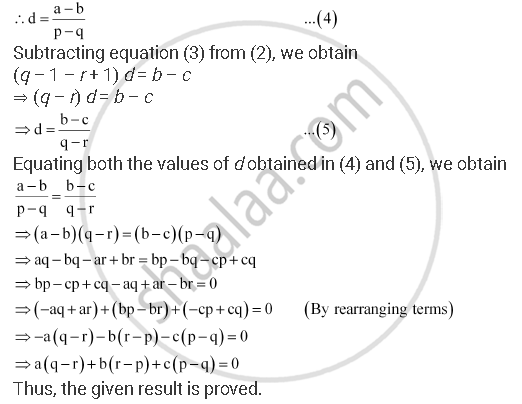
Subtracting equation (2) from (1), we obtain
(p – 1 – q + 1) d = a – b
⇒ (p – q) d = a – b
संबंधित प्रश्न
Find the sum to n terms of the A.P., whose kth term is 5k + 1.
Insert five numbers between 8 and 26 such that the resulting sequence is an A.P.
if `(a^n + b^n)/(a^(n-1) + b^(n-1))` is the A.M. between a and b, then find the value of n.
If the sum of three numbers in A.P., is 24 and their product is 440, find the numbers.
Find the sum of all numbers between 200 and 400 which are divisible by 7.
Let < an > be a sequence. Write the first five term in the following:
a1 = 1, an = an − 1 + 2, n ≥ 2
How many terms are there in the A.P. 7, 10, 13, ... 43 ?
The 6th and 17th terms of an A.P. are 19 and 41 respectively, find the 40th term.
The 10th and 18th terms of an A.P. are 41 and 73 respectively. Find 26th term.
Find the 12th term from the following arithmetic progression:
3, 5, 7, 9, ... 201
Find the four numbers in A.P., whose sum is 50 and in which the greatest number is 4 times the least.
The sum of three numbers in A.P. is 12 and the sum of their cubes is 288. Find the numbers.
Find the sum of the following arithmetic progression :
3, 9/2, 6, 15/2, ... to 25 terms
Find the sum of the following arithmetic progression :
a + b, a − b, a − 3b, ... to 22 terms
Find the sum of the following arithmetic progression :
\[\frac{x - y}{x + y}, \frac{3x - 2y}{x + y}, \frac{5x - 3y}{x + y}\], ... to n terms.
Find the sum of the following serie:
101 + 99 + 97 + ... + 47
Find the sum of first n natural numbers.
Find the sum of all integers between 84 and 719, which are multiples of 5.
Find the sum of all those integers between 100 and 800 each of which on division by 16 leaves the remainder 7.
Solve:
25 + 22 + 19 + 16 + ... + x = 115
The number of terms of an A.P. is even; the sum of odd terms is 24, of the even terms is 30, and the last term exceeds the first by \[10 \frac{1}{2}\] , find the number of terms and the series.
In an A.P. the first term is 2 and the sum of the first five terms is one fourth of the next five terms. Show that 20th term is −112.
If \[\frac{1}{a}, \frac{1}{b}, \frac{1}{c}\] are in A.P., prove that:
a (b +c), b (c + a), c (a +b) are in A.P.
If a, b, c is in A.P., prove that:
(a − c)2 = 4 (a − b) (b − c)
A farmer buys a used tractor for Rs 12000. He pays Rs 6000 cash and agrees to pay the balance in annual instalments of Rs 500 plus 12% interest on the unpaid amount. How much the tractor cost him?
We know that the sum of the interior angles of a triangle is 180°. Show that the sums of the interior angles of polygons with 3, 4, 5, 6, ... sides form an arithmetic progression. Find the sum of the interior angles for a 21 sided polygon.
Write the sum of first n even natural numbers.
If the sums of n terms of two AP.'s are in the ratio (3n + 2) : (2n + 3), then find the ratio of their 12th terms.
If Sn denotes the sum of first n terms of an A.P. < an > such that
Mark the correct alternative in the following question:
The 10th common term between the A.P.s 3, 7, 11, 15, ... and 1, 6, 11, 16, ... is
Mark the correct alternative in the following question:
\[\text { If in an A . P } . S_n = n^2 q \text { and } S_m = m^2 q, \text { where } S_r \text{ denotes the sum of r terms of the A . P . , then }S_q \text { equals }\]
Show that (x2 + xy + y2), (z2 + xz + x2) and (y2 + yz + z2) are consecutive terms of an A.P., if x, y and z are in A.P.
If the sum of m terms of an A.P. is equal to the sum of either the next n terms or the next p terms, then prove that `(m + n) (1/m - 1/p) = (m + p) (1/m - 1/n)`
Find the rth term of an A.P. sum of whose first n terms is 2n + 3n2
Any term of an A.P. (except first) is equal to half the sum of terms which are equidistant from it.
Which of the following best defines an Arithmetic Progression (A.P.)?
Which of the following is an example of a Constant A.P.?
