Advertisements
Advertisements
प्रश्न
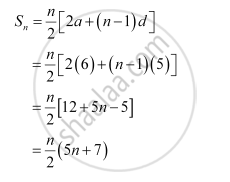
Find the sum to n terms of the A.P., whose kth term is 5k + 1.
Advertisements
उत्तर
It is given that the kth term of the A.P. is 5k + 1.
kth term = ak = a + (k – 1)d
∴ a + (k – 1)d = 5k + 1
a + kd – d = 5k + 1
Comparing the coefficient of k, we obtain d = 5
a – d = 1
⇒ a – 5 = 1
⇒ a = 6
संबंधित प्रश्न
Between 1 and 31, m numbers have been inserted in such a way that the resulting sequence is an A.P. and the ratio of 7th and (m – 1)th numbers is 5:9. Find the value of m.
A man starts repaying a loan as first installment of Rs. 100. If he increases the installment by Rs 5 every month, what amount he will pay in the 30th installment?
Let the sum of n, 2n, 3n terms of an A.P. be S1, S2 and S3, respectively, show that S3 = 3 (S2– S1)
A manufacturer reckons that the value of a machine, which costs him Rs 15625, will depreciate each year by 20%. Find the estimated value at the end of 5 years.
Show that the following sequence is an A.P. Also find the common difference and write 3 more terms in case.
3, −1, −5, −9 ...
Which term of the A.P. 3, 8, 13, ... is 248?
Which term of the sequence 24, \[23\frac{1}{4,} 22\frac{1}{2,} 21\frac{3}{4}\]....... is the first negative term?
Which term of the sequence 12 + 8i, 11 + 6i, 10 + 4i, ... is purely real ?
The 6th and 17th terms of an A.P. are 19 and 41 respectively, find the 40th term.
The 10th and 18th terms of an A.P. are 41 and 73 respectively. Find 26th term.
If the nth term of the A.P. 9, 7, 5, ... is same as the nth term of the A.P. 15, 12, 9, ... find n.
Find the 12th term from the following arithmetic progression:
3, 5, 7, 9, ... 201
Find the second term and nth term of an A.P. whose 6th term is 12 and the 8th term is 22.
\[\text { If } \theta_1 , \theta_2 , \theta_3 , . . . , \theta_n \text { are in AP, whose common difference is d, then show that }\]
\[\sec \theta_1 \sec \theta_2 + \sec \theta_2 \sec \theta_3 + . . . + \sec \theta_{n - 1} \sec \theta_n = \frac{\tan \theta_n - \tan \theta_1}{\sin d} \left[ NCERT \hspace{0.167em} EXEMPLAR \right]\]
Find the four numbers in A.P., whose sum is 50 and in which the greatest number is 4 times the least.
Find the sum of the following arithmetic progression :
3, 9/2, 6, 15/2, ... to 25 terms
How many terms are there in the A.P. whose first and fifth terms are −14 and 2 respectively and the sum of the terms is 40?
The number of terms of an A.P. is even; the sum of odd terms is 24, of the even terms is 30, and the last term exceeds the first by \[10 \frac{1}{2}\] , find the number of terms and the series.
Find the sum of all two digit numbers which when divided by 4, yields 1 as remainder.
How many terms of the A.P. −6, \[- \frac{11}{2}\], −5, ... are needed to give the sum −25?
The sums of first n terms of two A.P.'s are in the ratio (7n + 2) : (n + 4). Find the ratio of their 5th terms.
If \[\frac{1}{a}, \frac{1}{b}, \frac{1}{c}\] are in A.P., prove that:
\[\frac{b + c}{a}, \frac{c + a}{b}, \frac{a + b}{c}\] are in A.P.
If \[\frac{1}{a}, \frac{1}{b}, \frac{1}{c}\] are in A.P., prove that:
a (b +c), b (c + a), c (a +b) are in A.P.
If a, b, c is in A.P., then show that:
a2 (b + c), b2 (c + a), c2 (a + b) are also in A.P.
If a, b, c is in A.P., then show that:
bc − a2, ca − b2, ab − c2 are in A.P.
Insert five numbers between 8 and 26 such that the resulting sequence is an A.P.
A man saves Rs 32 during the first year. Rs 36 in the second year and in this way he increases his savings by Rs 4 every year. Find in what time his saving will be Rs 200.
A farmer buys a used tractor for Rs 12000. He pays Rs 6000 cash and agrees to pay the balance in annual instalments of Rs 500 plus 12% interest on the unpaid amount. How much the tractor cost him?
A man accepts a position with an initial salary of ₹5200 per month. It is understood that he will receive an automatic increase of ₹320 in the very next month and each month thereafter.
(i) Find his salary for the tenth month.
(ii) What is his total earnings during the first year?
Write the common difference of an A.P. the sum of whose first n terms is
Mark the correct alternative in the following question:
Let Sn denote the sum of first n terms of an A.P. If S2n = 3Sn, then S3n : Sn is equal to
The first term of an A.P. is a, the second term is b and the last term is c. Show that the sum of the A.P. is `((b + c - 2a)(c + a))/(2(b - a))`.
If a, b, c, d are four distinct positive quantities in A.P., then show that bc > ad
In an A.P. the pth term is q and the (p + q)th term is 0. Then the qth term is ______.
A man accepts a position with an initial salary of Rs 5200 per month. It is understood that he will receive an automatic increase of Rs 320 in the very next month and each month thereafter. Find his salary for the tenth month
Let 3, 6, 9, 12 ....... upto 78 terms and 5, 9, 13, 17 ...... upto 59 be two series. Then, the sum of the terms common to both the series is equal to ______.
The internal angles of a convex polygon are in A.P. The smallest angle is 120° and the common difference is 5°. The number to sides of the polygon is ______.
What is the general form of an A.P. with first term \(a\) and common difference \(d\)?
