Advertisements
Advertisements
प्रश्न
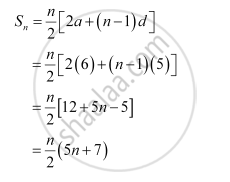
Find the sum to n terms of the A.P., whose kth term is 5k + 1.
Advertisements
उत्तर
It is given that the kth term of the A.P. is 5k + 1.
kth term = ak = a + (k – 1)d
∴ a + (k – 1)d = 5k + 1
a + kd – d = 5k + 1
Comparing the coefficient of k, we obtain d = 5
a – d = 1
⇒ a – 5 = 1
⇒ a = 6
संबंधित प्रश्न
Find the sum of all natural numbers lying between 100 and 1000, which are multiples of 5.
Sum of the first p, q and r terms of an A.P. are a, b and c, respectively.
Prove that `a/p (q - r) + b/q (r- p) + c/r (p - q) = 0`
The sum of the first four terms of an A.P. is 56. The sum of the last four terms is 112. If its first term is 11, then find the number of terms.
The pth, qth and rth terms of an A.P. are a, b, c respectively. Show that (q – r )a + (r – p )b + (p – q )c = 0
A sequence is defined by an = n3 − 6n2 + 11n − 6, n ϵ N. Show that the first three terms of the sequence are zero and all other terms are positive.
Let < an > be a sequence. Write the first five term in the following:
a1 = 1, an = an − 1 + 2, n ≥ 2
Show that the following sequence is an A.P. Also find the common difference and write 3 more terms in case.
\[\sqrt{2}, 3\sqrt{2}, 5\sqrt{2}, 7\sqrt{2}, . . .\]
Which term of the A.P. 3, 8, 13, ... is 248?
Which term of the A.P. 84, 80, 76,... is 0?
Which term of the A.P. 4, 9, 14, ... is 254?
The 6th and 17th terms of an A.P. are 19 and 41 respectively, find the 40th term.
If 9th term of an A.P. is zero, prove that its 29th term is double the 19th term.
The 10th and 18th terms of an A.P. are 41 and 73 respectively. Find 26th term.
Find the second term and nth term of an A.P. whose 6th term is 12 and the 8th term is 22.
If < an > is an A.P. such that \[\frac{a_4}{a_7} = \frac{2}{3}, \text { find }\frac{a_6}{a_8}\].
Find the sum of the following arithmetic progression :
41, 36, 31, ... to 12 terms
Find the sum of all natural numbers between 1 and 100, which are divisible by 2 or 5.
Find the sum of all integers between 100 and 550, which are divisible by 9.
The third term of an A.P. is 7 and the seventh term exceeds three times the third term by 2. Find the first term, the common difference and the sum of first 20 terms.
Find the sum of odd integers from 1 to 2001.
If S1 be the sum of (2n + 1) terms of an A.P. and S2 be the sum of its odd terms, then prove that: S1 : S2 = (2n + 1) : (n + 1).
Show that x2 + xy + y2, z2 + zx + x2 and y2 + yz + z2 are consecutive terms of an A.P., if x, y and z are in A.P.
A man saves Rs 32 during the first year. Rs 36 in the second year and in this way he increases his savings by Rs 4 every year. Find in what time his saving will be Rs 200.
There are 25 trees at equal distances of 5 metres in a line with a well, the distance of the well from the nearest tree being 10 metres. A gardener waters all the trees separately starting from the well and he returns to the well after watering each tree to get water for the next. Find the total distance the gardener will cover in order to water all the trees.
A man saved ₹66000 in 20 years. In each succeeding year after the first year he saved ₹200 more than what he saved in the previous year. How much did he save in the first year?
If the sums of n terms of two arithmetic progressions are in the ratio 2n + 5 : 3n + 4, then write the ratio of their m th terms.
If the sum of n terms of an A.P. be 3 n2 − n and its common difference is 6, then its first term is
Sum of all two digit numbers which when divided by 4 yield unity as remainder is
The first and last terms of an A.P. are 1 and 11. If the sum of its terms is 36, then the number of terms will be
The first three of four given numbers are in G.P. and their last three are in A.P. with common difference 6. If first and fourth numbers are equal, then the first number is
If for an arithmetic progression, 9 times nineth term is equal to 13 times thirteenth term, then value of twenty second term is ____________.
The product of three numbers in A.P. is 224, and the largest number is 7 times the smallest. Find the numbers
If the sum of m terms of an A.P. is equal to the sum of either the next n terms or the next p terms, then prove that `(m + n) (1/m - 1/p) = (m + p) (1/m - 1/n)`
If a, b, c, d are four distinct positive quantities in A.P., then show that bc > ad
A man accepts a position with an initial salary of Rs 5200 per month. It is understood that he will receive an automatic increase of Rs 320 in the very next month and each month thereafter. What is his total earnings during the first year?
If 9 times the 9th term of an A.P. is equal to 13 times the 13th term, then the 22nd term of the A.P. is ______.
Let 3, 6, 9, 12 ....... upto 78 terms and 5, 9, 13, 17 ...... upto 59 be two series. Then, the sum of the terms common to both the series is equal to ______.
The sum of n terms of an AP is 3n2 + 5n. The number of term which equals 164 is ______.
