Advertisements
Advertisements
प्रश्न
Sum of the first p, q and r terms of an A.P. are a, b and c, respectively.
Prove that `a/p (q - r) + b/q (r- p) + c/r (p - q) = 0`
Advertisements
उत्तर
Let a1 and d be the first term and the common difference of the A.P. respectively.
According to the given information
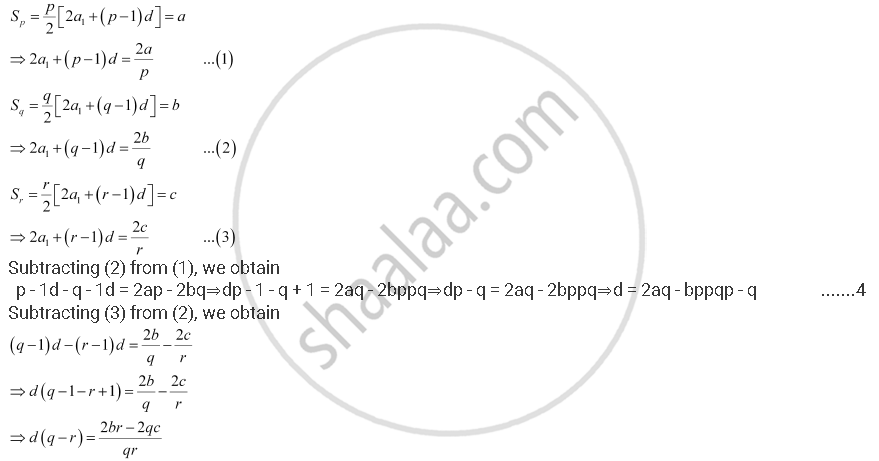

Equating both the values of d obtained in (4) and (5), we obtain
aq - bppqp - q = br - qcqrq - r⇒aq - bppp - q = br - qcrq - r⇒rq - raq - bp = pp - qbr - qc⇒raq - bpq - r = pbr - qcp - q⇒aqr - bprq - r = bpr - cpqp - q
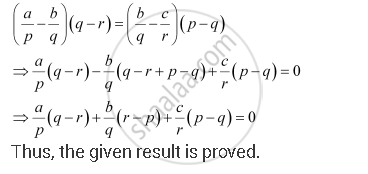
Dividing both sides by pqr, we obtain
संबंधित प्रश्न
Find the sum of odd integers from 1 to 2001.
If the sum of n terms of an A.P. is (pn + qn2), where p and q are constants, find the common difference.
Insert five numbers between 8 and 26 such that the resulting sequence is an A.P.
A person writes a letter to four of his friends. He asks each one of them to copy the letter and mail to four different persons with instruction that they move the chain similarly. Assuming that the chain is not broken and that it costs 50 paise to mail one letter. Find the amount spent on the postage when 8th set of letter is mailed.
If the nth term an of a sequence is given by an = n2 − n + 1, write down its first five terms.
The nth term of a sequence is given by an = 2n + 7. Show that it is an A.P. Also, find its 7th term.
Which term of the A.P. 3, 8, 13, ... is 248?
Which term of the A.P. 4, 9, 14, ... is 254?
Is 302 a term of the A.P. 3, 8, 13, ...?
Which term of the sequence 12 + 8i, 11 + 6i, 10 + 4i, ... is purely real ?
How many terms are there in the A.P. 7, 10, 13, ... 43 ?
How many terms are there in the A.P.\[- 1, - \frac{5}{6}, -\frac{2}{3}, - \frac{1}{2}, . . . , \frac{10}{3}?\]
If 9th term of an A.P. is zero, prove that its 29th term is double the 19th term.
The sum of three terms of an A.P. is 21 and the product of the first and the third terms exceeds the second term by 6, find three terms.
Find the sum of the following arithmetic progression :
50, 46, 42, ... to 10 terms
Find the sum of the following arithmetic progression :
1, 3, 5, 7, ... to 12 terms
Find the sum of the following arithmetic progression :
41, 36, 31, ... to 12 terms
Find the sum of the following arithmetic progression :
(x − y)2, (x2 + y2), (x + y)2, ... to n terms
Find the sum of first n odd natural numbers.
Find the sum of all odd numbers between 100 and 200.
Show that the sum of all odd integers between 1 and 1000 which are divisible by 3 is 83667.
The third term of an A.P. is 7 and the seventh term exceeds three times the third term by 2. Find the first term, the common difference and the sum of first 20 terms.
If the 5th and 12th terms of an A.P. are 30 and 65 respectively, what is the sum of first 20 terms?
If a, b, c is in A.P., prove that:
a2 + c2 + 4ac = 2 (ab + bc + ca)
The income of a person is Rs 300,000 in the first year and he receives an increase of Rs 10000 to his income per year for the next 19 years. Find the total amount, he received in 20 years.
A carpenter was hired to build 192 window frames. The first day he made five frames and each day thereafter he made two more frames than he made the day before. How many days did it take him to finish the job?
In a potato race 20 potatoes are placed in a line at intervals of 4 meters with the first potato 24 metres from the starting point. A contestant is required to bring the potatoes back to the starting place one at a time. How far would he run in bringing back all the potatoes?
Write the common difference of an A.P. the sum of whose first n terms is
Write the sum of first n even natural numbers.
If the sum of n terms of an A.P. be 3 n2 − n and its common difference is 6, then its first term is
The first and last terms of an A.P. are 1 and 11. If the sum of its terms is 36, then the number of terms will be
If, S1 is the sum of an arithmetic progression of 'n' odd number of terms and S2 the sum of the terms of the series in odd places, then \[\frac{S_1}{S_2}\] =
If in an A.P., Sn = n2p and Sm = m2p, where Sr denotes the sum of r terms of the A.P., then Sp is equal to
Mark the correct alternative in the following question:
Let Sn denote the sum of first n terms of an A.P. If S2n = 3Sn, then S3n : Sn is equal to
Write the quadratic equation the arithmetic and geometric means of whose roots are Aand G respectively.
In an A.P. the pth term is q and the (p + q)th term is 0. Then the qth term is ______.
The first term of an A.P.is a, and the sum of the first p terms is zero, show that the sum of its next q terms is `(-a(p + q)q)/(p - 1)`
If the first term of an A.P. is 3 and the sum of its first 25 terms is equal to the sum of its next 15 terms, then the common difference of this A.P. is ______.
