Advertisements
Advertisements
Question
Sum of the first p, q and r terms of an A.P. are a, b and c, respectively.
Prove that `a/p (q - r) + b/q (r- p) + c/r (p - q) = 0`
Advertisements
Solution
Let a1 and d be the first term and the common difference of the A.P. respectively.
According to the given information
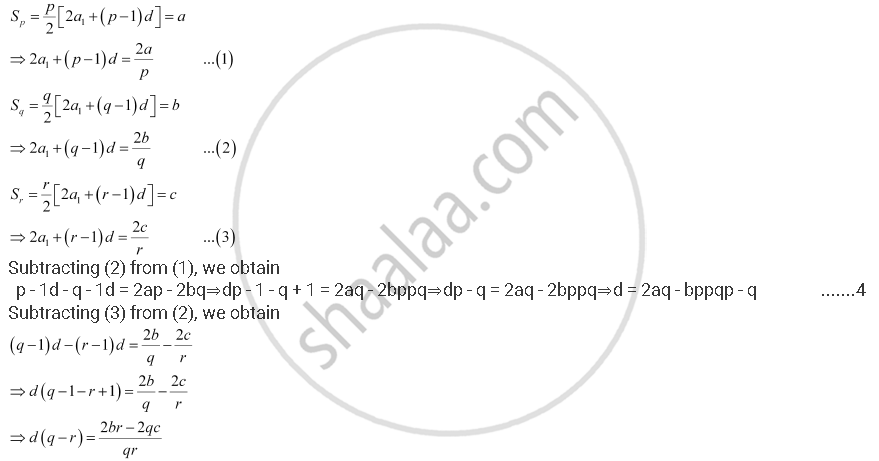

Equating both the values of d obtained in (4) and (5), we obtain
aq - bppqp - q = br - qcqrq - r⇒aq - bppp - q = br - qcrq - r⇒rq - raq - bp = pp - qbr - qc⇒raq - bpq - r = pbr - qcp - q⇒aqr - bprq - r = bpr - cpqp - q
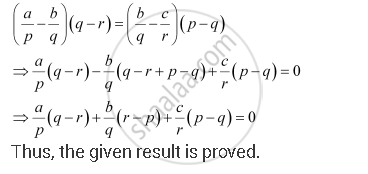
Dividing both sides by pqr, we obtain
RELATED QUESTIONS
How many terms of the A.P. -6 , `-11/2` , -5... are needed to give the sum –25?
if `(a^n + b^n)/(a^(n-1) + b^(n-1))` is the A.M. between a and b, then find the value of n.
Between 1 and 31, m numbers have been inserted in such a way that the resulting sequence is an A.P. and the ratio of 7th and (m – 1)th numbers is 5:9. Find the value of m.
Let the sum of n, 2n, 3n terms of an A.P. be S1, S2 and S3, respectively, show that S3 = 3 (S2– S1)
The sum of the first four terms of an A.P. is 56. The sum of the last four terms is 112. If its first term is 11, then find the number of terms.
Let < an > be a sequence. Write the first five term in the following:
a1 = 1, an = an − 1 + 2, n ≥ 2
Show that the following sequence is an A.P. Also find the common difference and write 3 more terms in case.
\[\sqrt{2}, 3\sqrt{2}, 5\sqrt{2}, 7\sqrt{2}, . . .\]
The nth term of a sequence is given by an = 2n2 + n + 1. Show that it is not an A.P.
If the sequence < an > is an A.P., show that am +n +am − n = 2am.
Is 68 a term of the A.P. 7, 10, 13, ...?
Find the 12th term from the following arithmetic progression:
3, 8, 13, ..., 253
The sum of 4th and 8th terms of an A.P. is 24 and the sum of the 6th and 10th terms is 34. Find the first term and the common difference of the A.P.
If < an > is an A.P. such that \[\frac{a_4}{a_7} = \frac{2}{3}, \text { find }\frac{a_6}{a_8}\].
The angles of a quadrilateral are in A.P. whose common difference is 10°. Find the angles.
Find the sum of all odd numbers between 100 and 200.
Show that the sum of all odd integers between 1 and 1000 which are divisible by 3 is 83667.
Find the sum of all even integers between 101 and 999.
If 12th term of an A.P. is −13 and the sum of the first four terms is 24, what is the sum of first 10 terms?
Find the sum of odd integers from 1 to 2001.
If S1 be the sum of (2n + 1) terms of an A.P. and S2 be the sum of its odd terms, then prove that: S1 : S2 = (2n + 1) : (n + 1).
If \[\frac{1}{a}, \frac{1}{b}, \frac{1}{c}\] are in A.P., prove that:
a (b +c), b (c + a), c (a +b) are in A.P.
Show that x2 + xy + y2, z2 + zx + x2 and y2 + yz + z2 are consecutive terms of an A.P., if x, y and z are in A.P.
If x, y, z are in A.P. and A1 is the A.M. of x and y and A2 is the A.M. of y and z, then prove that the A.M. of A1 and A2 is y.
There are 25 trees at equal distances of 5 metres in a line with a well, the distance of the well from the nearest tree being 10 metres. A gardener waters all the trees separately starting from the well and he returns to the well after watering each tree to get water for the next. Find the total distance the gardener will cover in order to water all the trees.
In a potato race 20 potatoes are placed in a line at intervals of 4 meters with the first potato 24 metres from the starting point. A contestant is required to bring the potatoes back to the starting place one at a time. How far would he run in bringing back all the potatoes?
In a cricket team tournament 16 teams participated. A sum of ₹8000 is to be awarded among themselves as prize money. If the last place team is awarded ₹275 in prize money and the award increases by the same amount for successive finishing places, then how much amount will the first place team receive?
If the sum of p terms of an A.P. is q and the sum of q terms is p, then the sum of p + q terms will be
If Sn denotes the sum of first n terms of an A.P. < an > such that
If the sum of n terms of an A.P., is 3 n2 + 5 n then which of its terms is 164?
If a1, a2, a3, .... an are in A.P. with common difference d, then the sum of the series sin d [sec a1 sec a2 + sec a2 sec a3 + .... + sec an − 1 sec an], is
Let Sn denote the sum of n terms of an A.P. whose first term is a. If the common difference d is given by d = Sn − k Sn − 1 + Sn − 2 , then k =
Mark the correct alternative in the following question:
If in an A.P., the pth term is q and (p + q)th term is zero, then the qth term is
In an A.P. the pth term is q and the (p + q)th term is 0. Then the qth term is ______.
A man accepts a position with an initial salary of Rs 5200 per month. It is understood that he will receive an automatic increase of Rs 320 in the very next month and each month thereafter. What is his total earnings during the first year?
If the sum of p terms of an A.P. is q and the sum of q terms is p, show that the sum of p + q terms is – (p + q). Also, find the sum of first p – q terms (p > q).
Any term of an A.P. (except first) is equal to half the sum of terms which are equidistant from it.
Let 3, 6, 9, 12 ....... upto 78 terms and 5, 9, 13, 17 ...... upto 59 be two series. Then, the sum of the terms common to both the series is equal to ______.
The fourth term of an A.P. is three times of the first term and the seventh term exceeds the twice of the third term by one, then the common difference of the progression is ______.
