Advertisements
Advertisements
प्रश्न
Sum of the first p, q and r terms of an A.P. are a, b and c, respectively.
Prove that `a/p (q - r) + b/q (r- p) + c/r (p - q) = 0`
Advertisements
उत्तर
Let a1 and d be the first term and the common difference of the A.P. respectively.
According to the given information
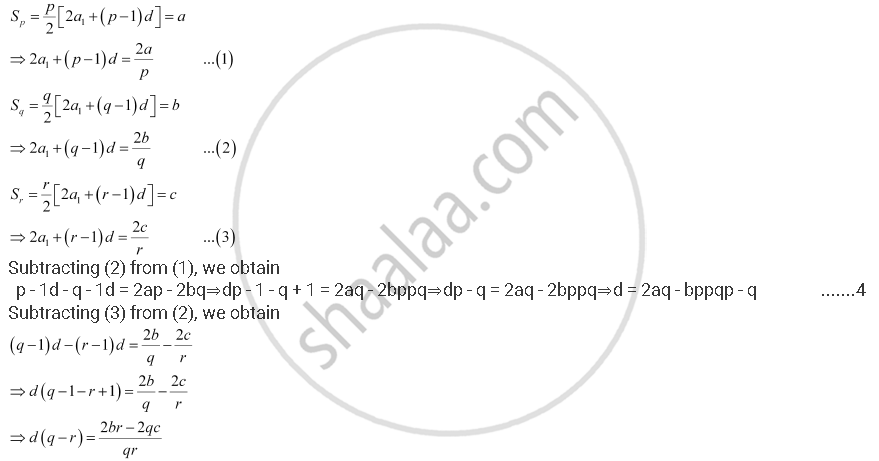

Equating both the values of d obtained in (4) and (5), we obtain
aq - bppqp - q = br - qcqrq - r⇒aq - bppp - q = br - qcrq - r⇒rq - raq - bp = pp - qbr - qc⇒raq - bpq - r = pbr - qcp - q⇒aqr - bprq - r = bpr - cpqp - q
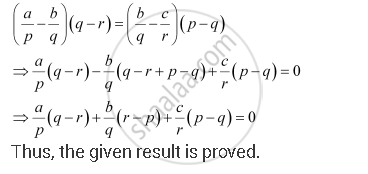
Dividing both sides by pqr, we obtain
संबंधित प्रश्न
Find the sum to n terms of the A.P., whose kth term is 5k + 1.
If the sum of n terms of an A.P. is (pn + qn2), where p and q are constants, find the common difference.
If the sum of first p terms of an A.P. is equal to the sum of the first q terms, then find the sum of the first (p + q) terms.
If the sum of three numbers in A.P., is 24 and their product is 440, find the numbers.
Let the sum of n, 2n, 3n terms of an A.P. be S1, S2 and S3, respectively, show that S3 = 3 (S2– S1)
Find the sum of all two digit numbers which when divided by 4, yields 1 as remainder.
Shamshad Ali buys a scooter for Rs 22000. He pays Rs 4000 cash and agrees to pay the balance in annual installment of Rs 1000 plus 10% interest on the unpaid amount. How much will the scooter cost him?
Find:
10th term of the A.P. 1, 4, 7, 10, ...
Find:
nth term of the A.P. 13, 8, 3, −2, ...
Which term of the A.P. 3, 8, 13, ... is 248?
Which term of the sequence 12 + 8i, 11 + 6i, 10 + 4i, ... is purely real ?
The first term of an A.P. is 5, the common difference is 3 and the last term is 80; find the number of terms.
If 10 times the 10th term of an A.P. is equal to 15 times the 15th term, show that 25th term of the A.P. is zero.
Find the 12th term from the following arithmetic progression:
3, 5, 7, 9, ... 201
Find the 12th term from the following arithmetic progression:
3, 8, 13, ..., 253
Three numbers are in A.P. If the sum of these numbers be 27 and the product 648, find the numbers.
Find the sum of the following arithmetic progression :
1, 3, 5, 7, ... to 12 terms
Find the sum of the following arithmetic progression :
a + b, a − b, a − 3b, ... to 22 terms
Find the sum of the following arithmetic progression :
\[\frac{x - y}{x + y}, \frac{3x - 2y}{x + y}, \frac{5x - 3y}{x + y}\], ... to n terms.
How many terms are there in the A.P. whose first and fifth terms are −14 and 2 respectively and the sum of the terms is 40?
If the sum of a certain number of terms of the AP 25, 22, 19, ... is 116. Find the last term.
Find an A.P. in which the sum of any number of terms is always three times the squared number of these terms.
The sums of n terms of two arithmetic progressions are in the ratio 5n + 4 : 9n + 6. Find the ratio of their 18th terms.
If \[a\left( \frac{1}{b} + \frac{1}{c} \right), b\left( \frac{1}{c} + \frac{1}{a} \right), c\left( \frac{1}{a} + \frac{1}{b} \right)\] are in A.P., prove that a, b, c are in A.P.
Insert five numbers between 8 and 26 such that the resulting sequence is an A.P.
There are 25 trees at equal distances of 5 metres in a line with a well, the distance of the well from the nearest tree being 10 metres. A gardener waters all the trees separately starting from the well and he returns to the well after watering each tree to get water for the next. Find the total distance the gardener will cover in order to water all the trees.
A man starts repaying a loan as first instalment of Rs 100 = 00. If he increases the instalments by Rs 5 every month, what amount he will pay in the 30th instalment?
Write the sum of first n even natural numbers.
If Sn denotes the sum of first n terms of an A.P. < an > such that
The first and last terms of an A.P. are 1 and 11. If the sum of its terms is 36, then the number of terms will be
If the sum of n terms of an A.P., is 3 n2 + 5 n then which of its terms is 164?
If a1, a2, a3, .... an are in A.P. with common difference d, then the sum of the series sin d [sec a1 sec a2 + sec a2 sec a3 + .... + sec an − 1 sec an], is
Mark the correct alternative in the following question:
\[\text { If in an A . P } . S_n = n^2 q \text { and } S_m = m^2 q, \text { where } S_r \text{ denotes the sum of r terms of the A . P . , then }S_q \text { equals }\]
Any term of an A.P. (except first) is equal to half the sum of terms which are equidistant from it.
If the sum of n terms of a sequence is quadratic expression then it always represents an A.P
Let 3, 6, 9, 12 ....... upto 78 terms and 5, 9, 13, 17 ...... upto 59 be two series. Then, the sum of the terms common to both the series is equal to ______.
If the first term of an A.P. is 3 and the sum of its first 25 terms is equal to the sum of its next 15 terms, then the common difference of this A.P. is ______.
For an A.P. with first term \(a\) and common difference \(d\), the common difference is computed as:
