Advertisements
Advertisements
Question
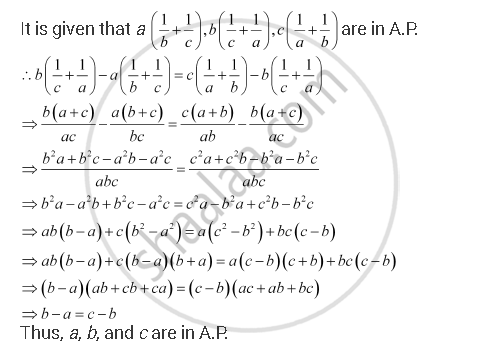
if `a(1/b + 1/c), b(1/c+1/a), c(1/a+1/b)` are in A.P., prove that a, b, c are in A.P.
Advertisements
Solution
RELATED QUESTIONS
If the sum of n terms of an A.P. is 3n2 + 5n and its mth term is 164, find the value of m.
The difference between any two consecutive interior angles of a polygon is 5°. If the smallest angle is 120°, find the number of the sides of the polygon.
If the sum of three numbers in A.P., is 24 and their product is 440, find the numbers.
Find the sum of all numbers between 200 and 400 which are divisible by 7.
If the nth term an of a sequence is given by an = n2 − n + 1, write down its first five terms.
The nth term of a sequence is given by an = 2n + 7. Show that it is an A.P. Also, find its 7th term.
The 10th and 18th terms of an A.P. are 41 and 73 respectively. Find 26th term.
Find the four numbers in A.P., whose sum is 50 and in which the greatest number is 4 times the least.
The angles of a quadrilateral are in A.P. whose common difference is 10°. Find the angles.
The third term of an A.P. is 7 and the seventh term exceeds three times the third term by 2. Find the first term, the common difference and the sum of first 20 terms.
The first term of an A.P. is 2 and the last term is 50. The sum of all these terms is 442. Find the common difference.
If Sn = n2 p and Sm = m2 p, m ≠ n, in an A.P., prove that Sp = p3.
If 12th term of an A.P. is −13 and the sum of the first four terms is 24, what is the sum of first 10 terms?
If the 5th and 12th terms of an A.P. are 30 and 65 respectively, what is the sum of first 20 terms?
Find an A.P. in which the sum of any number of terms is always three times the squared number of these terms.
If \[\frac{1}{a}, \frac{1}{b}, \frac{1}{c}\] are in A.P., prove that:
a (b +c), b (c + a), c (a +b) are in A.P.
If a2, b2, c2 are in A.P., prove that \[\frac{a}{b + c}, \frac{b}{c + a}, \frac{c}{a + b}\] are in A.P.
If a, b, c is in A.P., then show that:
bc − a2, ca − b2, ab − c2 are in A.P.
If \[a\left( \frac{1}{b} + \frac{1}{c} \right), b\left( \frac{1}{c} + \frac{1}{a} \right), c\left( \frac{1}{a} + \frac{1}{b} \right)\] are in A.P., prove that a, b, c are in A.P.
A man starts repaying a loan as first instalment of Rs 100 = 00. If he increases the instalments by Rs 5 every month, what amount he will pay in the 30th instalment?
A carpenter was hired to build 192 window frames. The first day he made five frames and each day thereafter he made two more frames than he made the day before. How many days did it take him to finish the job?
Write the common difference of an A.P. whose nth term is xn + y.
Write the common difference of an A.P. the sum of whose first n terms is
If log 2, log (2x − 1) and log (2x + 3) are in A.P., write the value of x.
If the sums of n terms of two arithmetic progressions are in the ratio 2n + 5 : 3n + 4, then write the ratio of their m th terms.
Write the sum of first n odd natural numbers.
If the sum of p terms of an A.P. is q and the sum of q terms is p, then the sum of p + q terms will be
If four numbers in A.P. are such that their sum is 50 and the greatest number is 4 times the least, then the numbers are
If, S1 is the sum of an arithmetic progression of 'n' odd number of terms and S2 the sum of the terms of the series in odd places, then \[\frac{S_1}{S_2}\] =
Mark the correct alternative in the following question:
The 10th common term between the A.P.s 3, 7, 11, 15, ... and 1, 6, 11, 16, ... is
Mark the correct alternative in the following question:
Let Sn denote the sum of first n terms of an A.P. If S2n = 3Sn, then S3n : Sn is equal to
The first term of an A.P. is a, the second term is b and the last term is c. Show that the sum of the A.P. is `((b + c - 2a)(c + a))/(2(b - a))`.
Show that (x2 + xy + y2), (z2 + xz + x2) and (y2 + yz + z2) are consecutive terms of an A.P., if x, y and z are in A.P.
In an A.P. the pth term is q and the (p + q)th term is 0. Then the qth term is ______.
A man accepts a position with an initial salary of Rs 5200 per month. It is understood that he will receive an automatic increase of Rs 320 in the very next month and each month thereafter. What is his total earnings during the first year?
Any term of an A.P. (except first) is equal to half the sum of terms which are equidistant from it.
If the sum of n terms of a sequence is quadratic expression then it always represents an A.P
If b2, a2, c2 are in A.P., then `1/(a + b), 1/(b + c), 1/(c + a)` will be in ______
