Advertisements
Advertisements
Question
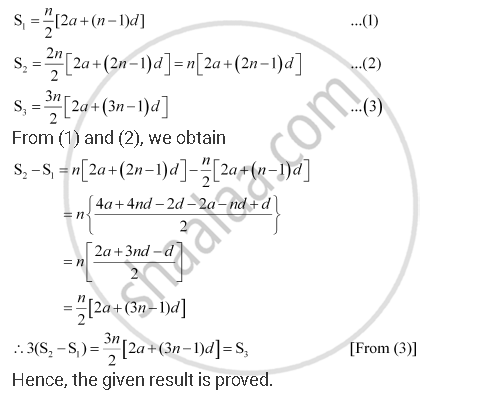
Let the sum of n, 2n, 3n terms of an A.P. be S1, S2 and S3, respectively, show that S3 = 3 (S2– S1)
Advertisements
Solution
Let a and b be the first term and the common difference of the A.P. respectively.
Therefore,
RELATED QUESTIONS
If the sum of first p terms of an A.P. is equal to the sum of the first q terms, then find the sum of the first (p + q) terms.
Between 1 and 31, m numbers have been inserted in such a way that the resulting sequence is an A.P. and the ratio of 7th and (m – 1)th numbers is 5:9. Find the value of m.
A man starts repaying a loan as first installment of Rs. 100. If he increases the installment by Rs 5 every month, what amount he will pay in the 30th installment?
If the nth term an of a sequence is given by an = n2 − n + 1, write down its first five terms.
Let < an > be a sequence defined by a1 = 3 and, an = 3an − 1 + 2, for all n > 1
Find the first four terms of the sequence.
Let < an > be a sequence. Write the first five term in the following:
a1 = 1, an = an − 1 + 2, n ≥ 2
Show that the following sequence is an A.P. Also find the common difference and write 3 more terms in case.
\[\sqrt{2}, 3\sqrt{2}, 5\sqrt{2}, 7\sqrt{2}, . . .\]
Find:
nth term of the A.P. 13, 8, 3, −2, ...
Which term of the sequence 12 + 8i, 11 + 6i, 10 + 4i, ... is purely real ?
How many terms are there in the A.P.\[- 1, - \frac{5}{6}, -\frac{2}{3}, - \frac{1}{2}, . . . , \frac{10}{3}?\]
The first term of an A.P. is 5, the common difference is 3 and the last term is 80; find the number of terms.
In a certain A.P. the 24th term is twice the 10th term. Prove that the 72nd term is twice the 34th term.
Three numbers are in A.P. If the sum of these numbers be 27 and the product 648, find the numbers.
Find the sum of the following serie:
2 + 5 + 8 + ... + 182
Find the sum of the following serie:
(a − b)2 + (a2 + b2) + (a + b)2 + ... + [(a + b)2 + 6ab]
Find the sum of all natural numbers between 1 and 100, which are divisible by 2 or 5.
Find the sum of all those integers between 100 and 800 each of which on division by 16 leaves the remainder 7.
Solve:
1 + 4 + 7 + 10 + ... + x = 590.
How many terms are there in the A.P. whose first and fifth terms are −14 and 2 respectively and the sum of the terms is 40?
Find an A.P. in which the sum of any number of terms is always three times the squared number of these terms.
A piece of equipment cost a certain factory Rs 600,000. If it depreciates in value, 15% the first, 13.5% the next year, 12% the third year, and so on. What will be its value at the end of 10 years, all percentages applying to the original cost?
A man starts repaying a loan as first instalment of Rs 100 = 00. If he increases the instalments by Rs 5 every month, what amount he will pay in the 30th instalment?
In a cricket team tournament 16 teams participated. A sum of ₹8000 is to be awarded among themselves as prize money. If the last place team is awarded ₹275 in prize money and the award increases by the same amount for successive finishing places, then how much amount will the first place team receive?
Write the common difference of an A.P. whose nth term is xn + y.
If the sum of n terms of an AP is 2n2 + 3n, then write its nth term.
If 7th and 13th terms of an A.P. be 34 and 64 respectively, then its 18th term is
Sum of all two digit numbers which when divided by 4 yield unity as remainder is
If a1, a2, a3, .... an are in A.P. with common difference d, then the sum of the series sin d [sec a1 sec a2 + sec a2 sec a3 + .... + sec an − 1 sec an], is
The first three of four given numbers are in G.P. and their last three are in A.P. with common difference 6. If first and fourth numbers are equal, then the first number is
If a, b, c are in G.P. and a1/x = b1/y = c1/z, then xyz are in
The first term of an A.P. is a, the second term is b and the last term is c. Show that the sum of the A.P. is `((b + c - 2a)(c + a))/(2(b - a))`.
Find the sum of first 24 terms of the A.P. a1, a2, a3, ... if it is known that a1 + a5 + a10 + a15 + a20 + a24 = 225.
Show that (x2 + xy + y2), (z2 + xz + x2) and (y2 + yz + z2) are consecutive terms of an A.P., if x, y and z are in A.P.
If a1, a2, ..., an are in A.P. with common difference d (where d ≠ 0); then the sum of the series sin d (cosec a1 cosec a2 + cosec a2 cosec a3 + ...+ cosec an–1 cosec an) is equal to cot a1 – cot an
A man saved Rs 66000 in 20 years. In each succeeding year after the first year he saved Rs 200 more than what he saved in the previous year. How much did he save in the first year?
If 9 times the 9th term of an A.P. is equal to 13 times the 13th term, then the 22nd term of the A.P. is ______.
Let 3, 6, 9, 12 ....... upto 78 terms and 5, 9, 13, 17 ...... upto 59 be two series. Then, the sum of the terms common to both the series is equal to ______.
If a1, a2, a3, .......... are an A.P. such that a1 + a5 + a10 + a15 + a20 + a24 = 225, then a1 + a2 + a3 + ...... + a23 + a24 is equal to ______.
