Advertisements
Advertisements
प्रश्न
Find the sum of all natural numbers lying between 100 and 1000, which are multiples of 5.
Advertisements
उत्तर
The natural numbers lying between 100 and 1000, which are multiples of 5, are 105, 110, … 995.
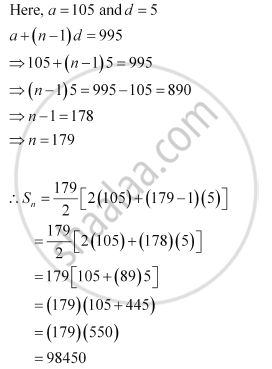
Thus, the sum of all natural numbers lying between 100 and 1000, which are multiples of 5, is 98450.
संबंधित प्रश्न
In an A.P, the first term is 2 and the sum of the first five terms is one-fourth of the next five terms. Show that 20th term is –112.
If the sum of n terms of an A.P. is (pn + qn2), where p and q are constants, find the common difference.
Show that the sum of (m + n)th and (m – n)th terms of an A.P. is equal to twice the mth term.
Let the sum of n, 2n, 3n terms of an A.P. be S1, S2 and S3, respectively, show that S3 = 3 (S2– S1)
The sum of the first four terms of an A.P. is 56. The sum of the last four terms is 112. If its first term is 11, then find the number of terms.
A farmer buys a used tractor for Rs 12000. He pays Rs 6000 cash and agrees to pay the balance in annual installments of Rs 500 plus 12% interest on the unpaid amount. How much will be the tractor cost him?
A man deposited Rs 10000 in a bank at the rate of 5% simple interest annually. Find the amount in 15th year since he deposited the amount and also calculate the total amount after 20 years.
Show that the following sequence is an A.P. Also find the common difference and write 3 more terms in case.
3, −1, −5, −9 ...
Show that the following sequence is an A.P. Also find the common difference and write 3 more terms in case.
9, 7, 5, 3, ...
Which term of the sequence 12 + 8i, 11 + 6i, 10 + 4i, ... is purely imaginary?
If (m + 1)th term of an A.P. is twice the (n + 1)th term, prove that (3m + 1)th term is twice the (m + n + 1)th term.
How many numbers of two digit are divisible by 3?
How many numbers are there between 1 and 1000 which when divided by 7 leave remainder 4?
Find the sum of the following arithmetic progression :
1, 3, 5, 7, ... to 12 terms
The third term of an A.P. is 7 and the seventh term exceeds three times the third term by 2. Find the first term, the common difference and the sum of first 20 terms.
Find the sum of all two digit numbers which when divided by 4, yields 1 as remainder.
If the sum of a certain number of terms of the AP 25, 22, 19, ... is 116. Find the last term.
If S1 be the sum of (2n + 1) terms of an A.P. and S2 be the sum of its odd terms, then prove that: S1 : S2 = (2n + 1) : (n + 1).
If \[\frac{1}{a}, \frac{1}{b}, \frac{1}{c}\] are in A.P., prove that:
a (b +c), b (c + a), c (a +b) are in A.P.
If a, b, c is in A.P., prove that:
a3 + c3 + 6abc = 8b3.
Show that x2 + xy + y2, z2 + zx + x2 and y2 + yz + z2 are consecutive terms of an A.P., if x, y and z are in A.P.
A man saves Rs 32 during the first year. Rs 36 in the second year and in this way he increases his savings by Rs 4 every year. Find in what time his saving will be Rs 200.
A man arranges to pay off a debt of Rs 3600 by 40 annual instalments which form an arithmetic series. When 30 of the instalments are paid, he dies leaving one-third of the debt unpaid, find the value of the first instalment.
We know that the sum of the interior angles of a triangle is 180°. Show that the sums of the interior angles of polygons with 3, 4, 5, 6, ... sides form an arithmetic progression. Find the sum of the interior angles for a 21 sided polygon.
If log 2, log (2x − 1) and log (2x + 3) are in A.P., write the value of x.
Write the sum of first n even natural numbers.
If 7th and 13th terms of an A.P. be 34 and 64 respectively, then its 18th term is
If the sum of n terms of an A.P. be 3 n2 − n and its common difference is 6, then its first term is
If the sum of n terms of an A.P. is 2 n2 + 5 n, then its nth term is
If four numbers in A.P. are such that their sum is 50 and the greatest number is 4 times the least, then the numbers are
If a, b, c are in A.P. and x, y, z are in G.P., then the value of xb − c yc − a za − b is
The first three of four given numbers are in G.P. and their last three are in A.P. with common difference 6. If first and fourth numbers are equal, then the first number is
The first term of an A.P. is a, the second term is b and the last term is c. Show that the sum of the A.P. is `((b + c - 2a)(c + a))/(2(b - a))`.
If there are (2n + 1) terms in an A.P., then prove that the ratio of the sum of odd terms and the sum of even terms is (n + 1) : n
Show that (x2 + xy + y2), (z2 + xz + x2) and (y2 + yz + z2) are consecutive terms of an A.P., if x, y and z are in A.P.
A man accepts a position with an initial salary of Rs 5200 per month. It is understood that he will receive an automatic increase of Rs 320 in the very next month and each month thereafter. Find his salary for the tenth month
If the sum of p terms of an A.P. is q and the sum of q terms is p, show that the sum of p + q terms is – (p + q). Also, find the sum of first p – q terms (p > q).
The sum of terms equidistant from the beginning and end in an A.P. is equal to ______.
If the ratio of the sum of n terms of two APs is 2n:(n + 1), then the ratio of their 8th terms is ______.
