Advertisements
Advertisements
प्रश्न
Find the sum of all natural numbers lying between 100 and 1000, which are multiples of 5.
Advertisements
उत्तर
The natural numbers lying between 100 and 1000, which are multiples of 5, are 105, 110, … 995.
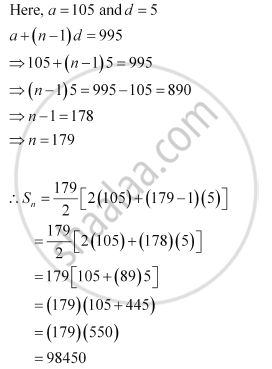
Thus, the sum of all natural numbers lying between 100 and 1000, which are multiples of 5, is 98450.
संबंधित प्रश्न
Find the sum of odd integers from 1 to 2001.
If the sum of first p terms of an A.P. is equal to the sum of the first q terms, then find the sum of the first (p + q) terms.
Sum of the first p, q and r terms of an A.P. are a, b and c, respectively.
Prove that `a/p (q - r) + b/q (r- p) + c/r (p - q) = 0`
The ratio of the sums of m and n terms of an A.P. is m2: n2. Show that the ratio of mth and nthterm is (2m – 1): (2n – 1)
The difference between any two consecutive interior angles of a polygon is 5°. If the smallest angle is 120°, find the number of the sides of the polygon.
Find the sum of all two digit numbers which when divided by 4, yields 1 as remainder.
If the nth term an of a sequence is given by an = n2 − n + 1, write down its first five terms.
Which term of the sequence 12 + 8i, 11 + 6i, 10 + 4i, ... is purely imaginary?
In a certain A.P. the 24th term is twice the 10th term. Prove that the 72nd term is twice the 34th term.
The 4th term of an A.P. is three times the first and the 7th term exceeds twice the third term by 1. Find the first term and the common difference.
The angles of a quadrilateral are in A.P. whose common difference is 10°. Find the angles.
Find the sum of the following arithmetic progression :
50, 46, 42, ... to 10 terms
Find the sum of first n natural numbers.
Find the sum of all those integers between 100 and 800 each of which on division by 16 leaves the remainder 7.
Solve:
1 + 4 + 7 + 10 + ... + x = 590.
How many terms are there in the A.P. whose first and fifth terms are −14 and 2 respectively and the sum of the terms is 40?
The third term of an A.P. is 7 and the seventh term exceeds three times the third term by 2. Find the first term, the common difference and the sum of first 20 terms.
The number of terms of an A.P. is even; the sum of odd terms is 24, of the even terms is 30, and the last term exceeds the first by \[10 \frac{1}{2}\] , find the number of terms and the series.
If 12th term of an A.P. is −13 and the sum of the first four terms is 24, what is the sum of first 10 terms?
The sums of first n terms of two A.P.'s are in the ratio (7n + 2) : (n + 4). Find the ratio of their 5th terms.
If a, b, c is in A.P., prove that:
a2 + c2 + 4ac = 2 (ab + bc + ca)
Show that x2 + xy + y2, z2 + zx + x2 and y2 + yz + z2 are consecutive terms of an A.P., if x, y and z are in A.P.
A manufacturer of radio sets produced 600 units in the third year and 700 units in the seventh year. Assuming that the product increases uniformly by a fixed number every year, find (i) the production in the first year (ii) the total product in 7 years and (iii) the product in the 10th year.
A man is employed to count Rs 10710. He counts at the rate of Rs 180 per minute for half an hour. After this he counts at the rate of Rs 3 less every minute than the preceding minute. Find the time taken by him to count the entire amount.
Write the sum of first n even natural numbers.
If the sums of n terms of two AP.'s are in the ratio (3n + 2) : (2n + 3), then find the ratio of their 12th terms.
If a1, a2, a3, .... an are in A.P. with common difference d, then the sum of the series sin d [sec a1 sec a2 + sec a2 sec a3 + .... + sec an − 1 sec an], is
Let Sn denote the sum of n terms of an A.P. whose first term is a. If the common difference d is given by d = Sn − k Sn − 1 + Sn − 2 , then k =
If in an A.P., Sn = n2p and Sm = m2p, where Sr denotes the sum of r terms of the A.P., then Sp is equal to
The first term of an A.P. is a, the second term is b and the last term is c. Show that the sum of the A.P. is `((b + c - 2a)(c + a))/(2(b - a))`.
The pth term of an A.P. is a and qth term is b. Prove that the sum of its (p + q) terms is `(p + q)/2[a + b + (a - b)/(p - q)]`.
Show that (x2 + xy + y2), (z2 + xz + x2) and (y2 + yz + z2) are consecutive terms of an A.P., if x, y and z are in A.P.
If 9 times the 9th term of an A.P. is equal to 13 times the 13th term, then the 22nd term of the A.P. is ______.
If the ratio of the sum of n terms of two APs is 2n:(n + 1), then the ratio of their 8th terms is ______.
The sum of n terms of an AP is 3n2 + 5n. The number of term which equals 164 is ______.
