Advertisements
Advertisements
Question
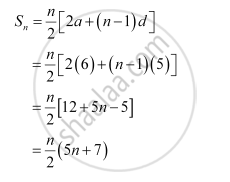
Find the sum to n terms of the A.P., whose kth term is 5k + 1.
Advertisements
Solution
It is given that the kth term of the A.P. is 5k + 1.
kth term = ak = a + (k – 1)d
∴ a + (k – 1)d = 5k + 1
a + kd – d = 5k + 1
Comparing the coefficient of k, we obtain d = 5
a – d = 1
⇒ a – 5 = 1
⇒ a = 6
RELATED QUESTIONS
Show that the sum of (m + n)th and (m – n)th terms of an A.P. is equal to twice the mth term.
Let the sum of n, 2n, 3n terms of an A.P. be S1, S2 and S3, respectively, show that S3 = 3 (S2– S1)
Show that the following sequence is an A.P. Also find the common difference and write 3 more terms in case.
3, −1, −5, −9 ...
The nth term of a sequence is given by an = 2n2 + n + 1. Show that it is not an A.P.
How many terms are there in the A.P. 7, 10, 13, ... 43 ?
The first term of an A.P. is 5, the common difference is 3 and the last term is 80; find the number of terms.
If 10 times the 10th term of an A.P. is equal to 15 times the 15th term, show that 25th term of the A.P. is zero.
Find the second term and nth term of an A.P. whose 6th term is 12 and the 8th term is 22.
The sum of three terms of an A.P. is 21 and the product of the first and the third terms exceeds the second term by 6, find three terms.
The sum of three numbers in A.P. is 12 and the sum of their cubes is 288. Find the numbers.
Find the sum of the following arithmetic progression :
41, 36, 31, ... to 12 terms
Find the sum of first n natural numbers.
Find the sum of all even integers between 101 and 999.
How many terms are there in the A.P. whose first and fifth terms are −14 and 2 respectively and the sum of the terms is 40?
If Sn = n2 p and Sm = m2 p, m ≠ n, in an A.P., prove that Sp = p3.
If \[\frac{1}{a}, \frac{1}{b}, \frac{1}{c}\] are in A.P., prove that:
\[\frac{b + c}{a}, \frac{c + a}{b}, \frac{a + b}{c}\] are in A.P.
If a, b, c is in A.P., then show that:
a2 (b + c), b2 (c + a), c2 (a + b) are also in A.P.
If a, b, c is in A.P., then show that:
b + c − a, c + a − b, a + b − c are in A.P.
A man starts repaying a loan as first instalment of Rs 100 = 00. If he increases the instalments by Rs 5 every month, what amount he will pay in the 30th instalment?
Write the common difference of an A.P. the sum of whose first n terms is
If log 2, log (2x − 1) and log (2x + 3) are in A.P., write the value of x.
If the sums of n terms of two arithmetic progressions are in the ratio 2n + 5 : 3n + 4, then write the ratio of their m th terms.
Write the sum of first n even natural numbers.
If the sum of p terms of an A.P. is q and the sum of q terms is p, then the sum of p + q terms will be
If Sn denotes the sum of first n terms of an A.P. < an > such that
If, S1 is the sum of an arithmetic progression of 'n' odd number of terms and S2 the sum of the terms of the series in odd places, then \[\frac{S_1}{S_2}\] =
Mark the correct alternative in the following question:
The 10th common term between the A.P.s 3, 7, 11, 15, ... and 1, 6, 11, 16, ... is
Write the quadratic equation the arithmetic and geometric means of whose roots are Aand G respectively.
If there are (2n + 1) terms in an A.P., then prove that the ratio of the sum of odd terms and the sum of even terms is (n + 1) : n
A man saved Rs 66000 in 20 years. In each succeeding year after the first year he saved Rs 200 more than what he saved in the previous year. How much did he save in the first year?
A man accepts a position with an initial salary of Rs 5200 per month. It is understood that he will receive an automatic increase of Rs 320 in the very next month and each month thereafter. Find his salary for the tenth month
If n AM's are inserted between 1 and 31 and ratio of 7th and (n – 1)th A.M. is 5:9, then n equals ______.
The sum of n terms of an AP is 3n2 + 5n. The number of term which equals 164 is ______.
If the first term of an A.P. is 3 and the sum of its first 25 terms is equal to the sum of its next 15 terms, then the common difference of this A.P. is ______.
If 100 times the 100th term of an A.P. with non zero common difference equals the 50 times its 50th term, then the 150th term of this A.P. is ______.
The number of terms in an A.P. is even; the sum of the odd terms in lt is 24 and that the even terms is 30. If the last term exceeds the first term by `10 1/2`, then the number of terms in the A.P. is ______.
The internal angles of a convex polygon are in A.P. The smallest angle is 120° and the common difference is 5°. The number to sides of the polygon is ______.
What is the general form of an A.P. with first term \(a\) and common difference \(d\)?
