Advertisements
Advertisements
Question
Find the sum of all two digit numbers which when divided by 4, yields 1 as remainder.
Advertisements
Solution
The two-digit numbers, which when divided by 4, yield 1 as remainder, are
13, 17, … 97.
This series forms an A.P. with first term 13 and common difference 4.
Let n be the number of terms of the A.P.
It is known that the nth term of an A.P. is given by, an = a + (n –1) d
∴97 = 13 + (n –1) (4)
⇒ 4 (n –1) = 84
⇒ n – 1 = 21
⇒ n = 22
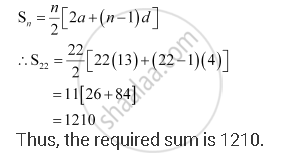
Sum of n terms of an A.P. is given by,
RELATED QUESTIONS
Between 1 and 31, m numbers have been inserted in such a way that the resulting sequence is an A.P. and the ratio of 7th and (m – 1)th numbers is 5:9. Find the value of m.
A person writes a letter to four of his friends. He asks each one of them to copy the letter and mail to four different persons with instruction that they move the chain similarly. Assuming that the chain is not broken and that it costs 50 paise to mail one letter. Find the amount spent on the postage when 8th set of letter is mailed.
Let < an > be a sequence defined by a1 = 3 and, an = 3an − 1 + 2, for all n > 1
Find the first four terms of the sequence.
Show that the following sequence is an A.P. Also find the common difference and write 3 more terms in case.
\[\sqrt{2}, 3\sqrt{2}, 5\sqrt{2}, 7\sqrt{2}, . . .\]
Show that the following sequence is an A.P. Also find the common difference and write 3 more terms in case.
9, 7, 5, 3, ...
The nth term of a sequence is given by an = 2n2 + n + 1. Show that it is not an A.P.
If 10 times the 10th term of an A.P. is equal to 15 times the 15th term, show that 25th term of the A.P. is zero.
Find the 12th term from the following arithmetic progression:
3, 8, 13, ..., 253
The first and the last terms of an A.P. are a and l respectively. Show that the sum of nthterm from the beginning and nth term from the end is a + l.
If < an > is an A.P. such that \[\frac{a_4}{a_7} = \frac{2}{3}, \text { find }\frac{a_6}{a_8}\].
The sum of three terms of an A.P. is 21 and the product of the first and the third terms exceeds the second term by 6, find three terms.
Three numbers are in A.P. If the sum of these numbers be 27 and the product 648, find the numbers.
Find the sum of the following arithmetic progression :
50, 46, 42, ... to 10 terms
Find the sum of the following arithmetic progression :
(x − y)2, (x2 + y2), (x + y)2, ... to n terms
Find the sum of the following serie:
101 + 99 + 97 + ... + 47
Find the sum of all integers between 50 and 500 which are divisible by 7.
Find the sum of all integers between 100 and 550, which are divisible by 9.
Solve:
1 + 4 + 7 + 10 + ... + x = 590.
Find the r th term of an A.P., the sum of whose first n terms is 3n2 + 2n.
Find the sum of n terms of the A.P. whose kth terms is 5k + 1.
How many terms of the A.P. −6, \[- \frac{11}{2}\], −5, ... are needed to give the sum −25?
If a, b, c is in A.P., then show that:
b + c − a, c + a − b, a + b − c are in A.P.
A man arranges to pay off a debt of Rs 3600 by 40 annual instalments which form an arithmetic series. When 30 of the instalments are paid, he dies leaving one-third of the debt unpaid, find the value of the first instalment.
The income of a person is Rs 300,000 in the first year and he receives an increase of Rs 10000 to his income per year for the next 19 years. Find the total amount, he received in 20 years.
A carpenter was hired to build 192 window frames. The first day he made five frames and each day thereafter he made two more frames than he made the day before. How many days did it take him to finish the job?
In a cricket team tournament 16 teams participated. A sum of ₹8000 is to be awarded among themselves as prize money. If the last place team is awarded ₹275 in prize money and the award increases by the same amount for successive finishing places, then how much amount will the first place team receive?
If the sum of n terms of an AP is 2n2 + 3n, then write its nth term.
If log 2, log (2x − 1) and log (2x + 3) are in A.P., write the value of x.
If \[\frac{3 + 5 + 7 + . . . + \text { upto n terms }}{5 + 8 + 11 + . . . . \text { upto 10 terms }}\] 7, then find the value of n.
In n A.M.'s are introduced between 3 and 17 such that the ratio of the last mean to the first mean is 3 : 1, then the value of n is
Mark the correct alternative in the following question:
The 10th common term between the A.P.s 3, 7, 11, 15, ... and 1, 6, 11, 16, ... is
The first term of an A.P. is a, the second term is b and the last term is c. Show that the sum of the A.P. is `((b + c - 2a)(c + a))/(2(b - a))`.
In an A.P. the pth term is q and the (p + q)th term is 0. Then the qth term is ______.
If the sum of p terms of an A.P. is q and the sum of q terms is p, show that the sum of p + q terms is – (p + q). Also, find the sum of first p – q terms (p > q).
If a1, a2, a3, .......... are an A.P. such that a1 + a5 + a10 + a15 + a20 + a24 = 225, then a1 + a2 + a3 + ...... + a23 + a24 is equal to ______.
If 100 times the 100th term of an A.P. with non zero common difference equals the 50 times its 50th term, then the 150th term of this A.P. is ______.
The internal angles of a convex polygon are in A.P. The smallest angle is 120° and the common difference is 5°. The number to sides of the polygon is ______.
The fourth term of an A.P. is three times of the first term and the seventh term exceeds the twice of the third term by one, then the common difference of the progression is ______.
