Advertisements
Advertisements
प्रश्न
Find the sum of integers from 1 to 100 that are divisible by 2 or 5.
Advertisements
उत्तर
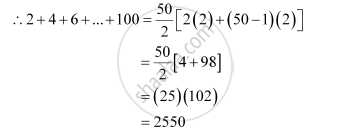
The integers from 1 to 100, which are divisible by 2, are 2, 4, 6… 100.
This forms an A.P. with both the first term and common difference equal to 2.
⇒100 = 2 + (n –1) 2
⇒ n = 50
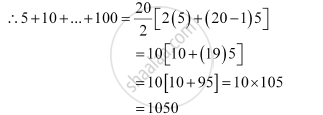
The integers from 1 to 100, which are divisible by 5, are 5, 10… 100.
This forms an A.P. with both the first term and common difference equal to 5.
∴100 = 5 + (n –1) 5
⇒ 5n = 100
⇒ n = 20
The integers, which are divisible by both 2 and 5, are 10, 20, … 100.
This also forms an A.P. with both the first term and common difference equal to 10.
∴100 = 10 + (n –1) (10)
⇒ 100 = 10n
⇒ n = 10

∴Required sum = 2550 + 1050 – 550 = 3050
Thus, the sum of the integers from 1 to 100, which are divisible by 2 or 5, is 3050.
संबंधित प्रश्न
If the sum of n terms of an A.P. is (pn + qn2), where p and q are constants, find the common difference.
Let < an > be a sequence. Write the first five term in the following:
a1 = 1 = a2, an = an − 1 + an − 2, n > 2
Is 302 a term of the A.P. 3, 8, 13, ...?
If the nth term of the A.P. 9, 7, 5, ... is same as the nth term of the A.P. 15, 12, 9, ... find n.
The first and the last terms of an A.P. are a and l respectively. Show that the sum of nthterm from the beginning and nth term from the end is a + l.
\[\text { If } \theta_1 , \theta_2 , \theta_3 , . . . , \theta_n \text { are in AP, whose common difference is d, then show that }\]
\[\sec \theta_1 \sec \theta_2 + \sec \theta_2 \sec \theta_3 + . . . + \sec \theta_{n - 1} \sec \theta_n = \frac{\tan \theta_n - \tan \theta_1}{\sin d} \left[ NCERT \hspace{0.167em} EXEMPLAR \right]\]
The sum of three terms of an A.P. is 21 and the product of the first and the third terms exceeds the second term by 6, find three terms.
Find the sum of the following arithmetic progression :
50, 46, 42, ... to 10 terms
Find the sum of the following arithmetic progression :
(x − y)2, (x2 + y2), (x + y)2, ... to n terms
Solve:
25 + 22 + 19 + 16 + ... + x = 115
Solve:
1 + 4 + 7 + 10 + ... + x = 590.
The third term of an A.P. is 7 and the seventh term exceeds three times the third term by 2. Find the first term, the common difference and the sum of first 20 terms.
The first term of an A.P. is 2 and the last term is 50. The sum of all these terms is 442. Find the common difference.
The number of terms of an A.P. is even; the sum of odd terms is 24, of the even terms is 30, and the last term exceeds the first by \[10 \frac{1}{2}\] , find the number of terms and the series.
If the sum of a certain number of terms of the AP 25, 22, 19, ... is 116. Find the last term.
If \[\frac{1}{a}, \frac{1}{b}, \frac{1}{c}\] are in A.P., prove that:
a (b +c), b (c + a), c (a +b) are in A.P.
If \[\frac{b + c}{a}, \frac{c + a}{b}, \frac{a + b}{c}\] are in A.P., prove that:
\[\frac{1}{a}, \frac{1}{b}, \frac{1}{c}\] are in A.P.
If \[a\left( \frac{1}{b} + \frac{1}{c} \right), b\left( \frac{1}{c} + \frac{1}{a} \right), c\left( \frac{1}{a} + \frac{1}{b} \right)\] are in A.P., prove that a, b, c are in A.P.
If x, y, z are in A.P. and A1 is the A.M. of x and y and A2 is the A.M. of y and z, then prove that the A.M. of A1 and A2 is y.
A man arranges to pay off a debt of Rs 3600 by 40 annual instalments which form an arithmetic series. When 30 of the instalments are paid, he dies leaving one-third of the debt unpaid, find the value of the first instalment.
A manufacturer of radio sets produced 600 units in the third year and 700 units in the seventh year. Assuming that the product increases uniformly by a fixed number every year, find (i) the production in the first year (ii) the total product in 7 years and (iii) the product in the 10th year.
A carpenter was hired to build 192 window frames. The first day he made five frames and each day thereafter he made two more frames than he made the day before. How many days did it take him to finish the job?
If m th term of an A.P. is n and nth term is m, then write its pth term.
Sum of all two digit numbers which when divided by 4 yield unity as remainder is
If Sn denotes the sum of first n terms of an A.P. < an > such that
The first and last terms of an A.P. are 1 and 11. If the sum of its terms is 36, then the number of terms will be
If the sum of n terms of an A.P., is 3 n2 + 5 n then which of its terms is 164?
The pth term of an A.P. is a and qth term is b. Prove that the sum of its (p + q) terms is `(p + q)/2[a + b + (a - b)/(p - q)]`.
Show that (x2 + xy + y2), (z2 + xz + x2) and (y2 + yz + z2) are consecutive terms of an A.P., if x, y and z are in A.P.
In an A.P. the pth term is q and the (p + q)th term is 0. Then the qth term is ______.
If 9 times the 9th term of an A.P. is equal to 13 times the 13th term, then the 22nd term of the A.P. is ______.
Let 3, 6, 9, 12 ....... upto 78 terms and 5, 9, 13, 17 ...... upto 59 be two series. Then, the sum of the terms common to both the series is equal to ______.
If a1, a2, a3, .......... are an A.P. such that a1 + a5 + a10 + a15 + a20 + a24 = 225, then a1 + a2 + a3 + ...... + a23 + a24 is equal to ______.
Which of the following best defines an Arithmetic Progression (A.P.)?
