Advertisements
Advertisements
प्रश्न
Find the sum of all numbers between 200 and 400 which are divisible by 7.
Advertisements
उत्तर
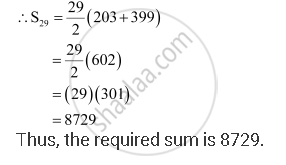
The numbers lying between 200 and 400, which are divisible by 7, are
203, 210, 217, … 399
∴First term, a = 203
Last term, l = 399
Common difference, d = 7
Let the number of terms of the A.P. be n.
∴ an = 399 = a + (n –1) d
⇒ 399 = 203 + (n –1) 7
⇒ 7 (n –1) = 196
⇒ n –1 = 28
⇒ n = 29
संबंधित प्रश्न
Insert five numbers between 8 and 26 such that the resulting sequence is an A.P.
Show that the following sequence is an A.P. Also find the common difference and write 3 more terms in case.
9, 7, 5, 3, ...
Find:
18th term of the A.P.
\[\sqrt{2}, 3\sqrt{2}, 5\sqrt{2},\]
Which term of the sequence 12 + 8i, 11 + 6i, 10 + 4i, ... is purely real ?
How many terms are there in the A.P.\[- 1, - \frac{5}{6}, -\frac{2}{3}, - \frac{1}{2}, . . . , \frac{10}{3}?\]
If the nth term of the A.P. 9, 7, 5, ... is same as the nth term of the A.P. 15, 12, 9, ... find n.
Find the 12th term from the following arithmetic progression:
1, 4, 7, 10, ..., 88
The 4th term of an A.P. is three times the first and the 7th term exceeds twice the third term by 1. Find the first term and the common difference.
If < an > is an A.P. such that \[\frac{a_4}{a_7} = \frac{2}{3}, \text { find }\frac{a_6}{a_8}\].
The sum of three terms of an A.P. is 21 and the product of the first and the third terms exceeds the second term by 6, find three terms.
Find the four numbers in A.P., whose sum is 50 and in which the greatest number is 4 times the least.
The sum of three numbers in A.P. is 12 and the sum of their cubes is 288. Find the numbers.
Find the sum of the following arithmetic progression :
3, 9/2, 6, 15/2, ... to 25 terms
Find the sum of the following serie:
2 + 5 + 8 + ... + 182
Show that the sum of all odd integers between 1 and 1000 which are divisible by 3 is 83667.
Find the sum of all even integers between 101 and 999.
Find the sum of all integers between 100 and 550, which are divisible by 9.
Find the sum of the series:
3 + 5 + 7 + 6 + 9 + 12 + 9 + 13 + 17 + ... to 3n terms.
Solve:
1 + 4 + 7 + 10 + ... + x = 590.
Find the r th term of an A.P., the sum of whose first n terms is 3n2 + 2n.
If S1 be the sum of (2n + 1) terms of an A.P. and S2 be the sum of its odd terms, then prove that: S1 : S2 = (2n + 1) : (n + 1).
Find an A.P. in which the sum of any number of terms is always three times the squared number of these terms.
If a2, b2, c2 are in A.P., prove that \[\frac{a}{b + c}, \frac{b}{c + a}, \frac{c}{a + b}\] are in A.P.
If a, b, c is in A.P., prove that:
a3 + c3 + 6abc = 8b3.
Shamshad Ali buys a scooter for Rs 22000. He pays Rs 4000 cash and agrees to pay the balance in annual instalments of Rs 1000 plus 10% interest on the unpaid amount. How much the scooter will cost him.
The income of a person is Rs 300,000 in the first year and he receives an increase of Rs 10000 to his income per year for the next 19 years. Find the total amount, he received in 20 years.
If the sums of n terms of two arithmetic progressions are in the ratio 2n + 5 : 3n + 4, then write the ratio of their m th terms.
Write the value of n for which n th terms of the A.P.s 3, 10, 17, ... and 63, 65, 67, .... are equal.
If the sum of n terms of an A.P. be 3 n2 − n and its common difference is 6, then its first term is
If the sum of n terms of an A.P. is 2 n2 + 5 n, then its nth term is
If n arithmetic means are inserted between 1 and 31 such that the ratio of the first mean and nth mean is 3 : 29, then the value of n is
If in an A.P., Sn = n2p and Sm = m2p, where Sr denotes the sum of r terms of the A.P., then Sp is equal to
Mark the correct alternative in the following question:
The 10th common term between the A.P.s 3, 7, 11, 15, ... and 1, 6, 11, 16, ... is
The first term of an A.P. is a, the second term is b and the last term is c. Show that the sum of the A.P. is `((b + c - 2a)(c + a))/(2(b - a))`.
The pth term of an A.P. is a and qth term is b. Prove that the sum of its (p + q) terms is `(p + q)/2[a + b + (a - b)/(p - q)]`.
Show that (x2 + xy + y2), (z2 + xz + x2) and (y2 + yz + z2) are consecutive terms of an A.P., if x, y and z are in A.P.
If in an A.P., Sn = qn2 and Sm = qm2, where Sr denotes the sum of r terms of the A.P., then Sq equals ______.
If the ratio of the sum of n terms of two APs is 2n:(n + 1), then the ratio of their 8th terms is ______.
If 100 times the 100th term of an A.P. with non zero common difference equals the 50 times its 50th term, then the 150th term of this A.P. is ______.
What is the general form of an A.P. with first term \(a\) and common difference \(d\)?
