Advertisements
Advertisements
Question
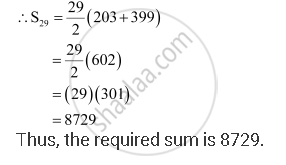
Find the sum of all numbers between 200 and 400 which are divisible by 7.
Advertisements
Solution
The numbers lying between 200 and 400, which are divisible by 7, are
203, 210, 217, … 399
∴First term, a = 203
Last term, l = 399
Common difference, d = 7
Let the number of terms of the A.P. be n.
∴ an = 399 = a + (n –1) d
⇒ 399 = 203 + (n –1) 7
⇒ 7 (n –1) = 196
⇒ n –1 = 28
⇒ n = 29
RELATED QUESTIONS
In an A.P., if pth term is 1/q and qth term is 1/p, prove that the sum of first pq terms is 1/2 (pq + 1) where `p != q`
Find the sum to n terms of the A.P., whose kth term is 5k + 1.
The sums of n terms of two arithmetic progressions are in the ratio 5n + 4: 9n + 6. Find the ratio of their 18th terms
The ratio of the sums of m and n terms of an A.P. is m2: n2. Show that the ratio of mth and nthterm is (2m – 1): (2n – 1)
Show that the sum of (m + n)th and (m – n)th terms of an A.P. is equal to twice the mth term.
The Fibonacci sequence is defined by a1 = 1 = a2, an = an − 1 + an − 2 for n > 2
Find `(""^an +1)/(""^an")` for n = 1, 2, 3, 4, 5.
Show that the following sequence is an A.P. Also find the common difference and write 3 more terms in case.
\[\sqrt{2}, 3\sqrt{2}, 5\sqrt{2}, 7\sqrt{2}, . . .\]
Which term of the A.P. 3, 8, 13, ... is 248?
The 10th and 18th terms of an A.P. are 41 and 73 respectively. Find 26th term.
Find the 12th term from the following arithmetic progression:
1, 4, 7, 10, ..., 88
The 4th term of an A.P. is three times the first and the 7th term exceeds twice the third term by 1. Find the first term and the common difference.
How many numbers are there between 1 and 1000 which when divided by 7 leave remainder 4?
The sum of three terms of an A.P. is 21 and the product of the first and the third terms exceeds the second term by 6, find three terms.
Three numbers are in A.P. If the sum of these numbers be 27 and the product 648, find the numbers.
Find the sum of the following arithmetic progression :
50, 46, 42, ... to 10 terms
Find the sum of the following arithmetic progression :
(x − y)2, (x2 + y2), (x + y)2, ... to n terms
Find the sum of first n natural numbers.
Show that the sum of all odd integers between 1 and 1000 which are divisible by 3 is 83667.
Find the sum of all integers between 84 and 719, which are multiples of 5.
The sum of first 7 terms of an A.P. is 10 and that of next 7 terms is 17. Find the progression.
If S1 be the sum of (2n + 1) terms of an A.P. and S2 be the sum of its odd terms, then prove that: S1 : S2 = (2n + 1) : (n + 1).
Find an A.P. in which the sum of any number of terms is always three times the squared number of these terms.
A carpenter was hired to build 192 window frames. The first day he made five frames and each day thereafter he made two more frames than he made the day before. How many days did it take him to finish the job?
Write the value of n for which n th terms of the A.P.s 3, 10, 17, ... and 63, 65, 67, .... are equal.
If m th term of an A.P. is n and nth term is m, then write its pth term.
If Sn denotes the sum of first n terms of an A.P. < an > such that
If n arithmetic means are inserted between 1 and 31 such that the ratio of the first mean and nth mean is 3 : 29, then the value of n is
Mark the correct alternative in the following question:
\[\text { If in an A . P } . S_n = n^2 q \text { and } S_m = m^2 q, \text { where } S_r \text{ denotes the sum of r terms of the A . P . , then }S_q \text { equals }\]
The first term of an A.P. is a, the second term is b and the last term is c. Show that the sum of the A.P. is `((b + c - 2a)(c + a))/(2(b - a))`.
If there are (2n + 1) terms in an A.P., then prove that the ratio of the sum of odd terms and the sum of even terms is (n + 1) : n
If a1, a2, ..., an are in A.P. with common difference d (where d ≠ 0); then the sum of the series sin d (cosec a1 cosec a2 + cosec a2 cosec a3 + ...+ cosec an–1 cosec an) is equal to cot a1 – cot an
In an A.P. the pth term is q and the (p + q)th term is 0. Then the qth term is ______.
A man accepts a position with an initial salary of Rs 5200 per month. It is understood that he will receive an automatic increase of Rs 320 in the very next month and each month thereafter. Find his salary for the tenth month
If the sum of n terms of an A.P. is given by Sn = 3n + 2n2, then the common difference of the A.P. is ______.
Let Sn denote the sum of the first n terms of an A.P. If S2n = 3Sn then S3n: Sn is equal to ______.
The number of terms in an A.P. is even; the sum of the odd terms in lt is 24 and that the even terms is 30. If the last term exceeds the first term by `10 1/2`, then the number of terms in the A.P. is ______.
