Advertisements
Advertisements
Question
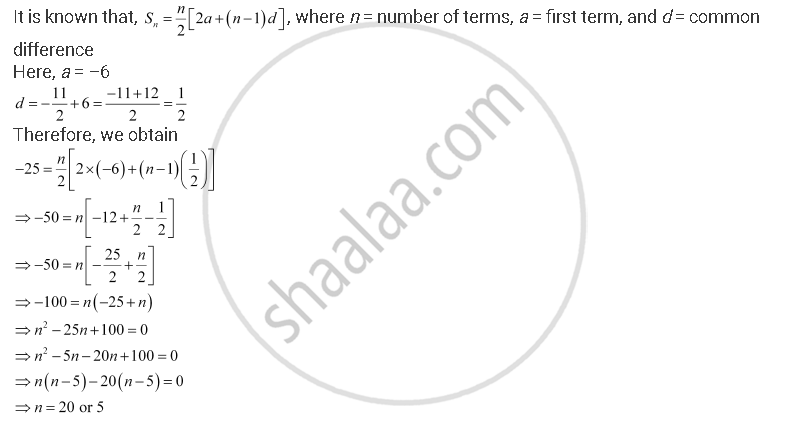
How many terms of the A.P. -6 , `-11/2` , -5... are needed to give the sum –25?
Advertisements
Solution
Let the sum of n terms of the given A.P. be –25.
RELATED QUESTIONS
Find the sum of odd integers from 1 to 2001.
Find the sum of all natural numbers lying between 100 and 1000, which are multiples of 5.
The sums of n terms of two arithmetic progressions are in the ratio 5n + 4: 9n + 6. Find the ratio of their 18th terms
If the sum of first p terms of an A.P. is equal to the sum of the first q terms, then find the sum of the first (p + q) terms.
A farmer buys a used tractor for Rs 12000. He pays Rs 6000 cash and agrees to pay the balance in annual installments of Rs 500 plus 12% interest on the unpaid amount. How much will be the tractor cost him?
Show that the following sequence is an A.P. Also find the common difference and write 3 more terms in case.
\[\sqrt{2}, 3\sqrt{2}, 5\sqrt{2}, 7\sqrt{2}, . . .\]
Find:
18th term of the A.P.
\[\sqrt{2}, 3\sqrt{2}, 5\sqrt{2},\]
The first term of an A.P. is 5, the common difference is 3 and the last term is 80; find the number of terms.
If 10 times the 10th term of an A.P. is equal to 15 times the 15th term, show that 25th term of the A.P. is zero.
If (m + 1)th term of an A.P. is twice the (n + 1)th term, prove that (3m + 1)th term is twice the (m + n + 1)th term.
The 4th term of an A.P. is three times the first and the 7th term exceeds twice the third term by 1. Find the first term and the common difference.
If the sum of three numbers in A.P. is 24 and their product is 440, find the numbers.
Find the sum of the following arithmetic progression :
41, 36, 31, ... to 12 terms
Find the sum of all integers between 100 and 550, which are divisible by 9.
Find the r th term of an A.P., the sum of whose first n terms is 3n2 + 2n.
The third term of an A.P. is 7 and the seventh term exceeds three times the third term by 2. Find the first term, the common difference and the sum of first 20 terms.
If Sn = n2 p and Sm = m2 p, m ≠ n, in an A.P., prove that Sp = p3.
Find the sum of all two digit numbers which when divided by 4, yields 1 as remainder.
Find the sum of odd integers from 1 to 2001.
If \[\frac{1}{a}, \frac{1}{b}, \frac{1}{c}\] are in A.P., prove that:
a (b +c), b (c + a), c (a +b) are in A.P.
If a2, b2, c2 are in A.P., prove that \[\frac{a}{b + c}, \frac{b}{c + a}, \frac{c}{a + b}\] are in A.P.
If a, b, c is in A.P., then show that:
bc − a2, ca − b2, ab − c2 are in A.P.
If \[a\left( \frac{1}{b} + \frac{1}{c} \right), b\left( \frac{1}{c} + \frac{1}{a} \right), c\left( \frac{1}{a} + \frac{1}{b} \right)\] are in A.P., prove that a, b, c are in A.P.
A carpenter was hired to build 192 window frames. The first day he made five frames and each day thereafter he made two more frames than he made the day before. How many days did it take him to finish the job?
We know that the sum of the interior angles of a triangle is 180°. Show that the sums of the interior angles of polygons with 3, 4, 5, 6, ... sides form an arithmetic progression. Find the sum of the interior angles for a 21 sided polygon.
In a cricket team tournament 16 teams participated. A sum of ₹8000 is to be awarded among themselves as prize money. If the last place team is awarded ₹275 in prize money and the award increases by the same amount for successive finishing places, then how much amount will the first place team receive?
Sum of all two digit numbers which when divided by 4 yield unity as remainder is
If the sum of n terms of an A.P. is 2 n2 + 5 n, then its nth term is
If a1, a2, a3, .... an are in A.P. with common difference d, then the sum of the series sin d [cosec a1cosec a2 + cosec a1 cosec a3 + .... + cosec an − 1 cosec an] is
Mark the correct alternative in the following question:
\[\text { If in an A . P } . S_n = n^2 q \text { and } S_m = m^2 q, \text { where } S_r \text{ denotes the sum of r terms of the A . P . , then }S_q \text { equals }\]
Find the sum of first 24 terms of the A.P. a1, a2, a3, ... if it is known that a1 + a5 + a10 + a15 + a20 + a24 = 225.
The product of three numbers in A.P. is 224, and the largest number is 7 times the smallest. Find the numbers
The first term of an A.P.is a, and the sum of the first p terms is zero, show that the sum of its next q terms is `(-a(p + q)q)/(p - 1)`
A man accepts a position with an initial salary of Rs 5200 per month. It is understood that he will receive an automatic increase of Rs 320 in the very next month and each month thereafter. What is his total earnings during the first year?
If in an A.P., Sn = qn2 and Sm = qm2, where Sr denotes the sum of r terms of the A.P., then Sq equals ______.
The internal angles of a convex polygon are in A.P. The smallest angle is 120° and the common difference is 5°. The number to sides of the polygon is ______.
If you save ₹500 in the first month, ₹700 in the second month, ₹900 in the third month, and so on, what is the common difference of the A.P. \(500, 700, 900, 1100, \ldots\)?
