Advertisements
Advertisements
प्रश्न
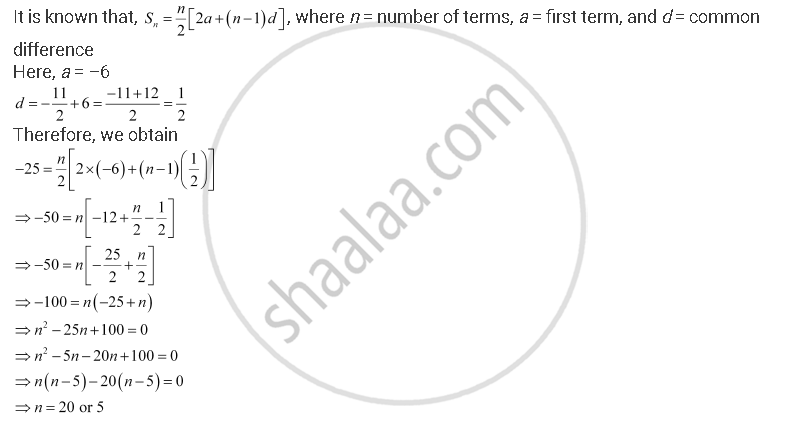
How many terms of the A.P. -6 , `-11/2` , -5... are needed to give the sum –25?
Advertisements
उत्तर
Let the sum of n terms of the given A.P. be –25.
संबंधित प्रश्न
If the sum of n terms of an A.P. is (pn + qn2), where p and q are constants, find the common difference.
If the sum of first p terms of an A.P. is equal to the sum of the first q terms, then find the sum of the first (p + q) terms.
if `(a^n + b^n)/(a^(n-1) + b^(n-1))` is the A.M. between a and b, then find the value of n.
Find the sum of integers from 1 to 100 that are divisible by 2 or 5.
The pth, qth and rth terms of an A.P. are a, b, c respectively. Show that (q – r )a + (r – p )b + (p – q )c = 0
Let < an > be a sequence. Write the first five term in the following:
a1 = 1 = a2, an = an − 1 + an − 2, n > 2
Find:
nth term of the A.P. 13, 8, 3, −2, ...
Which term of the A.P. 4, 9, 14, ... is 254?
Which term of the sequence 12 + 8i, 11 + 6i, 10 + 4i, ... is purely real ?
How many terms are there in the A.P.\[- 1, - \frac{5}{6}, -\frac{2}{3}, - \frac{1}{2}, . . . , \frac{10}{3}?\]
In a certain A.P. the 24th term is twice the 10th term. Prove that the 72nd term is twice the 34th term.
Find the 12th term from the following arithmetic progression:
3, 8, 13, ..., 253
The sum of three terms of an A.P. is 21 and the product of the first and the third terms exceeds the second term by 6, find three terms.
Three numbers are in A.P. If the sum of these numbers be 27 and the product 648, find the numbers.
If the sum of three numbers in A.P. is 24 and their product is 440, find the numbers.
Find the sum of first n natural numbers.
Find the sum of all natural numbers between 1 and 100, which are divisible by 2 or 5.
Find the sum of all integers between 50 and 500 which are divisible by 7.
Find the sum of all integers between 100 and 550, which are divisible by 9.
If Sn = n2 p and Sm = m2 p, m ≠ n, in an A.P., prove that Sp = p3.
Find the sum of n terms of the A.P. whose kth terms is 5k + 1.
Find the sum of all two digit numbers which when divided by 4, yields 1 as remainder.
If \[\frac{1}{a}, \frac{1}{b}, \frac{1}{c}\] are in A.P., prove that:
\[\frac{b + c}{a}, \frac{c + a}{b}, \frac{a + b}{c}\] are in A.P.
If \[\frac{b + c}{a}, \frac{c + a}{b}, \frac{a + b}{c}\] are in A.P., prove that:
\[\frac{1}{a}, \frac{1}{b}, \frac{1}{c}\] are in A.P.
If a, b, c is in A.P., prove that:
a2 + c2 + 4ac = 2 (ab + bc + ca)
A man arranges to pay off a debt of Rs 3600 by 40 annual instalments which form an arithmetic series. When 30 of the instalments are paid, he dies leaving one-third of the debt unpaid, find the value of the first instalment.
The income of a person is Rs 300,000 in the first year and he receives an increase of Rs 10000 to his income per year for the next 19 years. Find the total amount, he received in 20 years.
In n A.M.'s are introduced between 3 and 17 such that the ratio of the last mean to the first mean is 3 : 1, then the value of n is
If Sn denotes the sum of first n terms of an A.P. < an > such that
If the sum of n terms of an A.P., is 3 n2 + 5 n then which of its terms is 164?
If the first, second and last term of an A.P are a, b and 2a respectively, then its sum is
If for an arithmetic progression, 9 times nineth term is equal to 13 times thirteenth term, then value of twenty second term is ____________.
A man accepts a position with an initial salary of Rs 5200 per month. It is understood that he will receive an automatic increase of Rs 320 in the very next month and each month thereafter. Find his salary for the tenth month
If the sum of p terms of an A.P. is q and the sum of q terms is p, show that the sum of p + q terms is – (p + q). Also, find the sum of first p – q terms (p > q).
If the sum of n terms of an A.P. is given by Sn = 3n + 2n2, then the common difference of the A.P. is ______.
Any term of an A.P. (except first) is equal to half the sum of terms which are equidistant from it.
What is the general form of an A.P. with first term \(a\) and common difference \(d\)?
