Advertisements
Advertisements
प्रश्न
If the sum of first p terms of an A.P. is equal to the sum of the first q terms, then find the sum of the first (p + q) terms.
Advertisements
उत्तर
Let a and d be the first term and the common difference of the A.P. respectively.
Here,
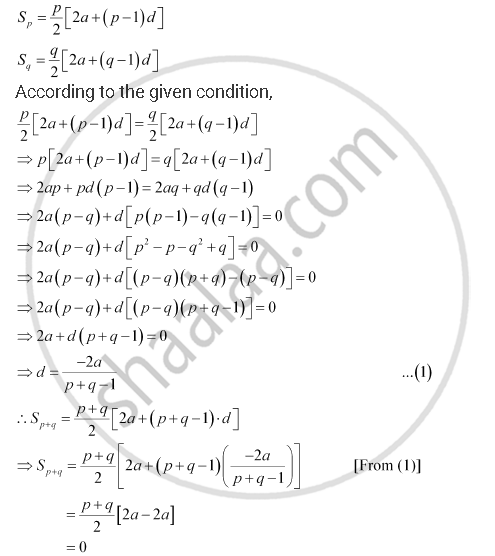
Thus, the sum of the first (p + q) terms of the A.P. is 0.
संबंधित प्रश्न
Find the sum of odd integers from 1 to 2001.
How many terms of the A.P. -6 , `-11/2` , -5... are needed to give the sum –25?
In an A.P., if pth term is 1/q and qth term is 1/p, prove that the sum of first pq terms is 1/2 (pq + 1) where `p != q`
A farmer buys a used tractor for Rs 12000. He pays Rs 6000 cash and agrees to pay the balance in annual installments of Rs 500 plus 12% interest on the unpaid amount. How much will be the tractor cost him?
Let < an > be a sequence defined by a1 = 3 and, an = 3an − 1 + 2, for all n > 1
Find the first four terms of the sequence.
Show that the following sequence is an A.P. Also find the common difference and write 3 more terms in case.
\[\sqrt{2}, 3\sqrt{2}, 5\sqrt{2}, 7\sqrt{2}, . . .\]
If the sequence < an > is an A.P., show that am +n +am − n = 2am.
Find the 12th term from the following arithmetic progression:
3, 8, 13, ..., 253
The 4th term of an A.P. is three times the first and the 7th term exceeds twice the third term by 1. Find the first term and the common difference.
The sum of 4th and 8th terms of an A.P. is 24 and the sum of the 6th and 10th terms is 34. Find the first term and the common difference of the A.P.
Three numbers are in A.P. If the sum of these numbers be 27 and the product 648, find the numbers.
If the sum of three numbers in A.P. is 24 and their product is 440, find the numbers.
The angles of a quadrilateral are in A.P. whose common difference is 10°. Find the angles.
Find the sum of the following arithmetic progression :
41, 36, 31, ... to 12 terms
Find the sum of the following serie:
2 + 5 + 8 + ... + 182
How many terms are there in the A.P. whose first and fifth terms are −14 and 2 respectively and the sum of the terms is 40?
If the 5th and 12th terms of an A.P. are 30 and 65 respectively, what is the sum of first 20 terms?
If the sum of a certain number of terms of the AP 25, 22, 19, ... is 116. Find the last term.
If S1 be the sum of (2n + 1) terms of an A.P. and S2 be the sum of its odd terms, then prove that: S1 : S2 = (2n + 1) : (n + 1).
The sums of n terms of two arithmetic progressions are in the ratio 5n + 4 : 9n + 6. Find the ratio of their 18th terms.
The sums of first n terms of two A.P.'s are in the ratio (7n + 2) : (n + 4). Find the ratio of their 5th terms.
If a, b, c is in A.P., then show that:
b + c − a, c + a − b, a + b − c are in A.P.
If a, b, c is in A.P., prove that:
a3 + c3 + 6abc = 8b3.
There are 25 trees at equal distances of 5 metres in a line with a well, the distance of the well from the nearest tree being 10 metres. A gardener waters all the trees separately starting from the well and he returns to the well after watering each tree to get water for the next. Find the total distance the gardener will cover in order to water all the trees.
A man is employed to count Rs 10710. He counts at the rate of Rs 180 per minute for half an hour. After this he counts at the rate of Rs 3 less every minute than the preceding minute. Find the time taken by him to count the entire amount.
A man saved ₹66000 in 20 years. In each succeeding year after the first year he saved ₹200 more than what he saved in the previous year. How much did he save in the first year?
If Sn denotes the sum of first n terms of an A.P. < an > such that
The first and last terms of an A.P. are 1 and 11. If the sum of its terms is 36, then the number of terms will be
If a1, a2, a3, .... an are in A.P. with common difference d, then the sum of the series sin d [cosec a1cosec a2 + cosec a1 cosec a3 + .... + cosec an − 1 cosec an] is
The pth term of an A.P. is a and qth term is b. Prove that the sum of its (p + q) terms is `(p + q)/2[a + b + (a - b)/(p - q)]`.
If a1, a2, ..., an are in A.P. with common difference d (where d ≠ 0); then the sum of the series sin d (cosec a1 cosec a2 + cosec a2 cosec a3 + ...+ cosec an–1 cosec an) is equal to cot a1 – cot an
If in an A.P., Sn = qn2 and Sm = qm2, where Sr denotes the sum of r terms of the A.P., then Sq equals ______.
Any term of an A.P. (except first) is equal to half the sum of terms which are equidistant from it.
If n AM's are inserted between 1 and 31 and ratio of 7th and (n – 1)th A.M. is 5:9, then n equals ______.
If b2, a2, c2 are in A.P., then `1/(a + b), 1/(b + c), 1/(c + a)` will be in ______
What is the general form of an A.P. with first term \(a\) and common difference \(d\)?
Which of the following is an example of a Constant A.P.?
