Advertisements
Advertisements
प्रश्न
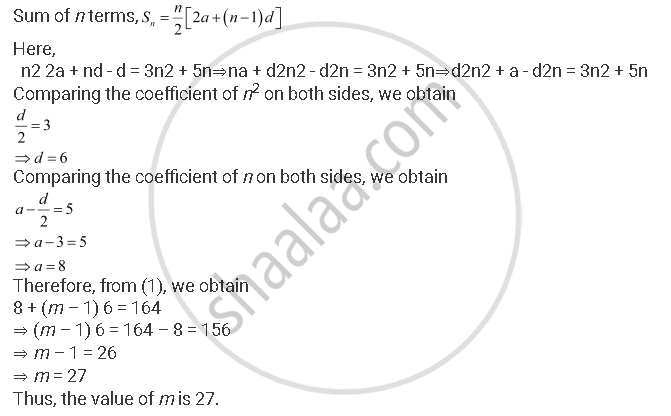
If the sum of n terms of an A.P. is 3n2 + 5n and its mth term is 164, find the value of m.
Advertisements
उत्तर
Let a and b be the first term and the common difference of the A.P. respectively.
am = a + (m – 1)d = 164 … (1)
संबंधित प्रश्न
Find the sum of odd integers from 1 to 2001.
Find the sum of all natural numbers lying between 100 and 1000, which are multiples of 5.
Insert five numbers between 8 and 26 such that the resulting sequence is an A.P.
Between 1 and 31, m numbers have been inserted in such a way that the resulting sequence is an A.P. and the ratio of 7th and (m – 1)th numbers is 5:9. Find the value of m.
A man starts repaying a loan as first installment of Rs. 100. If he increases the installment by Rs 5 every month, what amount he will pay in the 30th installment?
The difference between any two consecutive interior angles of a polygon is 5°. If the smallest angle is 120°, find the number of the sides of the polygon.
Let the sum of n, 2n, 3n terms of an A.P. be S1, S2 and S3, respectively, show that S3 = 3 (S2– S1)
if `a(1/b + 1/c), b(1/c+1/a), c(1/a+1/b)` are in A.P., prove that a, b, c are in A.P.
A farmer buys a used tractor for Rs 12000. He pays Rs 6000 cash and agrees to pay the balance in annual installments of Rs 500 plus 12% interest on the unpaid amount. How much will be the tractor cost him?
Shamshad Ali buys a scooter for Rs 22000. He pays Rs 4000 cash and agrees to pay the balance in annual installment of Rs 1000 plus 10% interest on the unpaid amount. How much will the scooter cost him?
Let < an > be a sequence defined by a1 = 3 and, an = 3an − 1 + 2, for all n > 1
Find the first four terms of the sequence.
Let < an > be a sequence. Write the first five term in the following:
a1 = 1, an = an − 1 + 2, n ≥ 2
Let < an > be a sequence. Write the first five term in the following:
a1 = a2 = 2, an = an − 1 − 1, n > 2
The Fibonacci sequence is defined by a1 = 1 = a2, an = an − 1 + an − 2 for n > 2
Find `(""^an +1)/(""^an")` for n = 1, 2, 3, 4, 5.
Show that the following sequence is an A.P. Also find the common difference and write 3 more terms in case.
−1, 1/4, 3/2, 11/4, ...
If the sequence < an > is an A.P., show that am +n +am − n = 2am.
Which term of the sequence 12 + 8i, 11 + 6i, 10 + 4i, ... is purely real ?
The 4th term of an A.P. is three times the first and the 7th term exceeds twice the third term by 1. Find the first term and the common difference.
The sum of 4th and 8th terms of an A.P. is 24 and the sum of the 6th and 10th terms is 34. Find the first term and the common difference of the A.P.
Find the sum of the following arithmetic progression :
41, 36, 31, ... to 12 terms
Solve:
1 + 4 + 7 + 10 + ... + x = 590.
Find the r th term of an A.P., the sum of whose first n terms is 3n2 + 2n.
The sum of first 7 terms of an A.P. is 10 and that of next 7 terms is 17. Find the progression.
The third term of an A.P. is 7 and the seventh term exceeds three times the third term by 2. Find the first term, the common difference and the sum of first 20 terms.
If the 5th and 12th terms of an A.P. are 30 and 65 respectively, what is the sum of first 20 terms?
In an A.P. the first term is 2 and the sum of the first five terms is one fourth of the next five terms. Show that 20th term is −112.
If \[\frac{b + c}{a}, \frac{c + a}{b}, \frac{a + b}{c}\] are in A.P., prove that:
\[\frac{1}{a}, \frac{1}{b}, \frac{1}{c}\] are in A.P.
If the sum of n terms of an AP is 2n2 + 3n, then write its nth term.
If the sums of n terms of two arithmetic progressions are in the ratio 2n + 5 : 3n + 4, then write the ratio of their m th terms.
If four numbers in A.P. are such that their sum is 50 and the greatest number is 4 times the least, then the numbers are
If n arithmetic means are inserted between 1 and 31 such that the ratio of the first mean and nth mean is 3 : 29, then the value of n is
The first and last term of an A.P. are a and l respectively. If S is the sum of all the terms of the A.P. and the common difference is given by \[\frac{l^2 - a^2}{k - (l + a)}\] , then k =
If the sum of m terms of an A.P. is equal to the sum of either the next n terms or the next p terms, then prove that `(m + n) (1/m - 1/p) = (m + p) (1/m - 1/n)`
If a, b, c, d are four distinct positive quantities in A.P., then show that bc > ad
If a1, a2, a3, .......... are an A.P. such that a1 + a5 + a10 + a15 + a20 + a24 = 225, then a1 + a2 + a3 + ...... + a23 + a24 is equal to ______.
Which type of A.P. is represented by the sequence \(2, 5, 8, 11, \ldots\)?
A sequence \(20, 17, 14, 11, \ldots\) is classified as:
Which of the following is an example of a Constant A.P.?
