Advertisements
Advertisements
Question
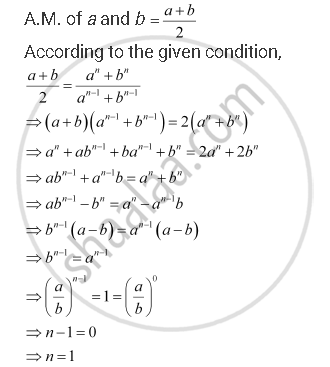
if `(a^n + b^n)/(a^(n-1) + b^(n-1))` is the A.M. between a and b, then find the value of n.
Advertisements
Solution
RELATED QUESTIONS
In an A.P, the first term is 2 and the sum of the first five terms is one-fourth of the next five terms. Show that 20th term is –112.
In an A.P., if pth term is 1/q and qth term is 1/p, prove that the sum of first pq terms is 1/2 (pq + 1) where `p != q`
Sum of the first p, q and r terms of an A.P. are a, b and c, respectively.
Prove that `a/p (q - r) + b/q (r- p) + c/r (p - q) = 0`
A man starts repaying a loan as first installment of Rs. 100. If he increases the installment by Rs 5 every month, what amount he will pay in the 30th installment?
Find the sum of integers from 1 to 100 that are divisible by 2 or 5.
Find the sum of all two digit numbers which when divided by 4, yields 1 as remainder.
if `a(1/b + 1/c), b(1/c+1/a), c(1/a+1/b)` are in A.P., prove that a, b, c are in A.P.
A person writes a letter to four of his friends. He asks each one of them to copy the letter and mail to four different persons with instruction that they move the chain similarly. Assuming that the chain is not broken and that it costs 50 paise to mail one letter. Find the amount spent on the postage when 8th set of letter is mailed.
Find:
18th term of the A.P.
\[\sqrt{2}, 3\sqrt{2}, 5\sqrt{2},\]
Is 68 a term of the A.P. 7, 10, 13, ...?
An A.P. consists of 60 terms. If the first and the last terms be 7 and 125 respectively, find 32nd term.
How many numbers are there between 1 and 1000 which when divided by 7 leave remainder 4?
Find the sum of the following arithmetic progression :
50, 46, 42, ... to 10 terms
Find the sum of the following serie:
101 + 99 + 97 + ... + 47
If 12th term of an A.P. is −13 and the sum of the first four terms is 24, what is the sum of first 10 terms?
Find the sum of odd integers from 1 to 2001.
If a, b, c is in A.P., then show that:
b + c − a, c + a − b, a + b − c are in A.P.
If a, b, c is in A.P., then show that:
bc − a2, ca − b2, ab − c2 are in A.P.
A man arranges to pay off a debt of Rs 3600 by 40 annual instalments which form an arithmetic series. When 30 of the instalments are paid, he dies leaving one-third of the debt unpaid, find the value of the first instalment.
There are 25 trees at equal distances of 5 metres in a line with a well, the distance of the well from the nearest tree being 10 metres. A gardener waters all the trees separately starting from the well and he returns to the well after watering each tree to get water for the next. Find the total distance the gardener will cover in order to water all the trees.
A carpenter was hired to build 192 window frames. The first day he made five frames and each day thereafter he made two more frames than he made the day before. How many days did it take him to finish the job?
We know that the sum of the interior angles of a triangle is 180°. Show that the sums of the interior angles of polygons with 3, 4, 5, 6, ... sides form an arithmetic progression. Find the sum of the interior angles for a 21 sided polygon.
A man saved ₹66000 in 20 years. In each succeeding year after the first year he saved ₹200 more than what he saved in the previous year. How much did he save in the first year?
If the sum of n terms of an AP is 2n2 + 3n, then write its nth term.
Let Sn denote the sum of n terms of an A.P. whose first term is a. If the common difference d is given by d = Sn − k Sn − 1 + Sn − 2 , then k =
If, S1 is the sum of an arithmetic progression of 'n' odd number of terms and S2 the sum of the terms of the series in odd places, then \[\frac{S_1}{S_2}\] =
Mark the correct alternative in the following question:
If in an A.P., the pth term is q and (p + q)th term is zero, then the qth term is
Mark the correct alternative in the following question:
The 10th common term between the A.P.s 3, 7, 11, 15, ... and 1, 6, 11, 16, ... is
If a, b, c are in G.P. and a1/x = b1/y = c1/z, then xyz are in
The pth term of an A.P. is a and qth term is b. Prove that the sum of its (p + q) terms is `(p + q)/2[a + b + (a - b)/(p - q)]`.
Find the sum of first 24 terms of the A.P. a1, a2, a3, ... if it is known that a1 + a5 + a10 + a15 + a20 + a24 = 225.
A man accepts a position with an initial salary of Rs 5200 per month. It is understood that he will receive an automatic increase of Rs 320 in the very next month and each month thereafter. Find his salary for the tenth month
Any term of an A.P. (except first) is equal to half the sum of terms which are equidistant from it.
If a1, a2, a3, .......... are an A.P. such that a1 + a5 + a10 + a15 + a20 + a24 = 225, then a1 + a2 + a3 + ...... + a23 + a24 is equal to ______.
The fourth term of an A.P. is three times of the first term and the seventh term exceeds the twice of the third term by one, then the common difference of the progression is ______.
