Advertisements
Advertisements
प्रश्न
If the sum of a certain number of terms of the A.P. 25, 22, 19, … is 116. Find the last term
Advertisements
उत्तर १
Let the sum of n terms of the given A.P. be 116.
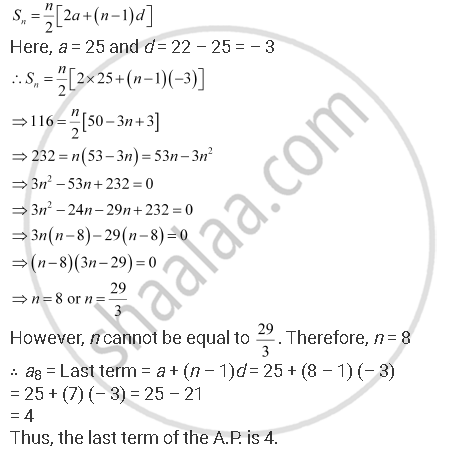
उत्तर २
In the given problem, we have the sum of the certain number of terms of an A.P. and we need to find the last term for that A.P.
So here, let us first find the number of terms whose sum is 116. For that, we will use the formula,
`S_n = n/2[2a+ (n-1)d]`
Where; a = first term for the given A.P.
d = common difference of the given A.P.
n = number of terms
So for the given A.P (25, 22, 19, .....)
The first term (a) = 25
The sum of n terms `S_n = 116`
Common difference of the A.P (d) = `a_2 - a_1`
= 22 - 25
= -3
So, on substituting the values in the formula for the sum of n terms of A.P. we get
`116 = n/2 [2(25) + (n - 1)(-3)]`
`116 = (n/2)[50 + (-3n + 3)]`
`116 = (n/2) [53 - 3n]`
`(116)(2) = 53n - 3n^2`
So, we get the following quadratic equation,
`3n^2 - 53n + 232 = 0`
On solving by splitting the middle term,we get
`3n^2 - 24n - 29n + 232 = 0`
3n(n - 8) - 29(n - 8) = 0
(3n - 29)(n - 8) = 0
Further
3n - 29 = 0
`n = 29/3`
Also
n - 8 = 0
Now since n cannot be a fraction, so the number of terms is a8
`a_8 = a_1 + 7d`
= 25 + 7(-3)
= 25 - 21
= 4
Therefore the last term of the given A.P such that the sum of terms is 116 is 4
संबंधित प्रश्न
If the sum of n terms of an A.P. is (pn + qn2), where p and q are constants, find the common difference.
If the sum of first p terms of an A.P. is equal to the sum of the first q terms, then find the sum of the first (p + q) terms.
if `(a^n + b^n)/(a^(n-1) + b^(n-1))` is the A.M. between a and b, then find the value of n.
The sum of the first four terms of an A.P. is 56. The sum of the last four terms is 112. If its first term is 11, then find the number of terms.
Let < an > be a sequence. Write the first five term in the following:
a1 = 1 = a2, an = an − 1 + an − 2, n > 2
Show that the following sequence is an A.P. Also find the common difference and write 3 more terms in case.
9, 7, 5, 3, ...
Is 302 a term of the A.P. 3, 8, 13, ...?
Which term of the sequence 12 + 8i, 11 + 6i, 10 + 4i, ... is purely imaginary?
How many numbers of two digit are divisible by 3?
How many numbers are there between 1 and 1000 which when divided by 7 leave remainder 4?
If < an > is an A.P. such that \[\frac{a_4}{a_7} = \frac{2}{3}, \text { find }\frac{a_6}{a_8}\].
If the sum of three numbers in A.P. is 24 and their product is 440, find the numbers.
Find the sum of the following arithmetic progression :
(x − y)2, (x2 + y2), (x + y)2, ... to n terms
Find the sum of the following serie:
101 + 99 + 97 + ... + 47
Find the sum of all integers between 84 and 719, which are multiples of 5.
Find the sum of all even integers between 101 and 999.
Find the r th term of an A.P., the sum of whose first n terms is 3n2 + 2n.
Find the sum of odd integers from 1 to 2001.
In an A.P. the first term is 2 and the sum of the first five terms is one fourth of the next five terms. Show that 20th term is −112.
A carpenter was hired to build 192 window frames. The first day he made five frames and each day thereafter he made two more frames than he made the day before. How many days did it take him to finish the job?
A man is employed to count Rs 10710. He counts at the rate of Rs 180 per minute for half an hour. After this he counts at the rate of Rs 3 less every minute than the preceding minute. Find the time taken by him to count the entire amount.
In a cricket team tournament 16 teams participated. A sum of ₹8000 is to be awarded among themselves as prize money. If the last place team is awarded ₹275 in prize money and the award increases by the same amount for successive finishing places, then how much amount will the first place team receive?
If the sum of n terms of an AP is 2n2 + 3n, then write its nth term.
If log 2, log (2x − 1) and log (2x + 3) are in A.P., write the value of x.
If the sums of n terms of two AP.'s are in the ratio (3n + 2) : (2n + 3), then find the ratio of their 12th terms.
If the sum of p terms of an A.P. is q and the sum of q terms is p, then the sum of p + q terms will be
In n A.M.'s are introduced between 3 and 17 such that the ratio of the last mean to the first mean is 3 : 1, then the value of n is
If the sum of n terms of an A.P. is 2 n2 + 5 n, then its nth term is
If a1, a2, a3, .... an are in A.P. with common difference d, then the sum of the series sin d [sec a1 sec a2 + sec a2 sec a3 + .... + sec an − 1 sec an], is
Let Sn denote the sum of n terms of an A.P. whose first term is a. If the common difference d is given by d = Sn − k Sn − 1 + Sn − 2 , then k =
The first and last term of an A.P. are a and l respectively. If S is the sum of all the terms of the A.P. and the common difference is given by \[\frac{l^2 - a^2}{k - (l + a)}\] , then k =
Mark the correct alternative in the following question:
If in an A.P., the pth term is q and (p + q)th term is zero, then the qth term is
Find the sum of first 24 terms of the A.P. a1, a2, a3, ... if it is known that a1 + a5 + a10 + a15 + a20 + a24 = 225.
A man accepts a position with an initial salary of Rs 5200 per month. It is understood that he will receive an automatic increase of Rs 320 in the very next month and each month thereafter. What is his total earnings during the first year?
If the sum of p terms of an A.P. is q and the sum of q terms is p, show that the sum of p + q terms is – (p + q). Also, find the sum of first p – q terms (p > q).
The sum of n terms of an AP is 3n2 + 5n. The number of term which equals 164 is ______.
If a1, a2, a3, .......... are an A.P. such that a1 + a5 + a10 + a15 + a20 + a24 = 225, then a1 + a2 + a3 + ...... + a23 + a24 is equal to ______.
If 100 times the 100th term of an A.P. with non zero common difference equals the 50 times its 50th term, then the 150th term of this A.P. is ______.
If b2, a2, c2 are in A.P., then `1/(a + b), 1/(b + c), 1/(c + a)` will be in ______
