Advertisements
Advertisements
प्रश्न
Circles are described on the sides of a triangle as diameters. Prove that the circles on any two sides intersect each other on the third side (or third side produced).
Advertisements
उत्तर
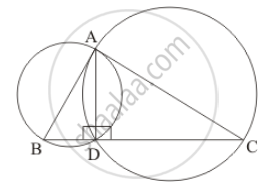
\[\angle ADB = 90° \left( \text{ Angle in a semicircle } \right)\]
\[\angle ADC = 90° \left( \text{ Angle in a semicircle } \right)\]
\[\text{ So } , \angle ADB + \angle ADC = 90° + 90° = 180\]
\[\text{ Therefore, BDC is a line } . \]
\[\text{ Hence, the point of intersection of two circles lie on the third side } .\]
APPEARS IN
संबंधित प्रश्न
Prove that ‘Opposite angles of a cyclic quadrilateral are supplementary’.
If circles are drawn taking two sides of a triangle as diameters, prove that the point of intersection of these circles lie on the third side.
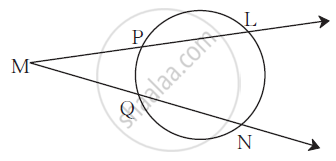
In the figure m(arc LN) = 110°,
m(arc PQ) = 50° then complete the following activity to find ∠LMN.
∠ LMN = `1/2` [m(arc LN) - _______]
∴ ∠ LMN = `1/2` [_________ - 50°]
∴ ∠ LMN = `1/2` × _________
∴ ∠ LMN = __________
Prove that the circles described on the four sides of a rhombus as diameters, pass through the point of intersection of its diagonals.
Prove that the perpendicular bisectors of the sides of a cyclic quadrilateral are concurrent.
Prove that the centre of the circle circumscribing the cyclic rectangle ABCD is the point of intersection of its diagonals.
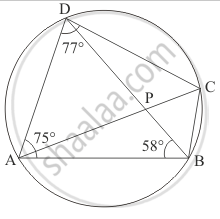
In the given figure, ABCD is a cyclic quadrilateral in which ∠BAD = 75°, ∠ABD = 58° and ∠ADC = 77°, AC and BD intersect at P. Then, find ∠DPC.
PQRS is a cyclic quadrilateral such that PR is a diameter of the circle. If ∠QPR = 67° and ∠SPR = 72°, then ∠QRS =
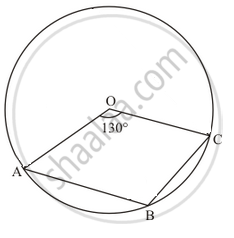
In the given figure, O is the centre of the circle such that ∠AOC = 130°, then ∠ABC =
In the following figure, AOB is a diameter of the circle and C, D, E are any three points on the semi-circle. Find the value of ∠ACD + ∠BED.

