Advertisements
Advertisements
प्रश्न
ABCD is a cyclic trapezium with AD || BC. If ∠B = 70°, determine other three angles of the trapezium.
Advertisements
उत्तर
If in cyclic quadrilateral `angle B = 70°` , then we have to find the other three angles.
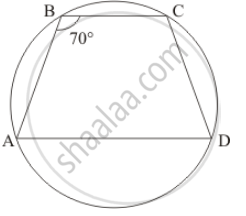
Since, AD is parallel to BC, So,
`angleB + angleA = 180 ` (Alternate interior angles)
`70 + angleA = 180`
`⇒ angle A = 180 - 70 = 110°`
Now, since ABCD is cyclic quadrilateral, so
`angle A + angle C = 180`
`⇒ 110 + angle C = 180`
`⇒ angle C = 180 - 110 = 70°`
And,
`angle B + angleD = 180`\
`⇒ 70 + angleD = 180`
`⇒ angleD = 180 - 70 = 110°`
APPEARS IN
संबंधित प्रश्न
Prove that ‘Opposite angles of a cyclic quadrilateral are supplementary’.
A chord of a circle is equal to the radius of the circle. Find the angle subtended by the chord at a point on the minor arc and also at a point on the major arc.
Prove that the line of centres of two intersecting circles subtends equal angles at the two points of intersection.
Let the vertex of an angle ABC be located outside a circle and let the sides of the angle intersect equal chords AD and CE with the circle. Prove that ∠ABC is equal to half the difference of the angles subtended by the chords AC and DE at the centre.
AC and BD are chords of a circle which bisect each other. Prove that (i) AC and BD are diameters; (ii) ABCD is a rectangle.
The lengths of two parallel chords of a circle are 6 cm and 8 cm. If the smaller chord is at distance 4 cm from the centre, what is the distance of the other chord from the centre?
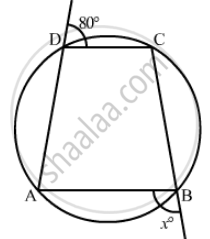
In the given figure, ABCD is a cyclic quadrilateral. Find the value of x.
ABCD is a cyclic quadrilateral such that AB is a diameter of the circle circumscribing it and ∠ADC = 140º, then ∠BAC is equal to ______.
If a line is drawn parallel to the base of an isosceles triangle to intersect its equal sides, prove that the quadrilateral so formed is cyclic.
If non-parallel sides of a trapezium are equal, prove that it is cyclic.
